

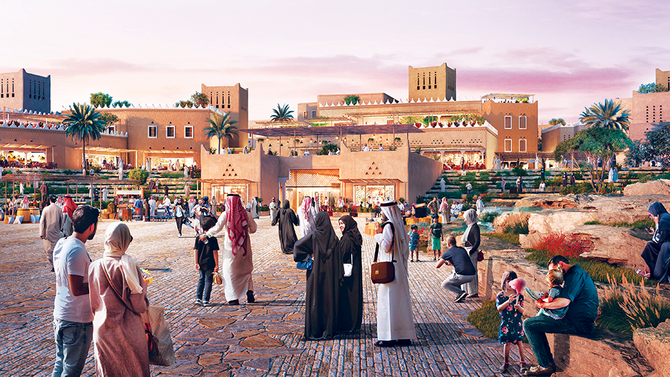

RIYADH: Saudi Arabia’s growing portfolio of megaprojects means the commercial opportunities on offer “are grander than any other place in the world,” according to the CEO of one of Kingdom’s flagship developments.
Speaking at the virtual GCC-UK Trade Summit 2021 on Tuesday, in a session moderated by senior Arab News business columnist Frank Kane, Jerry Inzerillo, CEO of the Diriyah Gate Development Authority, pointed out that before tourists flocked to Petra in Jordan or Alexandra in Egypt, but they would soon be coming to Riyadh to see a global destination rich in history, culture, nature and art.
Diriyah Gate is a $40 billion development project and joins the likes of the futuristic NEOM, the historic AlUla, the entertainment-focused Qiddiya and the eco-friendly Red Sea Project among Saudi Arabia’s mega projects.
A new global landmark, Diriyah is the site of the first Saudi Kingdom in the 18th century. Construction began on Diriyah Gate in July 2020. Located 15 minutes’ drive northwest of Riyadh, it will feature a Formula E racetrack and a 15,000-seat arena.
“We are hyper-accelerating all of the tourism infrastructure so we give a very qualitative experience so people can get around and enjoy the region,” Inzerillo added.
Speaking at the same event, Aradhana Khowala, chair of the global advisory board at The Red Sea Development Co., said the uniqueness of the Red Sea Project is its coral reefs and its renewable energy plans.
“As we speak, the Red Sea Project and the company is developing perhaps the largest battery storage facility in the world, ahead of Tesla,” she said.
The Red Sea Project was announced by Crown Prince Mohammed bin Salman in July 2017. Upon full completion in 2030, the project will comprise 50 hotels offering up to 8,000 rooms and 1,300 residential properties across 22 islands and six inland sites.
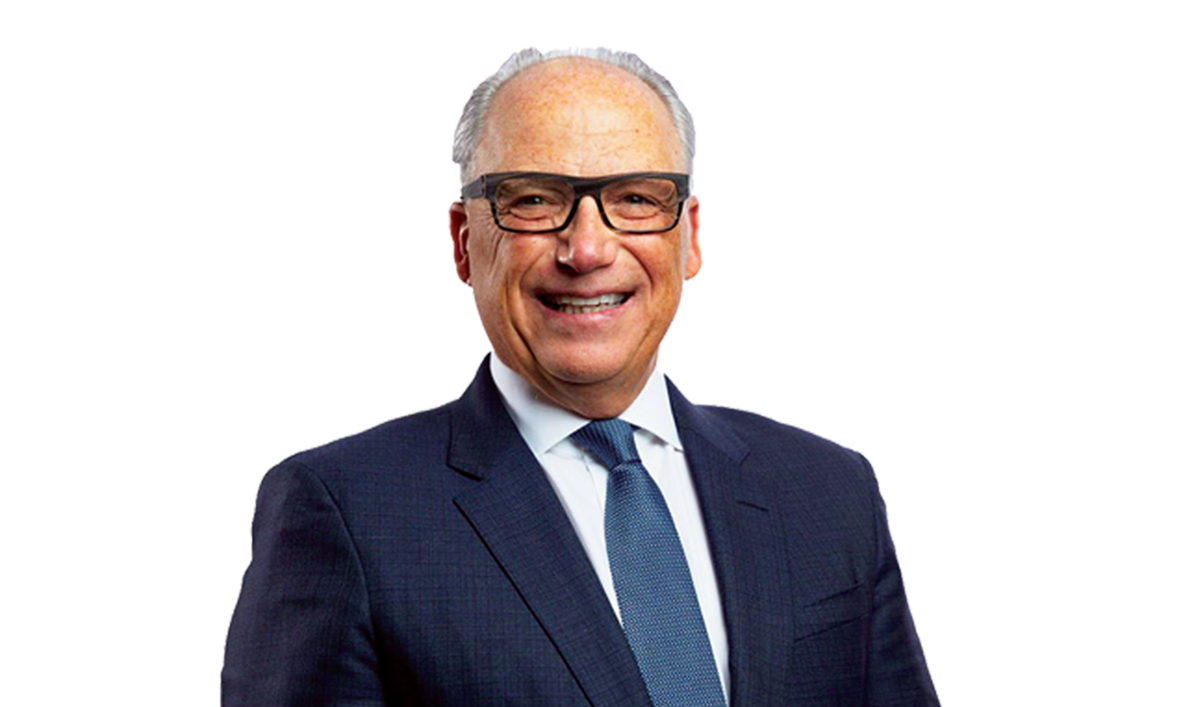
Jerry Inzerillo, CEO of the Diriyah Gate Development Authority.
Khowala also pointed out that, despite the impact of the coronavirus disease (COVID-19) pandemic, the project will be completed on schedule. By the end of 2022 we will be ready to receive our first guest,” she said.
Khowala added that advances such as the Red Sea Project were evidence of the Kingdom’s young population, for whom the Vision 2030 goals were reaping rewards. “What I find most fascinating is that 89 percent of young Saudis believe that the country is moving in the right direction,” she added.
Speaking at a session on growth prospects for GCC investors in Britain, experts said that Brexit and the UK’s handling of the COVID-19 crisis had not dampened GCC investor appetite, with opportunities available in the financial technology (fintech), decarbonization, life sciences and infrastructure sectors.
Panelists agreed that Britain’s exit from the EU has actually boosted investment opportunities, as the UK can make decisions faster because it is no longer subject to the red tape that comes with being a member of the economic bloc.
Matthew Hurn, executive director and chief financial officer for disruptive investments at Abu Dhabi’s Mubadala investment company said: “Brexit overhang is gone. Irrespective of whether you believe Brexit was a good idea or a bad idea, that uncertainty was not a good environment for potential investors. So, with that overhang now gone, it is very clear exactly the economic landscape in which you are playing.”
Hurn said the UK’s world-class academia, which have made some of the most innovative advances in life sciences, make it an attractive proposition. “When you start looking at drug discovery, drug development, medtech, digital health, they are very capital-intensive, IP-intensive businesses that actually need growth capital and I think there is a huge opportunity there,” he said.
Fintech is also key, he said, because London “is undoubtedly the fintech capital of the world.”
Prof. John Bryson of Birmingham University said that the UK is now able to work out its own strategy and offers a significant advantage to GCC investors looking for opportunities.
“Of course, now, within a post-Brexit environment, it has the ability to be rapid in its decision-making. So, irrespective of which government might be in power, you do not have the constraints of having to have things cleared by the European Commission,” Bryson said. Gavin Holland, a partner at global fintech-focused venture capital fund Anthemis Group, which has about 10 investors from GCC countries, said he has not received a single question about Brexit in the past 12 months and investor confidence has moved on from that.
He noted that the COVID-19 crisis has fueled digital transformation across several industries and created huge opportunities for businesses and investors to build new business models and accelerate things that otherwise might have taken decades.
As the GCC experiences a period of rapid growth and economic diversification, it is witnessing a corresponding upswing in its trade and economic relations with the UK. This is evidenced by the fact that the Gulf region accounts for as much as $50.8 billion out of the estimated $57.2 billion annual trade between the UK and the Middle East.


