

Pakistan, Islamic Trade Finance Corporation sign $4.5 billion agreement for fuel imports

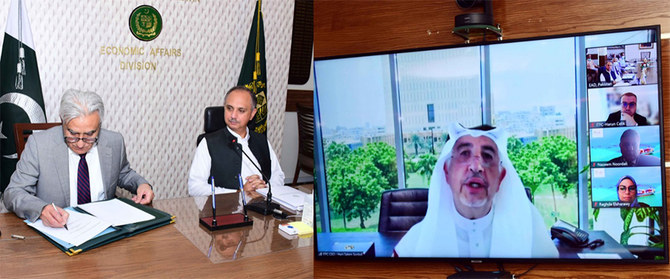
Pakistan's Minister for Economic Affairs Omer Ayub Khan (second from left) and CEO International Islamic Trade Finance Corporation (ITFC) Eng. Hani Salem Sonbol (third from left) witness the virtual signing of an agreement for the import of fuel on June 28, 2021. (Photo courtesy: ITFC)
Short Url
Updated 29 June 2021
Follow

Pakistan, Islamic Trade Finance Corporation sign $4.5 billion agreement for fuel imports

  • Pakistan will import petroleum products including crude oil, refined products, LNG under three-year agreement
  • Financing will be utilized by Pakistan State Oil, Pak-Arab Refinery Ltd, Pakistan LNG Ltd.

KARACHI: The International Islamic Trade Finance Corporation (ITFC) has signed a three-year agreement for a cumulative amount of $4.5 billion with Pakistan to provide financing for the import of essential commodities such as crude oil, refined petroleum products, LNG and urea.

The signing took place virtually on Monday between Omar Ayub Khan, Pakistani Minister of Economic Affairs, and Hani Salem Sonbol, the CEO of ITFC. Other officials were also present.
Financing available through the facility will be utilized by Pakistan State Oil (PSO), Pak-Arab Refinery Ltd. (PARCO) and Pakistan LNG Ltd. (PLL) for the import of crude oil, refined petroleum products and LNG during 2021-2023.
The ITFC agreement will facilitate identification of other areas of cooperation at the country and regional levels to enhance and promote trade, trade capacities of relevant state authorities and financial institutions and trade cooperation in Pakistan, a statement released by ITFC said.
Sonbol said the agreement reflected the importance of longstanding cooperation between ITFC and the government of Pakistan.
“ITFC is continuously workingclosely with its member countries to meet their requirements by providing integrated solutions that include financing and capacity building tools that allows for maximizing the development impact of ITFC interventions,” the CEO was quoted as saying in the statement from ITFC.
“We are delighted and we will continue to mobilize financial resources to support Pakistan in its endeavours to achieve its economic targets through the new Framework Agreement.”
The agreement also covers ITFC’s support for trade related technical assistance projects in Pakistan, which will be selected jointly by both parties according to the national economic priorities and the development plan of Pakistan.
Earlier this month Dr. Waqar Masood, the prime minister’s aide for revenue, had announced that Saudi Arabia would resume oil imports on deferred payments to help Pakistan ease its financial burdens.
The facility will be available to Pakistan from July this year.
Omar Ayub Khan thanked the ITFC for arranging the financing, which would help Pakistan in meeting its import requirements of oil and LNG and ease pressure on the country’s cash reserves.
“This Agreement will further strengthen partnership between Islamic Republic of Pakistan and ITFC,” the statement quoted Khan as saying.

Pakistan, Iraq agree on tighter coordination over pilgrims under new regulated travel system

Updated 4 sec ago
Follow

Pakistan, Iraq agree on tighter coordination over pilgrims under new regulated travel system

  • New system requires all Iraq-Iran pilgrimages to be organized by licensed groups under state oversight
  • Long-running “Salar” model relied on informal caravan leaders, leading to overstays and missing pilgrims

ISLAMABAD: Pakistan and Iraq this week agreed to closely coordinate on the management and security of Pakistani pilgrims, as Islamabad rolls out a new, tightly regulated travel system aimed at preventing overstays, undocumented migration and security breaches during religious visits to Iraq and Iran.

The understanding was reached during a meeting between Pakistan’s Interior and Narcotics Control Minister Mohsin Naqvi and Iraq’s Interior Minister General Abdul Amir Al-Shammari on Thursday evening, where both sides discussed measures to facilitate pilgrims while strengthening oversight, Pakistan’s interior ministry said.

The agreement comes as Pakistan dismantles its decades-old pilgrim travel model and replaces it with a centralized, licensed system after authorities confirmed that tens of thousands of Pakistani pilgrims had overstayed or gone missing abroad over the past decade, triggering concerns from host governments.

“You have, for the first time during your tenure, taken effective measures to organize pilgrim groups, which are commendable,” Al-Shammari told Naqvi, according to Pakistan’s interior ministry.

“All pilgrims included in the list provided by Pakistan’s Ministry of Interior will be allowed to enter Iraq,” he added, making clear that only travelers cleared under the new system would be permitted.

Naqvi said Pakistan would strictly enforce return timelines under the revised framework.

“Pilgrims traveling to Iraq will not be allowed to stay beyond the designated period,” he said, adding that relevant authorities in both countries would remain in close coordination.

Both interior ministers also agreed to strengthen information-sharing and joint mechanisms on security cooperation, counterterrorism and the prevention of human smuggling, officials said.

“The safety, dignity, and facilitation of Pakistani pilgrims is the top priority of the Government of Pakistan,” Naqvi said.

Al-Shammari said he would visit Pakistan soon to finalize a joint roadmap to further improve pilgrim facilitation, security coordination and broader bilateral cooperation, according to the interior ministry.

Pakistan’s government has overhauled its pilgrim travel regime this year, abolishing the long-running “Salar” system under which informal caravan leaders managed pilgrimages. The move followed official confirmation that around 40,000 Pakistani pilgrims had overstayed or disappeared in Iran, Iraq and Syria over the past ten years.

Under the new Ziyarat Management Policy, only licensed Ziyarat Group Organizers (ZGOs) are allowed to arrange pilgrimages, with companies held directly responsible for ensuring pilgrims return on time. Authorities have completed security clearance for 585 companies seeking registration, while scrutiny of applications remains ongoing.

Islamabad has also barred overland travel for major pilgrimages, including Arbaeen, citing security risks in Pakistan’s southwestern Balochistan province, meaning all travel to Iraq and Iran is now restricted to regulated air routes.

Tens of thousands of Pakistani pilgrims travel each year to Iraq and Iran to visit some of the most revered shrines in Shia Islam, including the mausoleums of Imam Ali in Najaf and Imam Hussain in Karbala in Iraq, and major religious sites in Mashhad and Qom in Iran. Pilgrimages peak during religious occasions such as Arbaeen, when millions of worshippers converge on Karbala from across the region. The scale of travel, often involving long stays and cross-border movements, has long posed logistical, security and migration-management challenges for Pakistani authorities and host governments alike.