

Suspected Iranian nuclear production plant hit by drones, Tehran claims ‘sabotage attack’

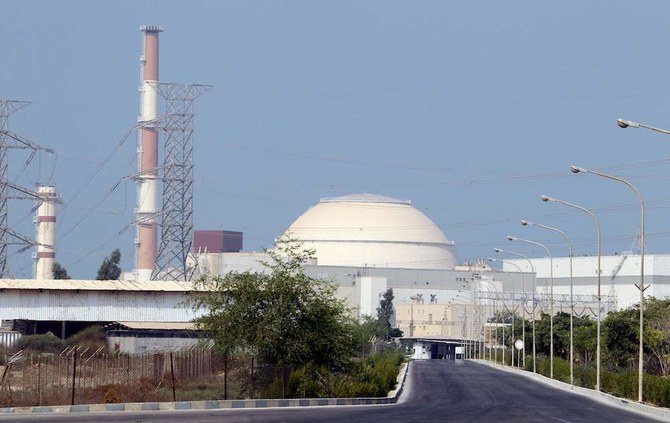
Iran's southern Bushehr nuclear power plant has been temporarily shut down over a "technical fault" and will be reconnected to the grid and the issue will be resolved "in a few days", the country's atomic energy body said. (AFP/File Photo)
Short Url
Updated 24 June 2021
Follow

Suspected Iranian nuclear production plant hit by drones, Tehran claims ‘sabotage attack’

  • There was no immediate comment or attribution of blame from either Israel or Iran

LONDON: A drone attack on a building in Iran, thought to be a nuclear facility, has caused considerable damage, it was claimed Thursday, despite Tehran stating on Wednesday it had foiled the “sabotage” attempt on the building.

At least one small rotor-powered drone hit a factory owned by the Iran Centrifuge Technology Co. in Karaj, according to a US intelligence tip off published by the New York Times.

The factory, just outside Tehran, is believed to produce aluminium blades for use in Iran’s two uranium enrichment facilities at Natanz and Fordow, UK paper The Times reported.

Israeli media also said the building had been hit in an attack, with some reports saying it had involved “several” drones.

There was no immediate comment or attribution of blame from either Israel or Iran.

The incident “left no casualties or damages and was unable to disrupt the Iranian nuclear program,” Iranian state television said, before adding that authorities were now working to identify the perpetrators.

The International Atomic Energy Agency (IAEA), the UN body that monitors Tehran’s nuclear program, did not immediately respond to a request for comment.

The factory was allegedly on a list of targets presented to the administration of former US President Donald Trump last year by Israel, which regards the Iranian nuclear program as a cover for developing nuclear warheads, a claim denied by Tehran.

The incident follows several sother uspected attacks targeting Iran’s nuclear program that have heightened regional tensions in recent months, amid diplomatic efforts to resurrect Tehran’s tattered nuclear deal, the Joint Comprehensive Plan of Action (JCPOA), with world powers.

Trump’s decision to withdraw from the deal in 2018 has seen Iran, over time, abandon all limitations on uranium enrichment. The country is now enriching uranium to 60 percent, its highest ever levels, although still short of those required to develop weapons. 

Iran has said that its nuclear ambitions are peaceful and that it will return to its commitments once the US lifts sanctions imposed after Trump withdrew from the JCPOA.

Earlier this week, Iran’s sole nuclear power plant at Bushehr underwent an unexplained temporary emergency shutdown. Authorities had warned earlier this year of the plant’s possible closure because of US sanctions that supposedly prevented Iran procuring equipment for repairs.

In April, Iran’s underground Natanz nuclear facility experienced a mysterious blackout that damaged some of its centrifuges. Last July, unexplained fires struck the advanced centrifuge assembly plant at Natanz, which authorities later also described as sabotage. Iran now is rebuilding that facility deep inside a nearby mountain.

* With AP


Israel to partially reopen Gaza’s Rafah crossing

Updated 5 sec ago
Follow

Israel to partially reopen Gaza’s Rafah crossing

  • Entry and exit “will be permitted in coordination with Egypt, following prior security clearance of individuals by Israel”
  • The crossing is the only route in and out of Gaza that does not pass through Israel

RAFAH, Palestinian Territories: Israel is set to partially reopen the Rafah crossing between the war-devastated Gaza Strip and Egypt on Sunday, following months of urging from humanitarian organizations, though access will be limited to the movement of people.

The reopening comes amid ongoing violence in the Palestinian territory, with Gaza’s civil defense agency reporting dozens killed in Israeli attacks on Saturday, while the Israeli military said it was retaliating against ceasefire violations.

The Rafah crossing is a vital gateway for both civilians and aid, but has remained closed since Israeli forces seized control of it in May 2024 during the war with Hamas, aside from a brief and limited reopening in early 2025.

Israel had previously said it would not reopen the crossing until the remains of Ran Gvili — the last Israeli hostage held in Gaza — were returned.

His remains were recovered days ago and he was laid to rest in Israel on Wednesday.

“The Rafah Crossing will open this coming Sunday (February 1st) in both directions, for limited movement of people only,” COGAT, an Israeli defense ministry body overseeing civil affairs in the occupied Palestinian territories, said on Friday.

Entry and exit “will be permitted in coordination with Egypt, following prior security clearance of individuals by Israel, and under the supervision of the European Union mission,” it added.

However, key details remain unclear, including how many people will be allowed to cross and whether those seeking to return to Gaza will be permitted entry.

A source at the border told AFP that Sunday would be largely devoted to preparations and logistical arrangements.

The crossing is set to open on Sunday on a trial basis to allow the passage of wounded individuals, ahead of a regular reopening scheduled for Monday, three sources at the crossing said.

However, no agreement has yet been reached on the number of Palestinians permitted to enter or exit, the sources added, noting that Egypt plans to admit “all Palestinians whom Israel authorizes to leave” the territory.

“Every day that passes drains my life and worsens my condition,” said Mohammed Shamiya, 33, who suffers from kidney disease and requires dialysis treatment abroad.

“I’m waiting every moment for the opening of the Rafah land crossing.”

Anxious wait

Safa Al-Hawajri, who has received a scholarship to study overseas, is also eagerly awaiting the reopening on Sunday.

“I’m waiting in the hope of fulfilling my ambition, which is tied to the reopening of the crossing,” said Hawajri, 18.

“I hope to be able to travel as soon as it opens.”

Located on Gaza’s southern border with Egypt, Rafah is the only crossing into and out of the territory that does not pass through Israel.

The crossing lies in an area held by Israeli forces following their withdrawal behind the so-called “Yellow Line” under the terms of a US-brokered ceasefire that came into effect on October 10.

Israeli troops still control more than half of Gaza, while the rest remains under Hamas authority.

The ceasefire has now entered its second phase and calls for reopening the crossing following the release or return of all Israeli hostages held by Palestinian militants.

Hamas had called for its full reopening in both directions after the remains of Gvili were brought back to Israel.

The reopening is expected to facilitate the entry of a 15-member Palestinian technocratic body, the National Committee for the Administration of Gaza (NCAG), established to oversee the day-to-day governance of the territory’s 2.2 million residents.

The committee is to operate under the supervision of the so-called “Board of Peace” chaired by US President Donald Trump.

The NCAG, headed by former Palestinian Authority deputy minister Ali Shaath, is expected to enter the Gaza Strip once the Rafah crossing reopens.

Violence continued ahead of the crossing’s reopening.

At least 32 people, including children, were killed on Saturday in Israeli air strikes in Gaza, reported the civil defense agency, which operates as a rescue force under the Hamas authority.

Israel’s military said the strikes were retaliation for an incident on Friday in which eight Palestinian fighters exited a tunnel in the city of Rafah, which it said violated the ceasefire.