

US Senate confirms Lina Khan, born to Pakistani immigrants, to Federal Trade Commission

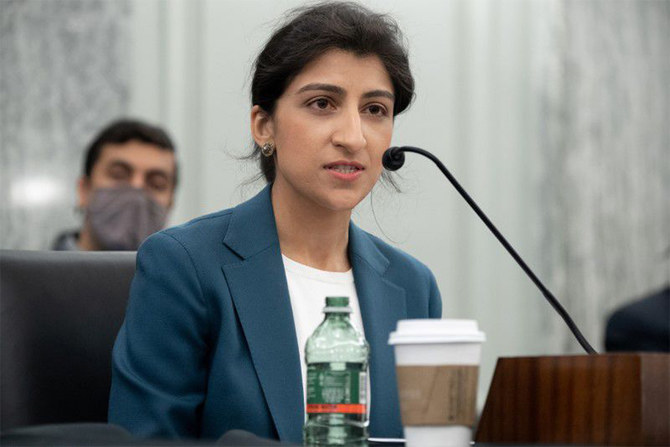
Lina Khan, nominee for Commissioner of the Federal Trade Commission (FTC), speaks during a Senate Committee on Commerce, Science, and Transportation confirmation hearing on Capitol Hill in Washington, DC, U.S. April 21, 2021. (AFP)
Short Url
Updated 16 June 2021
Follow

US Senate confirms Lina Khan, born to Pakistani immigrants, to Federal Trade Commission

  • Khan has pushed for antitrust legal reform and the breakup of companies like Facebook and Google
  • Her nomination to one of three Democratic seats at FTC is seen as sign of White House plans to get tough on tech

ISLAMABAD: The US Senate voted on Tuesday to confirm Lina Khan, an antitrust researcher who has focused her work on Big Tech’s immense market power, to be a commissioner on the Federal Trade Commission.
The position gives Khan, who was born in London to Pakistani parents, a central position at the agency that investigates antitrust violations, deceptive trade practices and data privacy lapses in Silicon Valley.
“I’m so grateful to the Senate for my confirmation,” Khan wrote on Twitter. “Congress created the FTC to safeguard fair competition and protect consumers, workers, and honest businesses from unfair & deceptive practices. I look forward to upholding this mission with vigor and serving the American public.”

Lawmakers voted 69-28 to confirm Khan, 32, who first attracted notice as a critic of Amazon. The agency is investigating the retail giant and filed an antitrust lawsuit against Facebook last year.
Khan will help regulate the kind of behavior highlighted for years by critics of Amazon, Facebook, Google and Apple. At her confirmation hearing in April, Khan outlined strong concerns over competition in the tech industry, saying she was “seeing whole range of potential risks. One that comes up across board is that the ability to dominate one market gives companies, in some instances, the ability to expand into adjacent markets.”
President Biden’s nomination of Khan to one of three Democratic seats at the FTC has been seen as a sign the White House plans to get tough on tech.


Pakistan PM approves framework for National Energy Plan aimed at cutting power costs

Updated 4 sec ago
Follow

Pakistan PM approves framework for National Energy Plan aimed at cutting power costs

  • Electricity costs in Pakistan have been a major concern for both industries and domestic consumers
  • PM Shehbaz Sharif instructs authorities to expedite privatization of power distribution companies

ISLAMABAD: Prime Minister Shehbaz Sharif on Wednesday approved the framework for a National Energy Plan aimed at ensuring low electricity costs for industries and facilitating domestic consumers, Pakistani state broadcaster reported. 

The development took place during a meeting of the Cabinet Committee on Energy in Islamabad presided over by Sharif. The Pakistani prime minister directed all ministries and provincial governments to present a “workable and coordinated” strategy under the proposed plan.

Electricity costs in Pakistan have been a major concern for both industries and domestic consumers. Industrial users often face high tariffs that increase production cost while residential consumers struggle with rising bills that impact household budgets. 

“Prime Minister Shehbaz Sharif has given in-principle approval for the formulation of a comprehensive National Energy Plan in consultation with relevant ministries and provincial governments,” Radio Pakistan said in a report.

“He emphasized that the government’s top priorities include ensuring electricity supply to industries at the lowest possible cost and providing facilitation for domestic consumers.”

Sharif also approved the establishment of a dedicated secretariat for the National Energy Plan and gave approval to the framework guidelines for auctioning wheeling charges, it added.

Wheeling charges are fees paid for using another company’s power grid to transmit electricity from a generator to a consumer, covering the cost of transporting electricity over someone else’s network.

The report said Sharif instructed authorities to include the recommendations of the climate change, finance, industries and petroleum ministries into the plan. 

Sharif also gave instructions to expedite the privatization of power distribution companies (DISCOs) and urged competitive tariffs for industries to boost production capacity.

Fluctuations in fuel prices, inefficiencies in the power sector, and reliance on imported energy have contributed to high electricity costs in Pakistan in recent years, making energy affordability and stability a key focus for government policies and reforms.

Pakistan has pushed energy sector reforms to tackle long-standing issues like circular debt, power theft, and transmission losses, which have caused blackouts and high electricity costs. 

In February, Pakistan developed a new energy policy that it says will help the country attract $5 billion in investment through public-private partnerships.