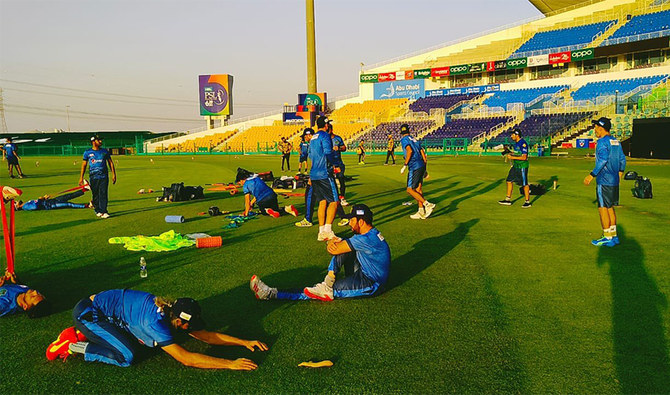
KARACHI: Pakistan Super League cricketers will have to contend with soaring temperatures and empty stadiums when the Covid-hit Twenty20 competition resumes far from home in Abu Dhabi on Wednesday.
With day-time temperatures hitting 40 degrees Celsius (104 Fahrenheit), some players will wear ice vests on the field, while bowlers have been told to drink coconut water, a natural coolant.
The T20 cricket league was halted in Pakistan in March after seven players and support staff tested positive for Covid-19, and restart efforts stalled as the country was hit by a third wave of the virus.
The PSL will now be completed in the intense heat of the Gulf summer but, with the earliest games starting at 5pm, PCB CEO Wasim Khan said the conditions weren’t “unplayable.”
“There will be ice vests, packs, ice collars, regular drink intervals to make sure that players are kept safe and healthy,” said Khan.
“But it’s not in a position which is unplayable. It’s 38-40 degrees but by five o’clock in the evening it cools down a little bit.”
The United Arab Emirates will also host the remainder of the suspended Indian Premier League in September and October, while India is considering moving the October-November T20 World Cup to the Gulf country.
After exploring the possibility of resuming in the UAE, the Pakistan Cricket Board almost canned the PSL’s sixth edition entirely because of visa problems for players and camera crews traveling from Pakistan, India and South Africa.
All three countries are all on the UAE’s “red list,” with direct scheduled flights banned and compulsory quarantine for passengers arriving on charters.
“It’s tough to organize these matches under Covid... bringing crew and players from around the world and then following the stringent protocols,” said former Pakistan all-rounder Wasim Akram, president of defending champions Karachi Kings.
“Everybody has done a great job, and we are now about to start.”
Still, he added, the compulsory quarantine was draining.
“No matter how good the hotel is, this quarantine is very tough,” he said in a video message.
The PSL is something of a poor relation to the super-rich IPL, but still attracts a host of international stars — even if some are past their prime.
But with a global cricket calendar badly affected by the coronavirus pandemic, several big names will miss the rest of the tournament including big-hitting West Indian Chris Gayle, and South African fast bowler Dale Steyn.
New Zealand’s Martin Guptill, however — whose 147 Twenty20 international sixes are a world record — will be in action, alongside Australian Usman Khawaja and West Indian Andre Russell.
Afghanistan’s Rashid Khan, second in the world Twenty20 rankings, is also taking part.
Pakistanis are used to playing in the UAE, which effectively became a home venue for a decade from 2009 because of security issues after the visiting Sri Lanka team was attacked by Islamist radicals in Lahore.
But they haven’t played there at this time of the year, when the searing heat is accompanied by sapping humidity.
“It will be tough,” said Pakistan captain Babar Azam, who plays for the Kings.
“Players are professionals, and once they enter the field their focus will be on the game,” he added.
The final is scheduled for June 24.


Ice vests, coconut water as Pakistan Super League feels heat in UAE
https://arab.news/2qpwf
Ice vests, coconut water as Pakistan Super League feels heat in UAE

- Twenty20 competition to resume on Wednesday far from home in Abu Dhabi
- With day-time temperatures hitting 40 degrees Celsius, some players will wear ice vests on the field

Pakistan says Afghanistan has created conditions ‘similar to or worse than’ pre-9/11 attacks
- The statement followed a suicide blast at a mosque in Islamabad that killed over 30, injured 169
- Pakistan frequently accuses the Afghan Taliban of backing militants, an allegation denied by Kabul
ISLAMABAD: Pakistan’s president has warned that the Taliban’s government in Afghanistan has created conditions “similar to or worse than” those before the Sept. 11, 2001, attacks, a sign of rising tensions with Kabul after last week’s mosque attack in Islamabad, which analysts said Monday highlights militants’ reach to the capital.
Asif Ali Zardari made the remarks while thanking the international community for condemning Friday’s suicide bombing at a Shiite mosque that killed 31 worshippers and wounded 169. Without directly blaming India, Zardari also said Pakistan’s eastern neighbor was “assisting the Taliban regime and threatening not only Pakistan but regional and global peace.”
In a statement issued Sunday, Zardari said Pakistan “takes strong exception to the situation in Afghanistan where the Taliban regime has created conditions similar to or worse than pre-9/11, when terror organizations posed threats to global peace.” He added that Pakistan had long maintained terrorism cannot be confronted by any single country in isolation.
The unusually strong comments were likely to irk Kabul and New Delhi, both of which have condemned the suicide attack claimed by Daesh (Islamic State) and have denied any involvement.
The previous Afghan Taliban government, which ruled Afghanistan from 1996 to 2001, had been blamed for sheltering the Al-Qaeda chief Osama bin Laden who was behind the Sept. 11, 2001 attacks that killed more than 3,000 people in the United States. The Afghan Taliban also allowed Al-Qaeda to operate training camps within Afghanistan, despite international warnings. However, bin Laden was killed during a US commando operation in Pakistan in May 2011.
Last week, Afghanistan’s Defense Ministry and New Delhi, in separate statements, rejected the Pakistani allegations, saying Islamabad had irresponsibly linked them to the attack.
Pakistan frequently accuses the Afghan Taliban, who returned to power in August 2021 in Afghanistan, of backing militants including the Pakistani Taliban, known as Tehreek-e-Taliban Pakistan (TTP). Both deny the accusations.
There was no immediate response from India or Afghanistan to Zardari’s latest allegations, which came after Interior Minister Mohsin Naqvi said the bomber involved in the attack was a Pakistani and trained by Daesh in Afghanistan.
Naqvi said security forces had arrested four suspects, including an Afghan national accused of links to the militant group and of helping mastermind the attack. The detainees included the bomber’s mother and brother-in-law, according to officials who said investigations into the attack were still ongoing.
Pakistan has not shared full details about the involvement of the bomber’s family, however.
On Monday, Naqvi received telephone calls from his Italian counterpart Matteo Piantedosi and European Commissioner Magnus Brunner, who condemned the mosque attack. According to a government statement, Naqvi maintained that “Pakistan is a shield for the world against terrorism and emphasized that strong global-level measures are needed today to protect the world from terrorism”.
Asif Durrani, Pakistan’s former special representative for Afghanistan, said Zardari’s warning was “unambiguous: terrorism thrives where it is tolerated, facilitated, or used as a proxy.”
He wrote on X that “allowing terrorist groups to operate from Afghan soil and India’s use of proxies to destabilize Pakistan is a dangerous path with grave regional and global consequences.” Durrani added, “Peace demands responsibility, not denial.”
Another Islamabad-based analyst, Abdullah Khan, said the preliminary findings into the mosque bombing suggest the attack may reflect a pattern seen in some IS attacks involving close family networks. He said the IS affiliates have at times recruited entire families, pointing to past attacks in Pakistan and Indonesia.
Although Islamabad has seen fewer attacks than some other regions, Pakistan has experienced a recent rise in militant violence, much of it attributed to Baloch separatist groups and the TTP, which is separate from but allied with Afghanistan’s Taliban.
Daesh’s regional affiliate, a major Taliban rival, has carried out attacks across Afghanistan.


