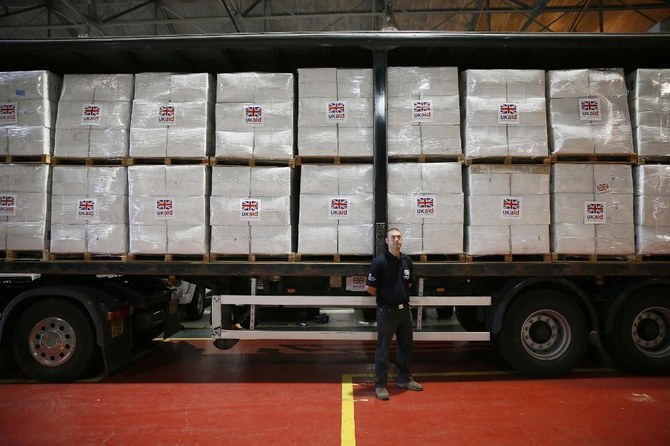
LONDON: Government plans to slash Britain’s foreign aid budget could be stopped in Parliament following a rebellion by dozens of MPs from the ruling Conservative Party.
Last year, Foreign Secretary Dominic Raab announced that the UK would cut its spending on foreign aid from 0.7 percent of gross domestic product (GDP) to 0.5 — representing a real-term cut of around $5 billion.
A group of high-profile Conservatives led by former Development Secretary Andrew Mitchell tabled an amendment on Wednesday that would prevent the cuts, citing their “devastating” impact on people’s lives.
Among the worst affected by the cuts are some of the Arab world’s poorest and most unstable countries.
UK aid to Yemen, which is experiencing one of the world’s most devastating humanitarian crises, was reduced from the £197 million ($279.5 million) pledged in 2020 to £87 million this year.
Mark Lowcock, former head civil servant at Britain’s Department for International Development, said the aid cut to Yemen would “cause many more deaths” and “damage the international reputation of the UK.”
Humanitarian aid programs in Libya and Syria faced cuts of nearly two-thirds, despite warnings from international bodies that the latter in particular faces acute and compounding health, economic and humanitarian crises.
Lebanon, despite an implosion of its financial system and warnings of collapse into chaos, is faced with the prospect of an 88 percent reduction in aid — a move that the Norwegian Refugee Council warned would leave tens of thousands of refugees currently living in Lebanon facing “utter destitution.”
The amendment tabled by MPs, if voted for in Parliament, would make a technical change that would force the government to comply with the 2015 International Development (Official Development Assistance Target) Act, which obliges the government to meet the 0.7 percent of GDP spending target in 2022.
According to The Guardian, rebel MPs believe they have enough support to have a realistic prospect of defeating the government and preserving British aid.
Mitchell said: “Every single member of the House of Commons was elected on a very clear manifesto promise to stand by this commitment. We have repeatedly urged the government to obey the law and implored ministers to reconsider breaking this commitment.
He added: “The cuts are now having a devastating impact on the ground and are leading to unnecessary loss of life. We urge the government to think again, or we shall be asking Parliament to reaffirm the law as it stands so as to oblige the government to meet its legal commitment, keep its very clear pledge to British voters and uphold Britain’s promise to the rest of the world.”
Officials have said the coronavirus pandemic and its ensuing economic crisis mean the aid cuts are necessary to balance British books.
The Foreign, Commonwealth & Development Office said the cuts are a “temporary measure” and the pandemic has “forced us to take tough” decisions.

Parliament vote could undo plan to slash UK foreign aid budget
Short Url
https://arab.news/buwtu
Parliament vote could undo plan to slash UK foreign aid budget
- High-profile Conservative MPs have rebelled against government plans for “devastating” cuts
- Yemen, Syria, Lebanon, Libya among countries worst affected
Militants kill 6 officers and a civilian in ambushes on police vehicles in northwest Pakistan
- Assailants ambushed a police vehicle and killed one officer in Kohat — When police reinforcements arrived minutes later, they launched another attack and killed five more officers and a civilian
- No group claimed responsibility for this week’s attacks, but suspicion may fall on the Pakistani Taliban, also known as Tehrik-e-Taliban Pakistan, or the TTP
PESHAWAR, Pakistan: A pair of attacks on police vehicles by suspected militants killed at least six police officers and a civilian in northwest Pakistan on Tuesday, authorities said.
The assailants ambushed a police vehicle and killed one officer in Kohat, a district in Khyber Pakhtunkhwa province. When police reinforcements arrived minutes later, they launched another attack and killed five more officers and a civilian, police official Kamran Khan said.
Separately on Tuesday, a suicide bomber detonated explosives at a police post in Bukkur, a district in eastern Punjab province, killing two officers and wounding four others, police official Shahzad Rafiq said.
He provided no further details and only said officers were still investigating.
No group immediately claimed responsibility for the attacks, which have increased across the country in recent months.
President Asif Ali Zardari condemned the attacks in Kohat and Bukkur and offered condolences to the victims’ families.
The latest violence followed an attack on a paramilitary post in Karak on Monday, when a drone loaded with explosives wounded several officers. The attackers later ambushed two ambulances transporting the wounded, killing three officers and burning their bodies before fleeing. The driver of the second ambulance transported several wounded officers despite suffering burn injuries and authorities recovered the remains of the three officers.
No group claimed responsibility for this week’s attacks, but suspicion may fall on the Pakistani Taliban, also known as Tehrik-e-Taliban Pakistan, or the TTP. The TTP is separate from, but closely allied with, Afghanistan’s Taliban. Islamabad has accused the group of operating from inside Afghanistan, a claim the TTP and Kabul deny.
Pakistan’s military said it killed at least 70 militants on Sunday in strikes along the Afghan border, targeting hideouts of Pakistani militants blamed for recent attacks inside the country.
The assailants ambushed a police vehicle and killed one officer in Kohat, a district in Khyber Pakhtunkhwa province. When police reinforcements arrived minutes later, they launched another attack and killed five more officers and a civilian, police official Kamran Khan said.
Separately on Tuesday, a suicide bomber detonated explosives at a police post in Bukkur, a district in eastern Punjab province, killing two officers and wounding four others, police official Shahzad Rafiq said.
He provided no further details and only said officers were still investigating.
No group immediately claimed responsibility for the attacks, which have increased across the country in recent months.
President Asif Ali Zardari condemned the attacks in Kohat and Bukkur and offered condolences to the victims’ families.
The latest violence followed an attack on a paramilitary post in Karak on Monday, when a drone loaded with explosives wounded several officers. The attackers later ambushed two ambulances transporting the wounded, killing three officers and burning their bodies before fleeing. The driver of the second ambulance transported several wounded officers despite suffering burn injuries and authorities recovered the remains of the three officers.
No group claimed responsibility for this week’s attacks, but suspicion may fall on the Pakistani Taliban, also known as Tehrik-e-Taliban Pakistan, or the TTP. The TTP is separate from, but closely allied with, Afghanistan’s Taliban. Islamabad has accused the group of operating from inside Afghanistan, a claim the TTP and Kabul deny.
Pakistan’s military said it killed at least 70 militants on Sunday in strikes along the Afghan border, targeting hideouts of Pakistani militants blamed for recent attacks inside the country.
© 2026 SAUDI RESEARCH & PUBLISHING COMPANY, All Rights Reserved And subject to Terms of Use Agreement.


