

UK asylum policy overhaul would see thousands of women, children rejected: Study

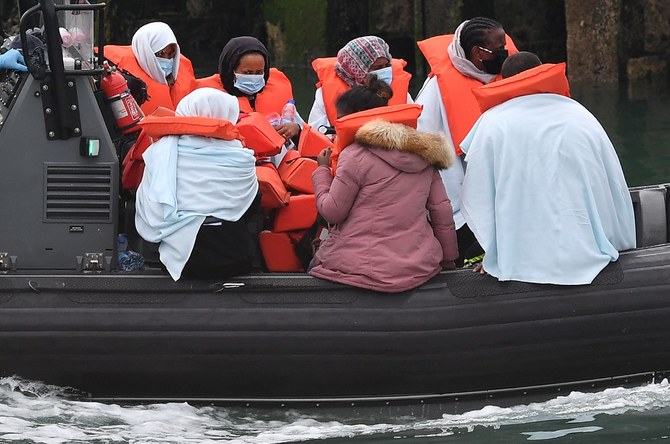
Migrants picked up at sea whilst Crossing the English Channel, but intercepted by UK Border Force officials, and taken into Dover. (AFP/File Photo)
Short Url
Updated 01 June 2021
Follow

UK asylum policy overhaul would see thousands of women, children rejected: Study

  • Scottish Refugee Council CEO: ‘Abandoning people fleeing war, persecution is not who we are in UK’
  • Top 5 countries from where refugees accepted by Britain: Iran, Sudan, Syria, Eritrea, Afghanistan

LONDON: Thousands of women and child refugees will be refused entry to Britain if the government’s New Plan for Immigration is enacted, including those fleeing war-torn countries, according to research by Together With Refugees, a coalition of over 200 national and local organizations.

If pushed through Parliament, the new regulations would mean that most arrivals who would now be accepted as refugees — covering people fleeing war or persecution — would not be recognized by the UK.

Analysis found that the top five countries from where refugees are accepted by the UK are Iran, Sudan, Syria, Eritrea and Afghanistan.

Refugee organizations and human rights campaigners are now urging the government to abandon the plan.

Research using past government data has revealed that two in three women and children who were accepted by the UK as refugees would be refused under the new changes. Women and children make up half of the refugees accepted each year by the UK.

As part of the study, a poll revealed that 64 percent of Britons believe that the UK should accept refugees fleeing conflict and persecution.

“Abandoning people fleeing war and persecution, including women and children, is not who we are in the UK,” said the coalition’s spokesperson, CEO of the Scottish Refugee Council and former asylum seeker Sabir Zazai.

READ MORE

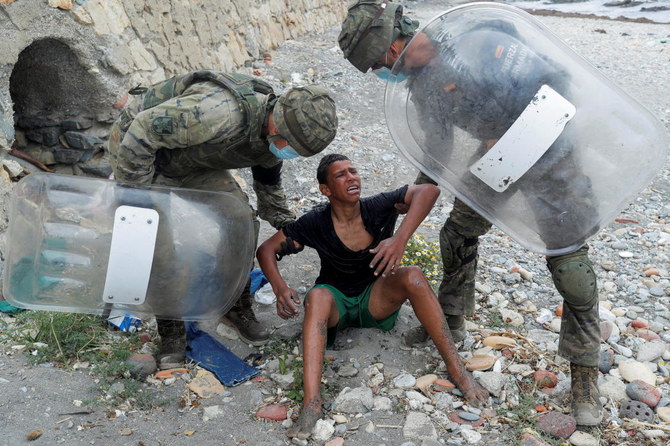
A Moroccan boy who used empty plastic bottles to swim to Spain’s North African enclave of Ceuta this week said he would rather die than go back to Morocco. Click here for more.
“These are mothers escaping war-torn Syria, women fleeing sexual violence in Congo or children escaping lifelong conscription into the military in Eritrea.”

About 85 percent of the world’s refugees are hosted by developing countries. Many European countries receive more asylum requests than the UK.

Last year, Germany, France and Spain each received about three times the number of applications.

A UK Home Office spokesperson said: “We have a responsibility to put the New Plan for Immigration into action so that we can fix the broken asylum system, helping people based on need, not the ability to pay people smugglers.

“People should be reassured by our track record — since 2015 we have resettled more than 25,000 vulnerable people, including many women and children, so that they can rebuild their lives here.

“We will continue to work closely with the UNHCR (UN High Commissioner for Refugees) to ensure those in the greatest need get our support.

“We make no apology for seeking to fix a system which is being exploited by human traffickers, who are encouraging women and children to risk their lives crossing the English Channel.”


Poland withdraws from treaty banning antipersonnel mines and will use them to defend against Russia

Updated 4 sec ago
Follow

Poland withdraws from treaty banning antipersonnel mines and will use them to defend against Russia

  • 1997 Anti-Personnel Mine Ban Treaty prohibits signatories from keeping or using antipersonnel mines
  • Poland will begin domestic production of both antipersonnel and anti-tank land mines
WARSAW: Poland will use antipersonnel as well as anti-tank land mines to defend its eastern border against the growing threat from Russia, Poland’s deputy defense minister said on Friday as the country officially left an international convention banning the use of the controversial weapons.
The 1997 Anti-Personnel Mine Ban Treaty, also known as the Ottawa Convention, prohibits signatories from keeping or using antipersonnel mines, which can last for years and are known for having caused large-scale suffering among civilians in former conflict zones in countries including Cambodia, Angola and Bosnia and Herzegovina.
Poland, which ratified the document in 2012 and completed the destruction of its domestic anti-personnel mine stockpile in 2016, withdrew from the treaty on Friday and says it plans to renew manufacturing weapons.
“These mines are one of the most important elements of the defense structure we are constructing on the eastern flank of NATO, in Poland, on the border with Russia in the north and with Belarus in the east,” Paweł Zalewski, Poland’s deputy defense minister, said.
He said Poland needed to defend itself against Russia, a country which “has very aggressive intentions vis a vis its neighbors” and which itself never committed to the international land mine ban treaty.
Since Russia’s full-scale invasion of Ukraine, nearby countries have been reassessing their participation in the international treaty. Last year, Warsaw joined Finland, the three Baltic states of Estonia, Latvia and Lithuania, and Ukraine to announce it would leave the treaty.
Russia is one of nearly three dozen countries that have never acceded to the Ottawa treaty, alongside the United States.
Poland vows to make its own mines
Zalewski said that Poland will begin domestic production of both antipersonnel and anti-tank land mines, adding that the government would cooperate with Polish producers. He said Poland was aiming for self-sufficiency.
Land mines are an explosive weapon that’s placed on or just under the ground and blows up when a person or a vehicle crosses over them. Anti-tank mines, which are designed not to be triggered by a person’s weight, are not forbidden by the Ottawa Convention.
Speaking on Thursday after attending a demonstration of Bluszcz, an unmanned vehicle designed to distribute anti-tank mines produced by Polish company Belma SA and a military research institute, Polish Prime Minister Donald Tusk said Poland would “soon” have the ability to mine its eastern borders within 48 hours in case of a threat.
Given the length of the country’s eastern borders, he said, “a lot” of land mines will be needed.
Poland says it will only use mines in case of ‘realistic threat of Russian aggression’
Poland plans to prepare mine stockpiles as part of the so-called Eastern Shield, a system of enhanced fortifications Poland has been building on its borders with Belarus and Russia since 2024, Zalewski said.
But he said that Poland would only deploy the mines along its borders “when there is a realistic threat of Russian aggression.”
“We very much respect our territory and we don’t want to exclude it from day to day use for the Polish citizens,” Zalewski said.
Human rights groups have condemned moves to withdraw from the Ottawa Convention, arguing that anti-personnel mines are too dangerous to civilians.
But Zalewski responded that the country is striking a balance by keeping the mines in reserve unless the country faces attack.
“We are not an aggressive country,” he said, “but we have to use all means to deter Russia.”