

UK condemns recent threats by armed groups against Iraq's Green Zone

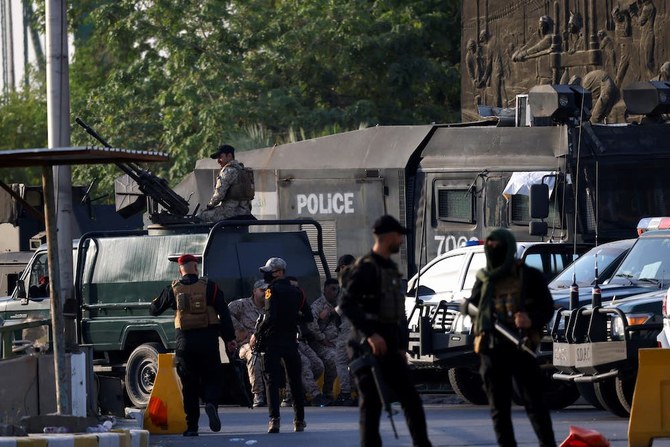
Unidentified gunmen drove vehicles around the fortified Green Zone, which hosts foreign embassies and government buildings, as a show of force. (Reuters)
Short Url
Updated 03 June 2021
Follow

UK condemns recent threats by armed groups against Iraq's Green Zone

  • ’These militia groups undermine the rule of law and the Iraqi people’s desire for peace,’ said Dominic Raab
  • Powerful paramilitary groups aligned with Iran in Iraq have attacked US targets in the country

LONDON: The UK on Wednesday condemned Iran-aligned armed militias for besieging the Green Zone in the Iraqi capital, Baghdad.
“Today I spoke to Prime Minister (Mustafa) Al-Khadhimi of Iraq to condemn recent threats by armed groups against the Baghdad International Zone,” Foreign Minister Dominic Raab said in a tweet.
Last week, Iraqi security forces arrested militia commander Qasim Muslih, in a move security sources said was linked to attacks on a base that hosts US forces and on suspicion of orchestrating the killing of a prominent pro-democracy activist amid a wave of murders of activists and journalists that started in 2019.
Following the arrest, unidentified gunmen drove vehicles around the heavily fortified diplomatic quarter, which hosts foreign embassies and government buildings, as a show of force and demanded his release, said a security source who spoke on condition of anonymity
“These militia groups undermine the rule of law and the Iraqi people’s desire for peace,” Raab added.

The US on Thursday also condemned the violence and the attacks on protesters.
“The violation of Iraqi sovereignty and rule of law by armed militias harms all Iraqis and their country,” State Department spokesman Ned Price said, two days after two Iraqis were killed during demonstrations by thousands of people in Baghdad.
Another 28 people were injured in the protests, which were held to demand justice over a wave of deadly attacks on pro-democracy activists and journalists.
“We welcome every effort by the government to hold accountable the militias, thugs, and vigilante groups for their attacks against Iraqis exercising their right to freedom of expression and peaceful assembly as well as for their assault on the rule of law,” Price said.
“The United States is outraged that peaceful demonstrators who took to the streets to urge reform were met with threats and brutal violence,” Price added.
Killings, attempted murders and abductions have targeted more than 70 activists since a protest movement erupted against government corruption and incompetence in 2019.
Since the fall of dictator Saddam Hussein in the US-led invasion of 2003, political parties have controlled life in Iraq and corruption has plagued state institutions.
(With Reuters and AFP)


Aleppo Citadel is a witness to the city’s great history and legacy

This aerial view shows the Citadel of Aleppo overlooking the northern Syrian city on December 11, 2024. (AFP)
Updated 11 sec ago
Follow

Aleppo Citadel is a witness to the city’s great history and legacy

  • Parts of military fortress date back nearly 2 millennia
  • Historian Abdullah Hajjar provides an extensive study

DAMASCUS: Towering above the old city, the Aleppo Citadel has stood for centuries as both a military stronghold and symbol of the location’s layered history.

After years of closure, neglect, and damage during the war, the Aleppo Citadel reopened to visitors on Sept. 27 following months of restoration.

The site has been listed as a UNESCO World Heritage landmark since 1986.

Rising around 38 meters above its surroundings, the fortress has played a central role in Aleppo’s political, military, and urban development.

Surrounded by a deep defensive moat, the citadel reflects advanced military engineering.

According to historian Abdullah Hajjar in his book “Archaeological Landmarks of Aleppo,” first published in 2010, the moat was excavated and reinforced during the reign of Ayyubid ruler Al-Zahir Ghazi.

At times it was 22 meters deep and about 30 meters wide, and filled with water to strengthen defenses.
Parts of the citadel date back nearly two millennia.

The lower section of its main entrance originates from the third century A.D., while the upper additions were made in the 15th century. Most of the towers and walls were built or expanded between the 13th and 16th centuries.

The citadel has repeatedly been damaged and rebuilt over the centuries. It was destroyed by the Sassanids in 540 A.D., but later restored.

Inside its walls, the citadel contains mosques, military structures, and residential buildings, offering a rare glimpse into daily life within a medieval fortress.

Among its landmarks are the Ibrahim Al-Khalil Mosque, the Great Mosque, defensive towers, barracks, and several historic houses.

Archaeological excavations have uncovered remains from multiple eras. This includes a ninth-century B.C. temple, Roman and Byzantine sarcophagi, and water cisterns dating to the reign of Byzantine Emperor Justinian, who rebuilt Aleppo’s fortifications in the sixth century against Persian invaders.

The citadel flourished during the Mamluk period, when it was restored by Sultan Baybars after the 1260 Battle of Ain Jalut.

Later inscriptions document victories by Mamluk rulers over Crusader and Mongol forces.

Under Ottoman rule, following the Battle of Marj Dabiq in 1516, the fortress gradually lost its military role and became an administrative and residential site.

The book outlines the various stages of restoration of the Aleppo Citadel over the centuries.

It highlights that Al-Zahir Ghazi, son of Saladdine Ayyubi, excavated the moat, reinforced the entrance with three wrought-iron gates, and built a large mosque within the fortress.

Later, Al-Zahir Baybars restored the citadel after the Mongol invasion, and in 1417, Sultan Al-Mu’ayyad Shaykh repaired its walls following their destruction by Timur in 1401.

The Aleppo Citadel has also survived powerful earthquakes, including a devastating quake in 1138 and another in 1822, each followed by major restoration efforts led by regional rulers of the time.

Beyond the citadel itself, Hajjar’s research documents Aleppo’s wider architectural heritage, including historic bathhouses and caravanserais that once supported the city’s role as a major trade center.