

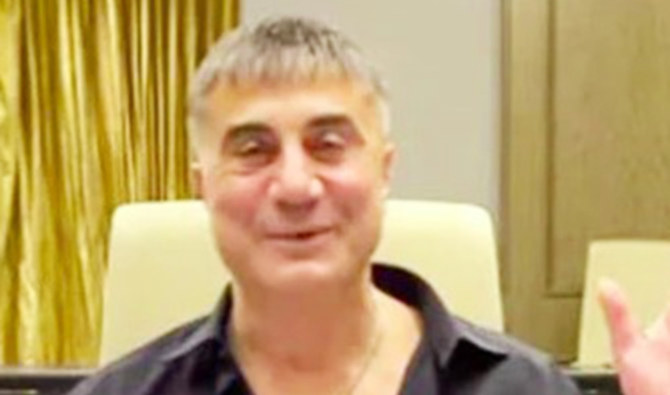

JEDDAH: Turkey’s notorious mafia leader Sedat Peker has resurfaced this week in a new video accusing the country’s rulers of conspiring with a paramilitary force to send weapons to Al-Qaeda-linked terror groups in Syria.
In the eighth video of his series released on Sunday, he claimed that Turkey sent weapons to Al-Nusra jihadists in Syria through a paramilitary group and so-called “parallel army,” named SADAT, formed by Turkish President Recep Tayyip Erdogan’s adviser.
Peker, who enjoyed close connections with Turkish rulers in the past, also detailed alleged cooperation between Turkish officials and Al-Nusra.
The fugitive mafia boss allegedly decided to send military equipment to Syrian Turkmens and shared the plan with a deputy from the ruling government in order to receive permission to dispatch the trucks in 2015.
“They said ‘lets send additional trucks to Syria with your aid convoy.’ We sent our trucks to Syria as aid trucks, then we posed for photos with them. However, I thought they sent other trucks to the Syrian Turkmen rebels,” he said.
The allegations were previously brought to the Turkish parliament by the opposition, but no further details were uncovered following government objections.
Ahmet Davutoglu, who was prime minister between 2014 and 2016 and now leads the breakaway Future Party, has been urged to provide accounts of the “corrupt irregularities” in Syria.
Peker alleged that the trucks sent to jihadists were orchestrated by a group within SADAT.
The consultancy group claims it is “the first and the only company in Turkey that internationally provides consultancy and military training services at the international defense and interior security sector,” according to its website.
HIGHLIGHT
Mafia leader Sedat Peker claims that Turkey sent weapons to Al-Nusra jihadists in Syria through a paramilitary group and so-called ‘parallel army,’ named SADAT, formed by Turkish President Recep Tayyip Erdogan’s adviser.
SADAT was founded in 2012 by a retired general and 23 officers who were expelled from the Turkish Armed Forces due to hard-line Islamic allegiances.
The paramilitary company is closely linked to the Turkish government and allegedly played a role in recruiting and providing training to jihadists during the Syrian and Libyan civil wars.
“They diverted aid trucks for Turkmen to Al-Nusra under my name, but I didn’t send them — SADAT did. I was informed about it from one of our Turkmen friends,” Peker said.
Peker, whose videos have reached millions of users on YouTube, said his videos are designed to “take revenge” against the Turkish government and especially Interior Minister Suleyman Soylu, who allowed police officers to raid his home after he fell out with the regime.
In a previous video, the mafia boss accused Erkan Yildirim, son of Turkish Prime Minister Binali Yildirim, and former police chief Mehmet Agar, of orchestrating an international drug trafficking scheme involving Turkey, Colombia and Venezuela.
The latest video is titled “Young trees which are grown by storms cannot be destroyed by wind.”
Peker asks a question in the clip: “Now do you know what you need to do business in Syria?”
He alleged that doing “big business” in Syria — worth billions of dollars — requires the permission of not only the presidential head of administrative affairs, Metin Kiratli, but also of pro-government businesspeople Ramazan Ozturk and Murat Sancak, as well as a senior Al-Nusra militant, Abu Abdurrahman, who is responsible for financing jihadis.
Peker also implied that the money trail could never be tracked back to the Turkish state after it was hidden by a “corrupt network” with the help of the interior minister.
The mafia boss claimed to have opposed the aid to Al-Nusra because they were fighting Turkmen minorities in Syria.
Al-Nusra is now called Hayat Tahrir Al-Sham and retains control in Syria’s rebel-held region.
Turkey’s alleged links with jihadists in Syria made headlines back in 2015 following Russian claims.
In December 2015, Russian President Vladimir Putin accused Ankara of shooting down a Russian jet near the Turkish border with Syria in order to protect its oil supply lines with Daesh, although Turkey denied any involvement in the incident.
Russia’s defense minister also accused Erdogan and his family of taking part in the illegal oil trade.
“If you allege something, you should prove it,” Erdogan said in response.
Peker, a high-profile mafia figure since the 1990s, says he now resides in Dubai, but regularly moves to avoid being captured by Turkish authorities. He fled Turkey last year to avoid a criminal investigation.


