

Report: Turkey ‘prevented harsh NATO sanctions against Belarus’

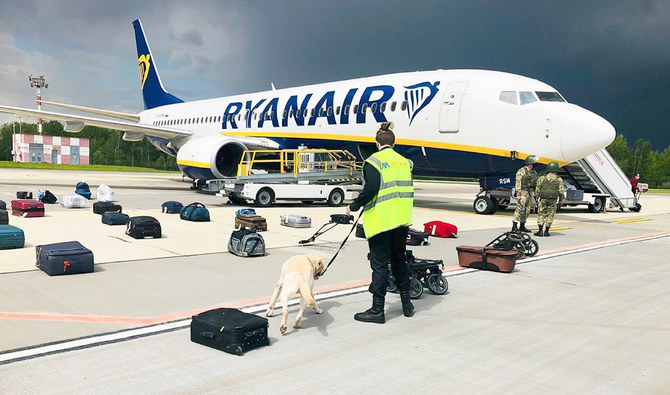
Security use a dog to check the luggage of passengers on the Ryanair jet that carried opposition figure Raman Pratasevich, traveling from Athens to Vilnius, Lithuania. (AP file photo)
Short Url
Updated 29 May 2021
Follow

Report: Turkey ‘prevented harsh NATO sanctions against Belarus’

  • Russian tourists favour Turkey as a top holiday destination, especially the country’s southern provinces, more than any other country, with 7 million visitors from the country recorded in 2019

ANKARA: Turkey convinced its NATO allies to opt for a milder official stance after Belarus forced down a European airliner passing through the country’s airspace so it could arrest a dissident journalist, Reuters reported on Thursday.

The Ryanair passenger plane was flying from Greece and bound for Lithuania, however Belarus diverted its route to force it to land in Minsk on Sunday.

In a two-paragraph statement released by NATO, the alliance condemned the arrest of the journalist Roman Protasevich after the forced landing, but it did not bring about the punitive sanctions that Poland, Lithuania and Latvia were pushing for.

The statement, which did not call for the release of political prisoners in Belarus, contradicts NATO Secretary-General Jens Stoltenberg’s declaration that the incident was “outrageous” and “a state hijacking.”

Diplomats quoted by Reuters claimed that Ankara might use its NATO leverage to consolidate its fragile ties with Moscow, a close ally of Belarus, to convince Moscow to allow Russian tourists to come to Turkey during the summer season despite the high risk of coronavirus infections.

Russian tourists favour Turkey as a top holiday destination, especially the country’s southern provinces, more than any other country, with 7 million visitors from the country recorded in 2019.

Moscow is expected to revise the one-and-half month ban on flights with Turkey that will expire on June 1.

However, on the diplomatic front, Turkey recently angered Russia over its rapprochement with Ukraine.

The Kremlin warned Ankara on May 24 that encouraging “aggressive” Ukrainian actions toward Crimea directly violated Russia’s territorial integrity. The Russian foreign minister criticized Turkey’s increased cooperation with Kiev, saying that it fuels “militaristic sentiment” in Ukraine.

Turkey’s alleged diplomatic move at NATO to prevent harsh sanctions against Belarus — probably a ban on Belarusian airlines flying over EU airspace or blocking Belarusian airlines from using EU airports — might also be aiming to boost economic cooperation with Minsk amid the financial hardship the country is facing during the pandemic.

Some experts, however, have underlined that this latest move within NATO hints at an attempt to balance the country’s geopolitical aims and economic necessities.

“Turkey is trying to preserve its ‘balancing act’ between NATO and Russia after it has been signaling during the last few weeks it was more willing to engage in the deterrence policy toward Russia, as evidenced by its outreach to Ukraine, drone sale to Poland and joining the NATO’s enhanced air policing,” Karol Wasilewski, an analyst at the Warsaw-based Polish Institute of International Affairs, told Arab News.

The Turkish Ministry of Foreign Affairs has remained silent about the Reuters’ report.

However, the Kremlin does not seem to appease its tension with Ankara with just a single move.

According to Wasilewski, any diplomatic move from Turkey to prevent sanctions against Belarus may calm Russia a little, but it will be enough to ease tensions.

“Russia is at the stage of signaling to Turkey that its actions will have consequences and this may continue until Turkey shows more clearly that its engagement in NATO won’t interfere in its policy toward Russia,” he said.

He added: “The bottom line is that Turkey continues its ‘eat a cake and have it too’ policy toward NATO and Russia. Moscow has been pretty much tolerant toward this policy, because for a long time it has had more negative consequences for NATO than for Russia.”

Turkey’s criticism of Moscow’s 2014 annexation of Crimea and its support for Ukraine’s territorial integrity is a source of annoyance for the Kremlin.

With Joe Biden’s administration now in the White House in the US, Wasilewski thinks that the equation has changed and that Moscow is interested in demonstrating to Turkey that this policy is no longer valid, especially if Turkey aims to modify its balancing act in a way that would have more negative consequences for Russia.

For Amanda Paul, senior policy analyst at the Brussels-based European Policy Center (EPC), it is disappointing that Ankara has taken this position, and the move has frustrated many in the Alliance.

“NATO should have delivered the strongest of responses to this outrageous incident. Of course, given the state of the Turkish economy these days, Ankara is focused on improving the situation,” she told Arab News.

When it comes to Belarus, Paul thinks that Turkey has been focused on strengthening economic — and other — ties over the past few years.

“In early May President Recep Tayyip Erdogan had a phone call with Alexander Lukashenka in which the two reiterated the intent to boost ties. That would indicate Turkey’s leadership has no problem in dealing with a man whose regime has beaten, and in some cases killed, peaceful protesters and now has hijacked a plane,” she said.


Swimming team in war-torn Gaza uses the sea as a pool

Updated 6 sec ago
Follow

Swimming team in war-torn Gaza uses the sea as a pool

  • Two years of war and air strikes have destroyed most recreational facilities in the Palestinian territory, including swimming pools
  • “On more than one occasion, some swimmers have been exposed to gunfire from the naval vessels present offshore,” Abu Ahmed said

GAZA CITY, Palestinian Territories: Just meters from tents for displaced people and trying to ensure they avoid Israeli naval patrols, men of all ages take to the beach at Gaza City for swimming practice.
Two years of war and air strikes have destroyed most recreational facilities in the Palestinian territory, including swimming pools.
So the men led by team captain Abu Mahmud now have to train in the Mediterranean Sea.
“We practice swimming amid serious dangers — foremost among them the Israeli patrol boats which chase swimmers and fishermen out at sea,” Abu Mahmud told AFP.
Despite a ceasefire in place since October 2025, Gaza remains a dangerous place with people killed by Israeli air strikes and gunfire every day.
At least 509 people have been killed since the ceasefire began, according to Gaza’s Hamas-run health ministry.
On Saturday alone, Israeli air strikes killed 22 people, mostly women and children, the civil defense agency said.
“On more than one occasion, some swimmers have been exposed to gunfire from the naval vessels present offshore,” Abu Ahmed said.
“The risks are many, but we try to avoid them by gathering in areas that the warships cannot reach.”
Abu Mahmud, 45, used to compete in local championships, and now he leads the men into the water after warm-up exercises including stretches, push-ups and jumping jacks.
He hopes the sport can become a psychological outlet for those affected by trauma caused by the war.
He said the swimming group once had more than 1,000 members, but most of them were displaced during the conflict.
Almost all of Gaza’s 2.2 million inhabitants were displaced at least once during the war. Hundreds of thousands still live in tents and makeshift shelters.

- Strict blockade -

One member of the swimming squad is Yehya Ali Awwad, a 54-year-old psychiatrist.
“From my perspective and my background in mental health, swimming is an excellent psychological exercise that helps us face daily events, everyday problems, and the difficult circumstances we are going through at this time,” he told AFP.
Mohamad Farahat, a young professional swimmer, lamented the destruction of Gaza’s swimming pools that he used to rely on for training.
“Before the war we used to participate in championships with the swimming federation, and I won many titles,” the 21-year-old said.
“But during the war, (Israel) left nothing behind, not a single swimming pool, and the destruction has spread across all of Gaza.”
The strict blockade that Israel imposed on the Gaza Strip makes the reconstruction of sports facilities particularly complicated, as many building materials routinely get rejected.
The official Palestinian news agency Wafa reported last week that a shipment of AstroTurf donated by China to Gaza’s youth and sports council was not allowed in.
With medicine, food and fuel all in short supply, sports equipment comes much lower on the list of items entering the Palestinian territory.
Among the men swimming with Abu Mahmud, few wore swimming caps. Many simply took to the water in cotton tank tops and polyester long johns.
A fishing boat was pulled from the water at the harbor as the men entered to swim, splashing each other and laughing.
Further up the beach, rows of tents bearing the logos of international charities or United Nations agencies stood on the sand.
The UN office for the coordination of humanitarian affairs, OCHA, reported Saturday that the camps for the displaced continue to face significant challenges, “with piles of debris and rubble obstructing stormwater drainage and contributing to frequent flooding.”
OCHA added that the rubble from damaged buildings has contributed to a rise in rodent infestations at several camps, creating hygiene risks for the displaced.
But for those who came to the beach under a winter sun, swimming is the best personal hygiene.
After spending some time in the water, the swimmers returned to shore and shared sweets and coffee as they warmed up again.
In the distance an Israeli military vessel could be seen patrolling at high speed off the Gaza coast.