Average airport processing times double to 3 hours

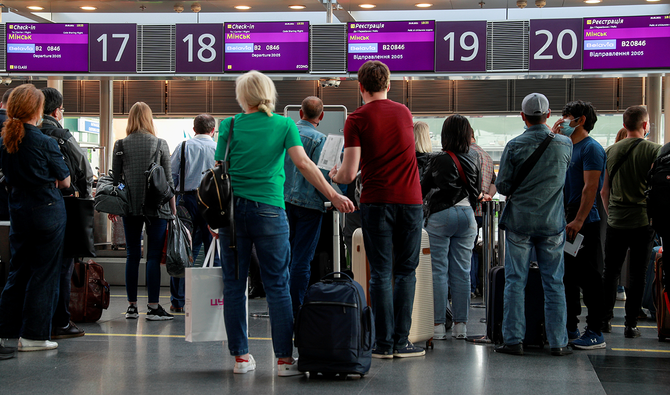
The amount of time passengers spend going through airports to board flights has doubled to an average of three hours. (Reuters)
Short Url
Updated 31 May 2021
Follow

Average airport processing times double to 3 hours

  • Airlines in the region have already begun addressing this issue

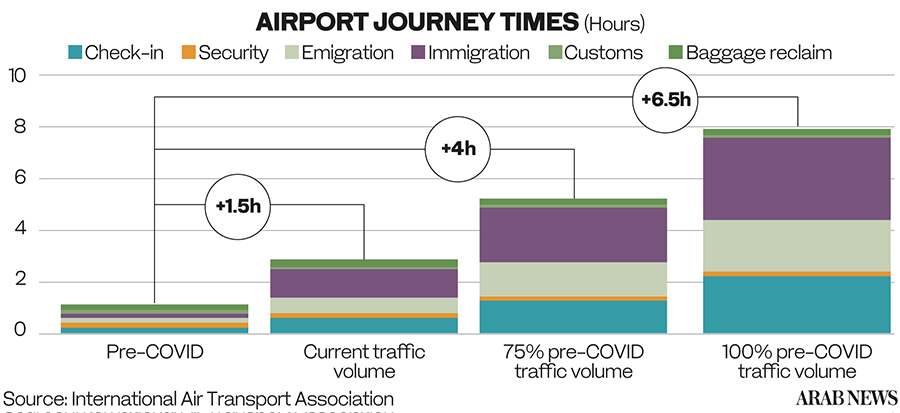
DUBAI: The amount of time passengers spend going through airports to board flights has doubled to an average of three hours, but this could surge to at least eight hours if traffic numbers return to pre-pandemic levels and restrictions remain in place, according to the International Air Transport Association (IATA).

It warned of “airport chaos” unless governments worldwide develop digital processes to speed up the processing of passengers.

“Without an automated solution for COVID-19 checks, we can see the potential for significant airport disruptions on the horizon,” IATA Director General Willie Walsh said in a statement, describing the current three-hour processing and waiting time as “unacceptable.”

He added: “Nobody will tolerate waiting hours at check-in or for border formalities. We must automate the checking of vaccine and test certificates before traffic ramps-up. 
“The technical solutions exist. But governments must agree on digital certificate standards and align processes to accept them. And they must act fast.”

Airlines in the region have already begun addressing this issue. On April 19, Saudia started trialing the digital travel and health pass developed by IATA.

The pass is a mobile app that contains flight details, personal information, passport data, verified COVID-19 test results, and proof of vaccination. It also includes an option to securely share required information with testing labs or airlines.

Emirates announced in February that it had signed an agreement with the Dubai Health Authority (DHA) to digitally verify passengers’ medical records.

The IT systems of DHA-approved laboratories were linked with Emirates’ reservations and check-in systems so the airline can verify passengers’ health information related to COVID-19 infection, testing, and vaccination.


Lebanese social entrepreneur Omar Itani recognized by Schwab Foundation

Updated 23 January 2026
Follow

Lebanese social entrepreneur Omar Itani recognized by Schwab Foundation

  • FabricAID co-founder among 21 global recipients recognized for social innovation

DAVOS: Lebanon’s Omar Itani is one of 21 recipients of the Social Entrepreneurs and Innovators of the Year Award by the Schwab Foundation for Social Entrepreneurship.

Itani is the co-founder of social enterprise FabricAID, which aims to “eradicate symptoms of poverty” by collecting and sanitizing secondhand clothing before placing items in stores in “extremely marginalized areas,” he told Arab News on the sidelines of the World Economic Forum in Davos, Switzerland.

With prices ranging from $0.25 to $4, the goal is for people to have a “dignified shopping experience” at affordable prices, he added.

FabricAID operates a network of clothing collection bins across key locations in Lebanon and Jordan, allowing people to donate pre-loved items. The garments are cleaned and sorted before being sold through the organization’s stores, while items that cannot be resold due to damage or heavy wear are repurposed for other uses, including corporate merchandise.

Since its launch, FabricAID has sold more than 1 million items, reached 200,000 beneficiaries and is preparing to expand into the Egyptian market.

Amid uncertainty in the Middle East, Itani advised young entrepreneurs to reframe challenges as opportunities.

“In Lebanon and the Arab world, we complain a lot,” he said. Understandably so, as “there are a lot of issues” in the region, resulting in people feeling frustrated and wanting to move away. But, he added, “a good portion of the challenges” facing the Middle East are “great economic and commercial opportunities.”

Over the past year, social innovators raised a combined $970 million in funding and secured a further $89 million in non-cash contributions, according to the Schwab Foundation’s recent report, “Built to Last: Social Innovation in Transition.”

This is particularly significant in an environment of geopolitical uncertainty and at a time when 82 percent report being affected by shrinking resources, triggering delays in program rollout (70 percent) and disruptions to scaling plans (72 percent).

Francois Bonnici, director of the Schwab Foundation for Social Entrepreneurship and a member of the World Economic Forum’s Executive Committee, said: “The next decade must move the models of social innovation decisively from the margins to the mainstream, transforming not only markets but mindsets.”

Award recipients take part in a structured three-year engagement with the Schwab Foundation, after which they join its global network as lifelong members. The program connects social entrepreneurs with international peers, collaborative initiatives, and capacity-building support aimed at strengthening and scaling their work.