DUBAI: Reza Pahlavi, the crown prince of Iran in exile, sees the outcome of the talks on a new nuclear deal as ‘futile as long as the current regime is in place in Tehran.
“Regardless of what is trying to be negotiated here, the net outcome is that it’s futile. The regime is simply using whatever it has as a means of blackmail — forcing the world to deal with it so it can continue maintaining its grip on the geopolitics of our region,” Pahlavi told Arab News.
In a wide-ranging interview kicking off a second season of Frankly Speaking video interviews, Pahlavi also talked about future Iranian relationships with Saudi Arabia and other Middle Eastern states once the ayatollah regime has ended, and the desire on the part of most Iranians to return to a normal post-theocratic life.
He insisted that he does not have ambitions to be a new “shah” in Iran, and that it would be up to Iranians to choose what kind of government they want to live under.
“I’m not running for any office. My only mission in life is to get to that finish line, which is the liberation of Iran and, post this regime, to have an opportunity to establish a new secular, democratic system … That day will be the end of my political mission in life,” he said.
Pahlavi, the eldest son of the late shah, was heir apparent to the throne until the Iranian Revolution in 1979.
Since then, he has lived mostly in the US as an activist against the regime through the National Council of Iran, of which he is founder and leader.

Reza Pahlavi, the eldest son of the late shah, sees the outcome of the talks on a new nuclear deal as “futile”. (Screengrab)
Pahlavi had a hard message for US President Joe Biden amid indirect talks between Washington and Tehran on a new version of the 2015 Joint Comprehensive Plan of Action to regulate Iran’s nuclear industry and re-establish economic links to the rest of the world.
“This regime can’t change its behavior because its entire existence depends on its viral state of wanting to export an ideology and dominate the region either directly or via proxies,” said Pahlavi.
“We’ve seen in fact that (US sanctions), for the most part, increased pressure on the regime and forced it to curtail its ability to do whatever it wanted to do. Any relaxation (of pressure) emboldens (the regime) and enables it to further its constant state of creating instability in the region.”
Pahlavi believes that if economic sanctions are lifted, it would only increase the potential for Iran to fund terrorism in the region, where it has orchestrated attacks on Saudi Arabia and other countries through its militias in Yemen, Iraq, Syria and Lebanon.
“I think we’ve seen that happen already once during the Obama administration, where a tremendous amount of money was released to the regime and none of it was spent on the people of Iran,” he said.
Pahlavi said he looks forward to a new era of good relations between Iran and its neighbors, including Saudi Arabia, after a change of regime in Tehran.
“Look at the way the relationship was before the revolution,” he said.
“When King Faisal of Saudi Arabia passed away, there was a seven-day mourning period in Iran. That’s the extent of what the relationship was,” Pahlavi said.
“The people haven’t changed; the regime has. And as a result of its negative impact in the region, we can certainly anticipate a future where mutual respect and a cordial relationship will be conducive to better trade, better commerce, more opportunities and (improvement of) people’s lives, standard of living, healthcare, regional stability, security coordination and many (other) things.”
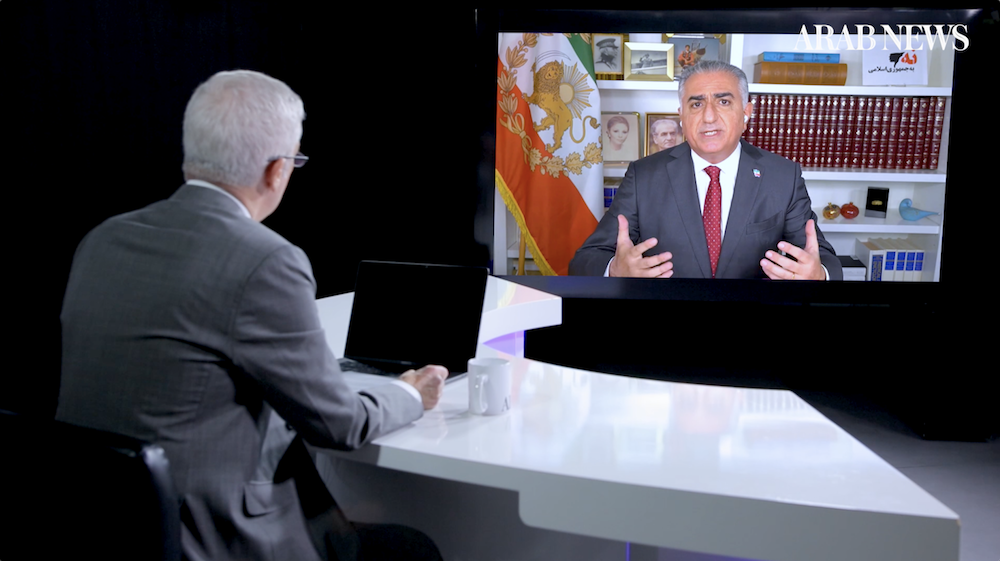
In a wide-ranging Frankly Speaking interview, Reza Pahlavi also talked about future Iranian relationships with Saudi Arabia and other Middle East states. (Screengrab)
Pahlavi contrasted the role Iran used to play in the Gulf before the revolution with the situation now, where the country and its people are increasingly isolated.
“There was a time when people in Dubai were dreaming of coming to Tehran to go to our supermarkets and shop in our stores. Today the dream of every Tehrani is to make the furthest move away from Iran,” he said.
Pahlavi insisted there is no deep-seated hatred on the part of Iranians for Arabs or Americans, pointing out that students in Tehran had recently refused to take part in regime-organized demonstrations against foreign countries.
“A nation like Iran, which has a long history of civilization, of culture, of tolerance within itself, has never had an issue of antagonism vis-a-vis any other culture or nation,” he said.
The regime’s theocratic rule has also alienated more Iranians from religion, Pahlavi added.
“I think religious governance has created a situation where people are steering away from religion. In fact, there’s much more apathy vis-a-vis any religious sentiment as a result of this regime directly trying to force a politicized religion and impose it on the public,” he said.
“Iranians have learned it the hard way, and I think today you see that even those who are pious in Iran don’t want this regime because they see the damage that it causes to people’s faith and to the clerical establishment.”
The Iranian people are emerging from their own “Islamic Inquisition,” he said, referring to the religious extremism of 16th-century Europe.
Pahlavi also attacked the influence of Iran’s Islamic Revolutionary Guard Corps, which controls much of the country’s economic infrastructure in alliance with the regime, as revealed in recent leaked comments by Foreign Minister Mohammad Javad Zarif.
Pahlavi said: “I was glad that somebody from the regime itself is dismantling this naive expectation by the Western world that moderates will be able to resolve the issues should they be in a position of control. It’s a totalitarian system at the end, depending on the decision of one supreme leader.”
He has advocated a democratic and secular system of government for his country, either with an elected president or a constitutional monarchy.
According to Pahlavi, greater regional cooperation will help the Middle East overcome many of the profound challenges it faces, such as climate change and water shortages.
“Long before we can resolve the political crisis, we should worry about the water crisis that exists in our area. This isn’t only Iran but many other countries also suffering from water crisis problems,” he said.
“If Iran today was a different Iran, you wouldn’t have missiles being shipped to Yemen. We’d have scientists working at resolving the water crisis for our respective countries.”
*Twitter: @frankkanedubai