

Saudi oil exports surge 75 percent while non-oil trade hits a high

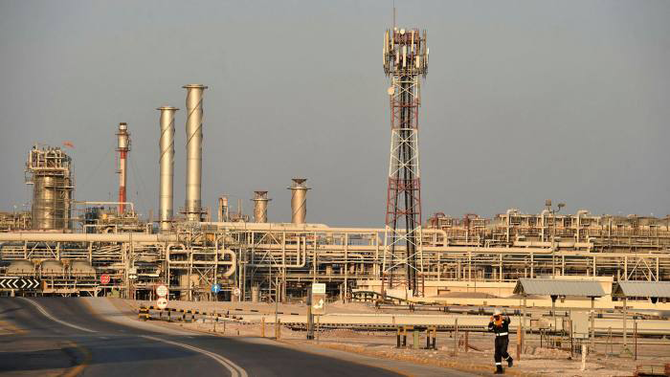
Oil remained the dominant export in the month, accounting for $19.91 billion — or 70 percent — of exports. (AFP/File)
Short Url
Updated 28 May 2021
Follow

Saudi oil exports surge 75 percent while non-oil trade hits a high

  • Oil prices were slightly lower on Thursday

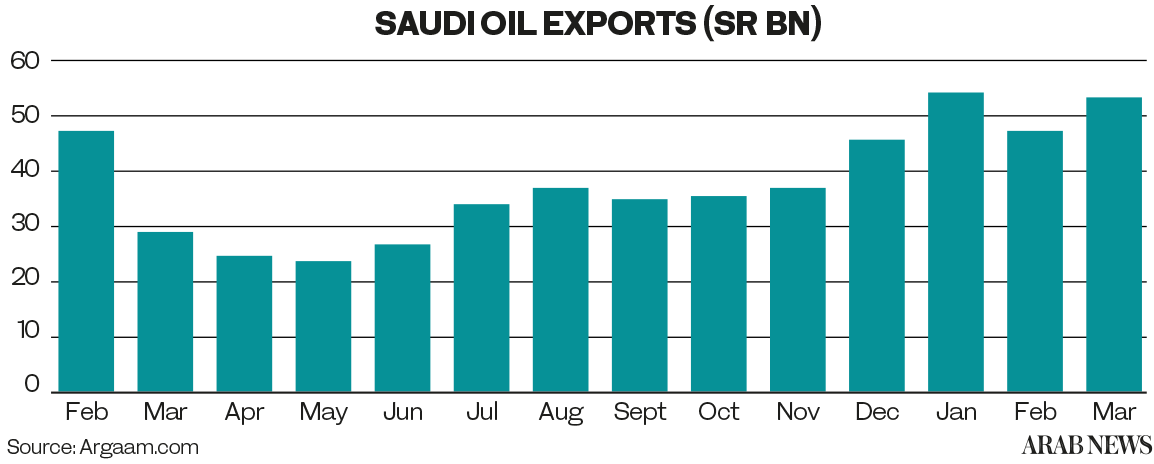
RIYADH: Saudi oil exports surged 75 percent year-on-year in March to SR52.3 billion ($13.95 billion) while non-oil exports rose 43 percent to $5.96 billion, which was the highest level since July 2018, according to official data.

The General Authority for Statistics (GASTAT) report showed that early last year, as the economic impact of the coronavirus (COVID-19) pandemic became evident, oil prices fell in March to around $34 a barrel.

Oil remained the dominant export in the month, accounting for $19.91 billion — or 70 percent — of exports.

Oil prices were slightly lower on Thursday. Brent was down 60 cents, or 0.9 percent, to $68.27 a barrel while US West Texas Intermediate (WTI) crude fell 57 cents, or 0.9 percent, to $65.64 a barrel.

At the same time, non-oil exports rose 43 percent year-on-year to $5.96 billion in March, the highest for 20 months, according to the GASTAT. The total value rose $14.1 billion between February and March.

The biggest monthly surge in exports was in the optical, medical or surgical instruments, clocks and watches category, which was up 261 percent. One of the biggest sectors was plastics, rubber, and their products, which rose 58 percent to $2 billion. 
Furthermore, vehicles, aircraft, vessels and associated transport equipment exports rose 240 percent, while food industry products and tobacco rose just 6 percent.

Sea remained the preferred method of transport, accounting for 74.1 percent of non-oil export trade, followed by land (16.7 percent) and air (9.2 percent).

Business activity in the Saudi Arabian non-oil private sector in April accelerated at the fastest pace in three months, owing to a significant rise in new sales as businesses recovered from the impact of COVID-19, according to the latest IHS Markit Purchasing Managers’ Index (PMI) survey.

Firms in the Kingdom also expanded staff numbers for the first time in five months, the index showed. The seasonally adjusted PMI rose to a three-month high of 55.2 in April, up from 53.3 in March, indicating a significant improvement in non-oil private sector business conditions. Any score above 50 indicates growth and the figure has been increasing every month since September 2020.

“The Saudi Arabia PMI rebounded in April to indicate a strengthening of growth across the non-oil economy,” said David Owen, an economist at IHS Markit.

“New orders picked up at the quickest rate for three months as business conditions continued to recover from COVID-19. The rise helped lead to a renewed uplift in employment, with the pace of increase the fastest since November 2019.”


Saudi Arabia leads outcome-based education to prepare future-ready generations: Harvard Business Review

A Harvard sign is seen at the Harvard University campus in Boston, Massachusetts, on May 27, 2025. (AFP)
Updated 10 February 2026
Follow

Saudi Arabia leads outcome-based education to prepare future-ready generations: Harvard Business Review

  • The Riyadh-based school group developed a strategy that links every classroom activity to measurable student competencies, aiming to graduate learners equipped for the digital economy and real-world contexts

RIYADH: Saudi Arabia’s education system is undergoing a sweeping transformation aligned with Vision 2030, shifting from traditional, input-focused methods to outcome-based education designed to equip students with future-ready skills, Harvard Business Review Arabic reported.

The transformation is being adopted and spearheaded by institutions such as Al-Nobala Private Schools, which introduced the Kingdom’s first national “learning outcomes framework,” aimed at preparing a generation of leaders and innovators for an AI-driven future, the report said.

Al-Nobala has leveraged international expertise to localize advanced learning methodologies.

The Riyadh-based school group developed a strategy that links every classroom activity to measurable student competencies, aiming to graduate learners equipped for the digital economy and real-world contexts. The school’s group approach combines traditional values with 21st-century skills such as critical thinking, communication, innovation and digital fluency.

According to the report, the shift addresses the growing gap between outdated models built for low-tech, resource-constrained environments and today’s dynamic world, where learners must navigate real-time information, virtual platforms, and smart technologies.

“This is not just about teaching content, it’s about creating impact,” the report noted, citing how Al-Nobala’s model prepares students to thrive in an AI-driven world while aligning with national priorities.

The report noted that Saudi Arabia’s Ministry of Education has paved the way for this shift by transitioning from a centralized controller to a strategic enabler, allowing schools such as Al-Nobala to tailor their curriculum to meet evolving market and societal needs. This is part of the long-term goal to place the Kingdom among the top 20 global education systems.

Al-Nobala’s work, the report stated, has succeeded in serving the broader national effort to link education outcomes directly to labor market demands, helping to fulfill the Vision 2030 pillar of building a vibrant society with a thriving economy driven by knowledge and innovation.

Last February, Yousef bin Abdullah Al-Benyan, Saudi Arabia’s minister of education, said that the Kingdom was making “an unprecedented investment in education,” with spending aligned to the needs of growth and development. He said that in 2025, education received the second-largest share of the state budget, totaling $53.5 billion.