DUBAI: Abu Dhabi plans to sell US dollar bonds on Tuesday in its first foray in the international debt markets this year, raising cash for state coffers despite a recent rebound in oil prices.
The oil-rich emirate gave initial guidance of 70-75 basis points over US Treasuries for seven-year US dollar-denominated bonds expected to price later in the day. It did not say how much it intended to raise.
The UAE was hit hard by the COVID-19 pandemic and last year’s crash in oil prices, but a rebound in global crude demand as economies re-open has reduced the urgency to borrow for budget purposes.
“I’m hearing that the issue size is around $2 billion only,” said Zeina Rizk, executive fixed income director at Arqaam Capital, adding some of the funds might end up boosting foreign currency reserves.
Citi, First Abu Dhabi Bank, HSBC, JPMorgan and Standard Chartered are joint lead managers and joint bookrunners for the deal, according to a document from one of the banks, seen by Reuters.
“This is more of an updating-the-curve kind of issuance. They didn’t have a seven-year paper and hence the curve was being interpolated,” another fund manager said.
Brent crude, trading at over $68 on Tuesday, has more than tripled since oil’s crash last year, when Brent fell below $20 a barrel.
Abu Dhabi is expected to post a budget deficit of around 43 billion dirhams ($11.7 billion) in 2021 against 37.2 billion dirhams last year, the preliminary prospectus for the new bond offering, reviewed by Reuters, showed.
The budget, however, is based on an oil price assumption of about $46 per barrel versus roughly $50 per barrel last year.
“This deficit is expected to be funded principally by borrowings,” the prospectus said.
Abu Dhabi has become a relatively frequent issuer of US dollar-denominated debt in recent years, and tapped the market three times last year for a total of $15 billion.
At the end of 2020, it had $40 billion in outstanding bonds and $3.9 billion in outstanding loans. Outstanding bonds and loans totaled $29.4 billion at the end of 2019, the prospectus showed.

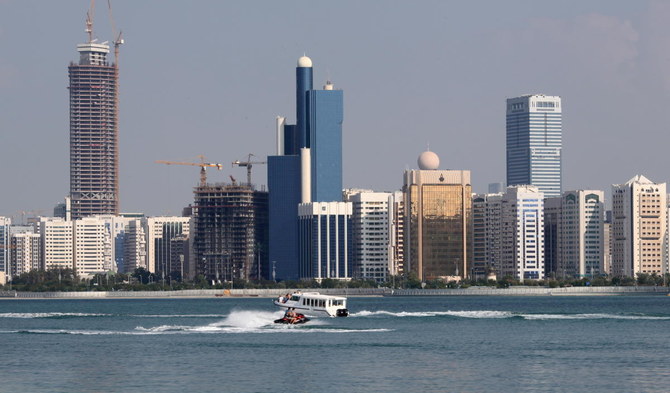
Abu Dhabi back to bond markets despite rebound in oil
https://arab.news/jta7z
Abu Dhabi back to bond markets despite rebound in oil
- Brent crude, trading at over $68 on Tuesday, has more than tripled since oil’s crash last year
Lebanese social entrepreneur Omar Itani recognized by Schwab Foundation
- FabricAID co-founder among 21 global recipients recognized for social innovation
DAVOS: Lebanon’s Omar Itani is one of 21 recipients of the Social Entrepreneurs and Innovators of the Year Award by the Schwab Foundation for Social Entrepreneurship.
Itani is the co-founder of social enterprise FabricAID, which aims to “eradicate symptoms of poverty” by collecting and sanitizing secondhand clothing before placing items in stores in “extremely marginalized areas,” he told Arab News on the sidelines of the World Economic Forum in Davos, Switzerland.
With prices ranging from $0.25 to $4, the goal is for people to have a “dignified shopping experience” at affordable prices, he added.
FabricAID operates a network of clothing collection bins across key locations in Lebanon and Jordan, allowing people to donate pre-loved items. The garments are cleaned and sorted before being sold through the organization’s stores, while items that cannot be resold due to damage or heavy wear are repurposed for other uses, including corporate merchandise.
Since its launch, FabricAID has sold more than 1 million items, reached 200,000 beneficiaries and is preparing to expand into the Egyptian market.
Amid uncertainty in the Middle East, Itani advised young entrepreneurs to reframe challenges as opportunities.
“In Lebanon and the Arab world, we complain a lot,” he said. Understandably so, as “there are a lot of issues” in the region, resulting in people feeling frustrated and wanting to move away. But, he added, “a good portion of the challenges” facing the Middle East are “great economic and commercial opportunities.”
Over the past year, social innovators raised a combined $970 million in funding and secured a further $89 million in non-cash contributions, according to the Schwab Foundation’s recent report, “Built to Last: Social Innovation in Transition.”
This is particularly significant in an environment of geopolitical uncertainty and at a time when 82 percent report being affected by shrinking resources, triggering delays in program rollout (70 percent) and disruptions to scaling plans (72 percent).
Francois Bonnici, director of the Schwab Foundation for Social Entrepreneurship and a member of the World Economic Forum’s Executive Committee, said: “The next decade must move the models of social innovation decisively from the margins to the mainstream, transforming not only markets but mindsets.”
Award recipients take part in a structured three-year engagement with the Schwab Foundation, after which they join its global network as lifelong members. The program connects social entrepreneurs with international peers, collaborative initiatives, and capacity-building support aimed at strengthening and scaling their work.


