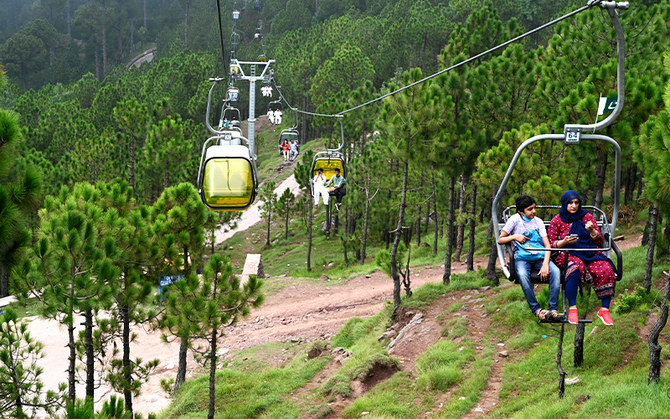
ISLAMABAD: Pakistan began allowing visitors to its top tourist destinations on Monday, more than two weeks after imposing a ban on travel to curb the spread of the coronavirus disease during the Eid Al-Fitr festivities.
The National Command and Operation Center (NCOC), which oversees Pakistan’s response to the pandemic, said that lifting the travel ban was an “important move toward normalcy.”
“Revival of tourism is an important component of move toward normalcy. Protocols have been designed to minimize the potential for contracting COVID-19 at tourist resorts and reducing its spread,” the NCOC said after a meeting on Sunday before issuing detailed guidelines for tourists.
“Mandatory collection of negative PCR/ COVID-19 report along with CNICs [Computerised National Identity Cards] by hotels/guest houses management should be ensured before booking of rooms,” the NCOC said in a statement.
It added that reservation of rooms “would not be done for guests over 40 years of age after 1st July 2021” without vaccination certificates.
The NCOC further instructed local authorities to “arrange check posts manned by law enforcement agencies” at all entry points and made it mandatory for tourists to register and submit a Health Declaration Form (HDF) prior to travel.
“Travelers should ensure adequate supplies of masks and sanitizers before they embark on the trip,” the statement said, adding: “Tour operators, guides, hotels, guest houses and restaurant staff, porters etc., must be vaccinated” as well.
Pakistan imposed a nationwide ban on tourism and travel, which included the closure of all resorts, for a week starting from May 8.
However, on May 16, it resumed public transport services in all provinces and cities across the country and re-opened markets before lifting the travel curbs on Monday, under strict health protocols.
Pakistan is currently grappling with a third wave of the coronavirus outbreak and registered 3,060 new cases and 57 deaths in the past 24 hours.
It adds to the total tally of 903,599 infections and 20,308 deaths reported since the start of the pandemic in February last year.
According to NCOC data on Monday, the country of nearly 220 million has administered over 5.3 million doses of COVID-19 vaccines, with plans in place to inoculate more people with the arrival of two million doses of the Sinovac vaccine from China a day earlier.
“With the arrival of this consignment, [a total of] 11 million vaccines have been received by Pakistan,” the NCOC said.


Going places: Pakistan reopens tourism sector with COVID-19 checks in place
https://arab.news/nq5yx
Going places: Pakistan reopens tourism sector with COVID-19 checks in place

- Follows a two-week ban on travel to limit a surge in infections during Eid festivities
- Revival of tourism an important move toward normalcy, the NCOC says amid the third wave of the outbreak

Islamabad says engagement with Afghanistan hinges on action against militant groups
- Tensions have been high between Islamabad and Kabul over the increase in militant attacks inside Pakistan
- Minister says economic aspects do come in between, but Pakistan's security remains their highest priority
KARACHI: Any engagement between Pakistan and Afghanistan depends on concrete action by Kabul against militant groups, Pakistan's commerce minister said on Monday, citing a surge in militant attacks inside Pakistan.
Tensions have been high between Islamabad and Kabul over the increase in militant attacks that Pakistan has blamed on Afghanistan-based militant groups, an allegation denied by the Taliban authorities.
The attacks triggered one of the worst skirmishes between the neighbors in Oct. last year, after Islamabad hit what it called Pakistani Taliban targets inside Afghanistan. Pakistan has since suspended all trade with Afghanistan, despite a ceasefire reached in Doha on Oct. 19.
Commerce Minister Jam Kamal Khan said on Monday that Pakistan has made it clear at all levels that it could not make any compromise on its security and that militants using Afghan soil need to be "handled."
"If we have to engage in any form, Afghanistan has to address this aspect of terrorism first," he said on X. "In recent months, many such incidents have taken place and we see an increase in it."
There was no immediate response to the statement from the Afghan side, which comes as the suspension of trade between the neighbors has been severely impacting traders on either side of the border.
Kamal said they welcomed any dialogue and ways to facilitate trade but could not pursue them in the presence of militant "safe havens" in Afghanistan.
"Economic aspects do come in between, however, we keep our sovereignty and security as the highest priority," he added.


