

Pro-Israel, pro-Palestinian protesters clash in Canada

1 / 2
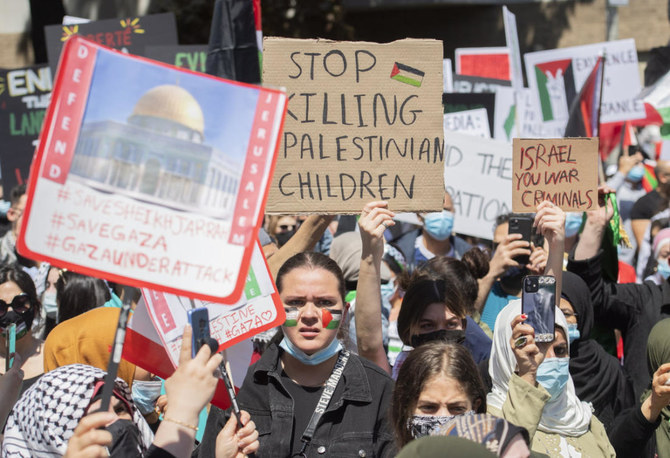
People in Montreal attend a demonstration outside the Israeli consulate on May 15, 2021, to denounce Israel's military actions in the Palestinian territories. (Graham Hughes/The Canadian Press via AP)
2 / 2
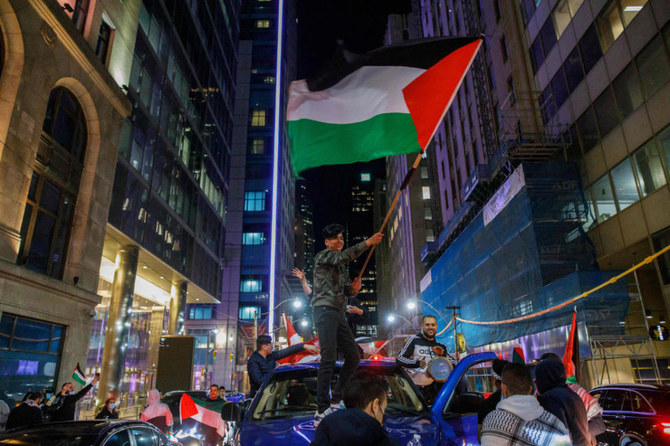
People wave flags atop cars in traffic during a demonstration on May 15, 2021 at Toronto City Hall in Toronto, Ontario, Canada, to voice support for the people of Palestine. (AFP / Cole Burston)
Short Url
Updated 17 May 2021
Follow

Pro-Israel, pro-Palestinian protesters clash in Canada

  • PM Trudeau stresses that while citizens have the right to express themselves freely in Canada, there was no tolerance for “antisemitism, Islamophobia, or hate of any kind”

MONTREAL, Canada: Canadian Prime Minister Justin Trudeau on Sunday condemned the violence and “despicable rhetoric” that marked several weekend protests throughout the country, after clashes between pro-Israel and pro-Palestinian protesters in Montreal.
The worst violence in years, sparked by unrest in Jerusalem, is raging between the Jewish state and Islamist militants.
Israeli strikes killed 42 Palestinians in the Gaza Strip on Sunday, the worst daily toll in almost a week of deadly clashes.
Speaking after protests in Montreal, Trudeau condemned what he said was “despicable rhetoric and violence we saw on display in some protests this weekend.”
While insisting on the “right to assemble peacefully and express themselves freely in Canada,” Trudeau stressed in a tweet that there was no tolerance for “antisemitism, Islamophobia, or hate of any kind.”
Earlier Sunday, Montreal police used tear gas following clashes between pro-Israel and pro-Palestinian protesters.
Several hundred demonstrators, draped in Israeli flags, had gathered in a central Montreal square to express solidarity with the Jewish state.
Although the protest started peacefully, tensions ratcheted up with the arrival of pro-Palestinian demonstrators and clashes soon broke out.
The SPVM, Montreal’s city police force, declared the protests illegal, and squads of riot police intervened, using tear gas to separate and disperse the two groups, according to an AFP journalist at the scene.
The police spent much of the afternoon in pursuit of the pro-Palestinian protesters, who spread out and regrouped in commercial streets in the city center.
Following the clashes, Montreal Mayor Valerie Plante said on Twitter that “protesting is a right,” but that “intolerance, violence and anti-Semitism have no place here.”
“Montreal is a city of peace,” she said.
Several thousand pro-Palestinian demonstrators had gathered Saturday in central Montreal to denounce what they said were Israeli repression and “war crimes” in Gaza.
“Terrorist Israel,” some protesters chanted, while others held up a banner that read, “Stop the genocide of Palestinian children.”
Pro-Palestinian protests happened the same day in multiple Canadian cities, including Toronto, Ottawa and Vancouver.


US to cut roughly 200 NATO positions, sources say

Updated 21 January 2026
Follow

US to cut roughly 200 NATO positions, sources say

  • Trump famously threatened to withdraw from NATO during ⁠his first presidential term and said on the campaign trail that he would encourage Russia to attack NATO members that did not pay their fair share on defense

WASHINGTON: The United States plans to reduce the number of personnel it has stationed within several key NATO command centers, a move that could intensify concerns ​in Europe about Washington’s commitment to the alliance, three sources familiar with the matter said this week.
As part of the move, which the Trump administration has communicated to some European capitals, the US will eliminate roughly 200 positions from the NATO entities that oversee and plan the alliance’s military and intelligence operations, said the sources, who requested anonymity to discuss private diplomatic conversations.
Among the bodies that will be affected, said the sources, are the UK-based NATO Intelligence Fusion Center and the Allied Special Operations Forces Command in Brussels. Portugal-based STRIKFORNATO, which oversees some maritime operations, will also be cut, as will several other similar NATO entities, the sources said.
The sources did not specify why the US had decided to cut the number of staff dedicated to the NATO roles, but the moves broadly align with the ‌Trump administration’s stated intention to ‌shift more resources toward the Western Hemisphere.
The Washington Post first reported the decision.

TRUMP ‌RE-POSTS ⁠MESSAGE ​IDENTIFYING NATO ‌AS THREAT
The changes are small relative to the size of the US military force stationed in Europe and do not necessarily signal a broader US shift away from the continent. Around 80,000 military personnel are stationed in Europe, almost half of them in Germany. But the moves are nonetheless likely to stoke European anxiety about the future of the alliance, which is already running high given US President Donald Trump’s stepped-up campaign to wrest Greenland away from Denmark, raising the unprecedented prospect of territorial aggression within NATO.
On Tuesday morning, the US president, who is scheduled to fly to the World Economic Forum in Switzerland in the evening, shared another user’s post on social media that identified NATO as a threat to the ⁠United States. The post described China and Russia as merely “boogeymen.”
Asked for comment, a NATO official said changes to US staffing are not unusual and that the US presence in ‌Europe is larger than it has been in years.
“NATO and US authorities are in ‍close contact about our overall posture – to ensure NATO retains our ‍robust capacity to deter and defend,” the NATO official said.
The White House and the Pentagon did not respond to requests for ‍comment.

MILITARY IMPACT UNCLEAR, SYMBOLIC IMPACT OBVIOUS
Reuters could not obtain a full list of NATO entities that will be affected by the new policy. About 400 US personnel are stationed within the entities that will see cuts, one of the sources said, meaning the total number of Americans at the affected NATO bodies will be reduced by roughly half.
Rather than recalling servicemembers from their current posts, the US will for the most part decline to ​backfill them as they move on from their positions, the sources said.
The drawdown comes as the alliance traverses one of the most diplomatically fraught moments in its 77-year history. Trump famously threatened to withdraw from NATO during ⁠his first presidential term and said on the campaign trail that he would encourage Russian President Vladimir Putin to attack NATO members that did not pay their fair share on defense. But he appeared to warm to NATO over the first half of 2025, effusively praising NATO Secretary-General Mark Rutte and other European leaders after they agreed to boost defense spending at a June summit.
In recent weeks, however, his administration has again provoked alarm across Europe. In early December, Pentagon officials told diplomats that the US wants Europe to take over the majority of NATO’s conventional defense capabilities, from intelligence to missiles, by 2027, a deadline that struck European officials as unrealistic. A key US national security document released shortly after called for the US to dedicate more of its military resources to the Western Hemisphere, calling into question whether Europe will continue to be a priority theater for the US
In the first weeks of 2026, Trump has revived his longstanding campaign to acquire Greenland, an overseas territory of Denmark, enraging officials in Copenhagen and throughout Europe, many of whom believe any territorial aggression within the alliance would mark the end of NATO. Over the weekend, ‌Trump said he would slap several NATO countries with tariffs starting February 1 due to their support for Denmark’s sovereignty over the island. That has caused European Union officials to mull retaliatory tariffs of their own.