BANGKOK, Thailand: Beaten, kicked in the groin and threatened with sexual violence — a young Myanmar teenager detained by the junta’s security forces has described the treatment suffered by some women and girls behind bars.
Shwe Yamin Htet, 17, and her mother were arrested on April 14 in Yangon, Myanmar’s commercial capital, which has been blanketed with heavy security since the military seized power in a coup.
As they were walking to a friend’s house from a morning protest, she said, they were stopped by two security trucks.
“They forced us to crouch face-down on the ground,” Shwe Yamin Htet told AFP.
The high school student then faced six days of fear and anxiety, held with women who alleged torture and abuse by police behind closed doors.
Shwe Yamin Htet said she herself had to endure a police officer molesting her during an interrogation session.
The teenager was released on April 20, but her mother was not as fortunate — Sandar Win was instead taken to Yangon’s Insein prison.
“My mother is my only family,” she said. “I’m very worried for her safety and life.”
To secure her release, she said, she had to sign documents saying she suffered “no torture” behind bars.
“It’s the opposite of what they have done,” Shwe Yamin Htet said. “It is totally unacceptable and unfair.”
Political prisoners
Her mother is among more than 3,800 civilians arrested and still languishing behind bars since the February 1 coup, according to local monitoring group the Assistance Association for Political Prisoners.
Little is known about the conditions of detainees across Myanmar, as those released rarely speak out about it.
Shwe Yamin Htet said she and her mother were taken first to a local police station where they were questioned separately.
“I was touched by a police officer, who told me he could kill me and make me disappear,” she said.
“If I didn’t push his hand away, I’m sure he would have continued.”
She added that her mother was slapped twice during her interrogation.
The following day, they were taken to a detention center on Yangon’s northern outskirts where they met other women, some of whom had bruises all over their bodies.
One of them — a woman who had been in a relationship with a foreigner — was beaten so badly she could barely talk or eat, Shwe Yamin Htet said.
“We had to feed her fried egg and rice,” she said. “She told us she couldn’t urinate because her women parts had been kicked during the interrogation.”
The National Unity Government — an underground group of ousted lawmakers opposing the junta — has announced it is investigating the “allegations of sexual and gender-based violence against women and girls in unlawful detention.”
“These cases are indicative of the wider pattern of sexual and gender-based violence committed by Myanmar’s military that has persisted for years with impunity, particularly against ethnic minority women and girls in armed conflict areas,” it said in a statement.
Rights and dignity violated
Another woman held in the same detention center as Shwe Yamin Htet recalled similar experiences.
Ngwe Thanzin — a pseudonym to protect her identity — told AFP she and four others were protesting in Yangon’s South Okkalapa township when they were arrested.
“I was kicked in my face for having a black mask in my bag,” she said, adding that security forces also yelled misogynistic abuse at them.
The women were then taken to the same detention center as Shwe Yamin Htet, where Ngwe Thanzin said she was handcuffed so tightly it left marks on her wrists.
“They also threatened us saying they could kill us and make us disappear without anyone knowing it,” she told AFP.
During her three-night detention, she said she saw a 19-year-old girl bruised so badly she could barely stand.
“They don’t beat or torture in front of other people. But when people were individually interrogated, they came out with bruises.”
AFP was unable to independently verify the allegations made by Shwe Yamin Htet and Ngwe Thanzin.
Repeated attempts to contact the junta spokesman for a response went unanswered.
And junta-appointed Minister of Social Welfare Thet Thet Khine — who chairs a National Committee on Prevention and Response to Sexual Violence in Conflict — could not be reached for comment.
Ngwe Thanzin said the least the junta could do was have female security personnel available to interrogate them, instead of men.
“All our rights and dignity were violated and abused,” she said.
“Since we have no rights, I felt we were like water in their hands.”


Myanmar teen describes junta’s brutal treatment of detained women

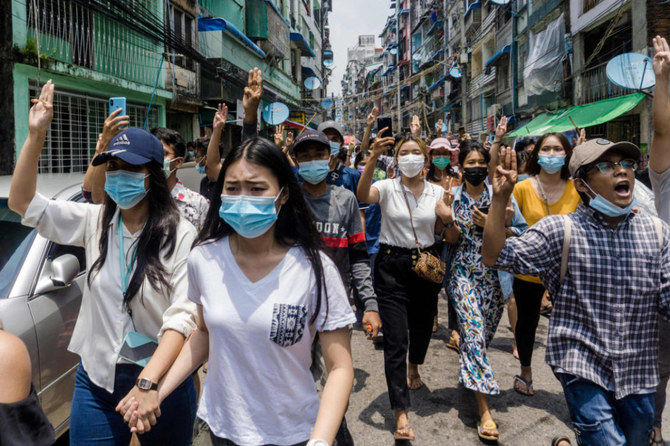
Myanmar teen describes junta’s brutal treatment of detained women


Anger as branch of ICE to help with security at Winter Olympics
ROME: A branch of the US Immigration and Customs Enforcement (ICE) will help with security for the Winter Olympics in Italy, it confirmed Tuesday, sparking anger and warnings they were not welcome.
Reports had been circulating for days that the agency embroiled in an often brutal immigration crackdown in the United States could be involved in US security measures for the February 6-22 Games in northern Italy.
In a statement overnight to AFP, ICE said: “At the Olympics, ICE’s Homeland Security Investigations (HSI) is supporting the US Department of State’s Diplomatic Security Service and host nation to vet and mitigate risks from transnational criminal organizations.
“All security operations remain under Italian authority.”
It’s not known whether the HSI has in the past been involved in the Olympics, or whether this is a first.
According to the ICE website, the HSI investigates global threats, investigating the illegal movement of people, goods, money, contraband, weapons and sensitive technology into, out of, and through the United States.
ICE made clear its operations in Italy were separate from the immigration crackdown, which is being carried out by the Enforcement and Removal Operations (ERO) department.
“Obviously, ICE does not conduct immigration enforcement operations in foreign countries,” it said.
The protection of US citizens during Olympic Games overseas is led by the State Department’s Diplomatic Security Service (DSS).
Yet the outrage over ICE immigration operations in the United States is shared among many in Italy, following the deaths of two civilians during an immigration crackdown in Minneapolis.
The leftist mayor of Milan, which is hosting several Olympic events, said ICE was “not welcome.”
“This is a militia that kills... It’s clear that they are not welcome in Milan, there’s no doubt about it, Giuseppe Sala told RTL 102.5 radio.
“Can’t we just say no to (US President Donald) Trump for once?“
Alessandro Zan, a member of the European Parliament for the center-left Democratic Party, condemned it as “unacceptable.”
“In Italy, we don’t want those who trample on human rights and act outside of any democratic control,” he wrote on X.
Monitoring Vance
Italian authorities initially denied the presence of ICE and then sought to downplay any role, suggesting they would help only in security for the US delegation.
US Vice President JD Vance and Secretary of State Marco Rubio are attending the opening ceremony in Milan on February 6.
On Monday, the president of the northern Lombardy region, said their involvement would be limited to monitoring Vance and Rubio.
“It will be only in a defensive role, but I am convinced that nothing will happen,” Attilio Fontana told reporters.
However, his office then issued a statement saying he did not have any specific information on their presence, but was responding to a hypothetical question.
Interior Minister Matteo Piantedosi was quoted as saying late Monday that “ICE, as such, will never operate in Italy.”
The International Olympic Committee when contacted by AFP about the matter replied: “We kindly refer you to the USOPC (the United States Olympic and Paralympic Committee).”
Thousands of ICE agents have been deployed by President Donald Trump in various US cities to carry out a crackdown on illegal immigration.
Their actions have prompted widespread protests, and the recent killings of US citizens Renee Good and Alex Pretti, both 37, on the streets of Minneapolis sparked outrage.


