

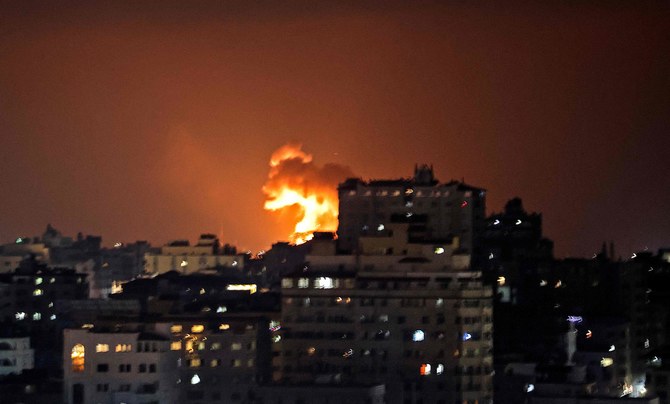

GAZA CITY, Gaza Strip: Israel unleashed new airstrikes on Gaza early Tuesday, hitting a pair of high-rise buildings believed to be housing militants, as Hamas and other armed groups bombarded southern Israel with hundreds of rockets. The escalation was sparked by weeks of tensions in contested Jerusalem.
Since sundown Monday, 26 Palestinians — including nine children and a woman— were killed in Gaza, most by airstrikes, Gaza health officials said. The Israeli military said at least 16 of the dead were militants. During the same period, Gaza militants fired hundreds of rockets toward Israel, killing two Israeli civilians and wounding 10 others.
In a further sign of rising tensions, Israel signaled it is widening its military campaign. The military said it is sending troop reinforcements to the Gaza border and the defense minister ordered the mobilization of 5,000 reserve soldiers.
But, in a potentially positive sign, officials said Egypt was working on brokering a cease-fire.
The barrage of rockets and airstrikes was preceded by hours of clashes between Palestinians and Israeli security forces, including dramatic confrontations at Jerusalem’s Al-Aqsa Mosque compound, a sacred site to both Jews and Muslims. The current violence, like previous rounds, including the last intifada, or uprising, has been fueled by conflicting claims over Jerusalem, which is at the emotional core of the long conflict.
In a sign of widening unrest, hundreds of residents of Arab communities across Israel staged overnight demonstrations — denouncing the recent actions of Israeli security forces against Palestinians. It was one of the largest protests by Palestinian citizens in Israel in recent years.
Militants launch rockets from Gaza towards Israel (AFP Video)
Israel and Hamas, an Islamic militant group that seeks Israel’s destruction, have fought three wars and numerous skirmishes since Hamas seized control of Gaza in 2007. Recent rounds of fighting have usually ended after a few days, often helped by behind-the-scenes mediation by Qatar, Egypt and others.
An Egyptian official confirmed that the country was trying to broker a truce. But the official, speaking on condition of anonymity because he was discussing sensitive diplomacy, said Israeli actions in Jerusalem had complicated those efforts. A Palestinian security official, also speaking on condition of anonymity, confirmed the cease-fire efforts.
Israeli Prime Minister Benjamin Netanyahu, meanwhile, has warned that fighting could “continue for some time.” Lt. Col. Jonathan Conricus, an Israeli military spokesman, told reporters Tuesday that the military was in “the early stages” of strikes against Gaza targets that it had planned well in advance.
Israel carried out dozens of airstrikes, including two that targeted high-rise buildings where militants were believed to be hiding.
At midday, an airstrike hit an apartment building in central Gaza City. Local media said an unknown number of militants had been killed. But the force of the blast sent terrified residents, including women and children who were barefoot, running into the streets.
An earlier airstrike struck a high-rise elsewhere in Gaza City as people were conducting dawn prayers, residents said. Health officials said two men and a woman were killed. The woman’s 19-year-old disabled son was among the dead, residents said.
Ashraf Al-Kidra, spokesman for the Gaza Health Ministry, said a total of 26 people, including nine children and the woman, were killed and 122 people were wounded. He said Israel’s “relentless assault” was overwhelming the health care system, which has been struggling with a COVID-19 outbreak.
The escalation comes at a time of political limbo in Israel.
Netanyahu has been acting as a caretaker prime minister since an inconclusive parliamentary election in March. He tried and failed to form a coalition government with his hard-line and ultra-Orthodox allies, and the task was handed to his political rivals last week.
Israelis run for cover as air raid sirens sound. (AFP Video)
One of those rivals is Israel’s defense minister, who is overseeing the Gaza campaign. It was not clear whether the toxic political atmosphere is spilling over into military decision-making, though the rival camps have unanimously expressed support for striking Hamas hard.
The support of an Arab-backed party with Islamist roots is key for the anti-Netanyahu bloc’s efforts. But the current tensions might deter the party’s leader, Mansour Abbas, from joining a coalition for now. The sides have three more weeks to reach a deal.
The current round of violence in Jerusalem coincided with the start of the Muslim fasting month of Ramadan in mid-April.
Critics say heavy-handed police measures helped stoke nightly unrest, including a decision to temporarily seal off a popular gathering spot where Palestinian residents would meet after evening prayers. Another flashpoint was the Jerusalem neighborhood of Sheikh Jarrah, where dozens of Palestinians are under treat of eviction by Jewish settlers.
Over the weekend, confrontations erupted at the Al-Aqsa Mosque compound, which is the third holiest site of Islam and the holiest site in Judaism.
Over several days, Israel police fired tear gas, stun grenades and rubber bullets at Palestinians in the compound who hurled stones and chairs. At times, police fired stun grenades into the carpeted mosque.
On Monday evening, Hamas began firing rockets from Gaza, setting off air raid sirens as far as Jerusalem. From there on, the escalation was rapid.
Conricus, the army spokesman, said Gaza militants fired more than 250 rockets at Israel, with about one-third falling short and landing in Gaza.
The army said that a rocket landed a direct hit on a seven-story apartment block in the coastal Israeli city of Ashkelon. Israeli paramedic service Magen David Adom said it treated six people injured in the rocket strike. Two were hospitalized in moderate condition.
Later, a second building in the city of Ashdod was hit, lightly wounding four people, Israeli police said.
Conricus said the military hit 130 targets in Gaza, including two tunnels militants were digging under the border with Israel. He said Israel’s new system of concrete barriers and electronic sensors, intended to thwart tunnel digging, has proven effective.
He did not address Gaza Health Ministry reports about the dead children.
In Gaza, most of the deaths were attributed to airstrikes. However, seven of the deaths were members of a single family, including three children, who died in an explosion in the northern Gaza town of Beit Hanoun. It was not clear if the blast was caused by an Israeli airstrike or errant rocket.
Dozens of mourners took part in the funeral of Hussein Hamad, an 11-year-old boy who was among the dead.
More than 100 Gazans were wounded in the airstrikes, the Health Ministry said.
Israel struck scores of Gaza homes in its 2014 war with Hamas, arguing it was aiming at militants, but also killing many civilians. The practice drew broad international condemnation at the time.
Israel’s tactics in Jerusalem have drawn angry reactions from the Muslim world.
Regional power house Saudi Arabia on Monday condemned in the strongest terms what it said were attacks by Israeli forces against the sanctity of Al-Aqsa and the safety of its worshippers. The Saudi Foreign Ministry called Tuesday on the international community to hold Israeli forces responsible for any escalation.


