


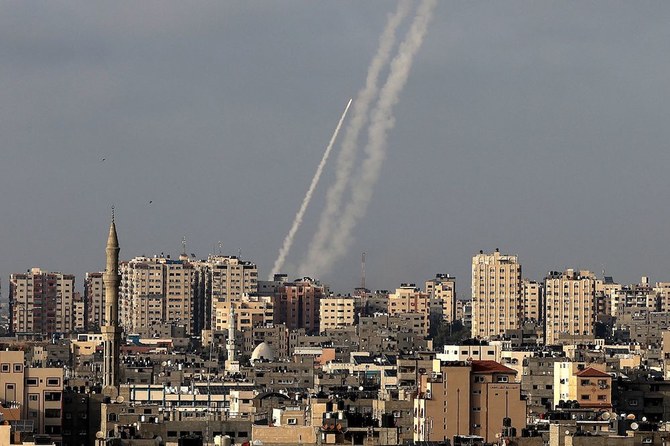

GAZA CITY: Palestinian health officials in the Gaza Strip said 20 people, including nine children, have been killed in fighting with Israel.
Israel’s army said it launched airstrikes on Monday, killing a senior Hamas commander, in response to rockets fired by Hamas amid spiraling violence sparked by unrest at Jerusalem’s Al-Aqsa mosque compound.
He said Israeli forces had targeted “a Hamas military operative,” while Hamas sources in Gaza said that one of their commanders had been killed.
Tensions on the Gaza Strip border with Israel continued to mount following recent violent confrontations at Al-Aqsa Mosque and in the Sheikh Jarrah neighborhood of Jerusalem.
A spokesman for Al-Qassam Brigades — the military wing of Hamas in Gaza — said that “a volley of rockets was fired toward the enemy in occupied Jerusalem in response to its crimes and aggression on the holy city and repression of its residents in Sheikh Jarrah and the Al-Aqsa Mosque.”
BACKGROUND
Mohammed Deif, commander-in-chief of the Al-Qassam Brigades, the military wing of Hamas in Gaza, recently warned that the resistance would ‘not stand idly by’ and that Israel would ‘pay a dear price’ if it continued with its actions against Palestinians.
The Islamic Jihad said that it targeted an Israeli vehicle with an anti-tank missile on the border with the Gaza Strip.
The developments in the Gaza Strip came after the Al-Qassam Brigades issued a warning to Israel to evacuate the Al-Aqsa Mosque and Sheikh Jarrah neighborhood, and release the detainees in Jerusalem, with a deadline of 6 p.m.
A number of rockets fired from Gaza toward Israeli towns on Sunday evening and Monday morning were intercepted by Israel’s Iron Dome air defense system and no injuries were reported. Incendiary balloons were also launched toward Israel.
The Israeli army responded to the attacks by bombing sites belonging to Palestinian factions in Gaza.
Night demonstrations also resumed along the border in support of several Palestinian families threatened with eviction from their homes in Jerusalem and as part of the so-called March of Return protests that have gone on for two years.
Mohammed Deif, commander-in-chief of the Al-Qassam Brigades, earlier said that the resistance would “not stand idly by” and that Israel would “pay a dear price” if it continued with its actions against Palestinians.
He said the brigades’ leadership was “watching what is happening (in Sheikh Jarrah) closely” while saluting “our steadfast people in occupied Jerusalem.”

A relative of a Palestinian, who was killed amid a flare-up of Israeli-Palestinian violence, is comforted as he reacts at a hospital in the northern Gaza Strip on Monday. (Reuters)
Deif has been on Israel’s wanted list for more than two decades and has been accused of being behind numerous military operations against the country. He has survived several assassination attempts, the most recent being during the 2014 Gaza war.
Jerusalem has recently witnessed violent clashes between Israeli police and Palestinian protesters over eviction plans to give Palestinian homes in the city suburb to Jewish settlers.
In East Jerusalem, which includes the Old City, Palestinians feel an increasing threat from settlers who have sought to expand the Jewish presence there by buying properties, constructing new buildings, and through court-ordered evictions.
Meanwhile, Israel has suspended Palestinian fishing rights off Gaza over the incendiary balloon attacks which it blamed on Hamas.

Fire billows from an Israeli air strike in Gaza in response to a barrage of rockets fired by Hamas. (AFP)
A statement on Sunday issued by the coordinator of the Israeli government’s activities in the Palestinian Territories, said: “It has been decided to close the fishing distance in the Gaza Strip, and the decision will take effect immediately, and will continue until further notice.”
On Monday, the Israelis also announced the complete closure of the Erez border crossing. Israeli Army Radio said: “Hamas in Gaza is making an extensive effort to ignite the situation. On the other hand, we are ready on all fronts. I advise them not to give us a try.”
Speaking at a recent Cabinet meeting, Israeli Prime Minister Benjamin Netanyahu said: “I tell the terrorist organizations that Israel will respond forcefully to any rocket fire from the Gaza Strip.”
Mustafa Ibrahim, a columnist, told Arab News that the current escalation in tensions was calculated both by Hamas and Israel.
He said: “At this stage, it seems that Hamas is well aware that the conditions are not conducive to escalating toward a military confrontation with Gaza. Therefore, the rockets fired from Gaza have a short range ... and also the current Israeli response to them does not indicate that it wants to expand the confrontation.
Opinion
This section contains relevant reference points, placed in (Opinion field)
“The somewhat positive reactions from the international community toward Jerusalem seem to have curbed the harsh reaction by the Palestinian factions in Gaza.
“Any developments in Jerusalem and the West Bank may always push Gaza into a military confrontation that may be limited and may be wide. But it seems that we have not reached a broad confrontation this time,” he added.


