

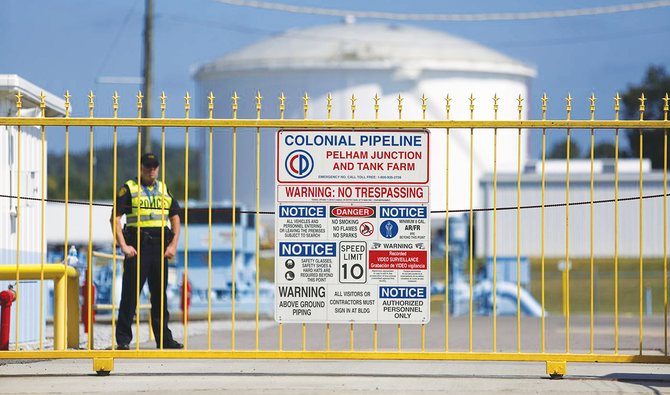
US pipeline company halts operations after cyberattack

The precise nature of the attack was unclear, including who launched it and what the motives were. (AFP/File)
Short Url
Updated 08 May 2021
Follow

US pipeline company halts operations after cyberattack

  • The company transports gasoline, diesel, jet fuel and home heating oil from refineries primarily located on the Gulf Coast through pipelines running from Texas to New Jersey

WASHINGTON: A US energy company says a cyberattack forced it to temporarily halt all operations on a major pipeline that delivers roughly 45 percent of all fuel consumed on the East Coast.

Colonial Pipeline said the attack took place on Friday and also affected some of its information technology systems. The company transports gasoline, diesel, jet fuel and home heating oil from refineries primarily located on the Gulf Coast through pipelines running from Texas to New Jersey.

The Alpharetta, Georgia-based company said it hired an outside cybersecurity firm to investigate the nature and scope of the attack and has also contacted law enforcement and federal agencies.

“Colonial Pipeline is taking steps to understand and resolve this issue,” the company said in a late Friday statement. “At this time, our primary focus is the safe and efficient restoration of our service and our efforts to return to normal operation. This process is already underway, and we are working diligently to address this matter and to minimize disruption to our customers and those who rely on Colonial Pipeline.”

Oil analyst Andy Lipow said the impact of the attack on fuel supplies and prices depends on how long the pipeline is down. An outage of one or two days would be minimal, he said, but an outage of five or six days could causes shortages and price hikes, particularly in an area stretching from central Alabama to the Washington, DC area.

Lipow said a key concern about a lengthy delay would be the supply of jet fuel needed to keep major airports operating, like those in Atlanta and Charlotte, North Carolina.

The precise nature of the attack was unclear, including who launched it and what the motives were. A Colonial Pipeline spokeswoman declined to say whether the company had received a ransom demand, as is common in attacks from cyber criminal syndicates.

Ransomware scrambles a victim organization’s data with encryption. The criminals leave instructions on infected computers for how to negotiate ransom payments and, once paid, provide software decryption keys.
While there have long been fears about US adversaries disrupting American energy suppliers, ransomware attacks are much more common and have been soaring lately.

Mike Chapple, teaching professor of IT, analytics and operations at the University of Notre Dame’s Mendoza College of Business and a former computer scientist with the National Security Agency, said systems that control pipelines should not be connected to the internet and vulnerable to cyber intrusions.

“The attacks were extremely sophisticated and they were able to defeat some pretty sophisticated security controls, or the right degree of security controls weren’t in place,” Chapple said.

Colonial Pipeline said it transports more than 100 million gallons of fuel daily, through a pipeline system spanning more than 5,500 miles.

The FBI and the White House’s National Security Council did not immediately return messages seeking comment. The federal Cybersecurity Infrastructure and Security Agency referred questions about the incident to the company.


Closing Bell: Saudi main market edges up to 11,458 points  

Updated 28 January 2026
Follow

Closing Bell: Saudi main market edges up to 11,458 points  

RIYADH: Saudi Arabia’s Tadawul All Share Index closed Wednesday at 11,458.11, up 0.67 percent, or 76.28 points, driven by selective buying in real estate, insurance, and healthcare stocks. 

The Nomu Parallel Market Index also finished higher, rising 0.44 percent to 23,855.01, while the MSCI Tadawul 30 Index added 0.69 percent to close at 1,543.87.  

Trading activity was moderate, with total volume reaching 280 million shares and a traded value of SR6.32 billion ($1.68 billion). 

On the gainers’ side, Marketing Home Group for Trading Co. surged 8.97 percent to SR59.50, leading advances. Al Ramz Real Estate Co. rose 6.42 percent to SR68.75, while Bupa Arabia for Cooperative Insurance Co. added 5.64 percent to close at SR164.80.   

Al Aziziah REIT Fund gained 5.22 percent to SR4.23, and Alistithmar AREIC Diversified REIT Fund advanced 4.19 percent to SR7.70.   

On the downside, Consolidated Grunenfelder Saady Holding Co. fell 4.27 percent to SR10.10. Thob Al Aseel Co. declined 4.01 percent to SR3.83, while National Gypsum Co. slipped 3.10 percent to SR15.92. 

Tabuk Agricultural Development Co. ended the session down 2.65 percent at SR7.72, and Tourism Enterprise Co. fell 2.54 percent to SR13.81.  

On the announcement front, Al Moammar Information Systems Co. said it has executed the investment agreement to acquire a 15 percent stake in the “Eltizam” electronic insurance platform, with a total investment value of SR19.5 million.   

The company said the subscription and purchase agreement was signed on Jan. 28 between Al Moammar Information Systems and Eltizam Electronic Insurance Brokerage Co., following the board’s earlier approval of the transaction.   

Shares of Al Moammar Information Systems closed at SR180.50, up 1.40 percent.  

In a separate disclosure, Al Moammar Information Systems Co. announced the latest developments related to its participation as a founding shareholder in the establishment of a Shariah-compliant digital bank in Saudi Arabia, known as Vision Bank.   

The company said a subscription agreement for a capital increase was jointly executed on Jan. 28 as part of a broader plan to raise Vision Bank’s capital to SR3 billion from SR1.5 billion.   

Al Moammar Information Systems said the value of its subscription amounts to SR23.75 million, based on a pre-money valuation of SR3.2 billion for Vision Bank.  

Alinma Bank announced that its board of directors has recommended increasing the bank’s capital by 20 percent through the capitalization of reserves and retained earnings via the issuance of bonus shares.   

Under the proposal, shareholders would receive one bonus share for every five shares held, raising the bank’s capital to SR30 billion from SR25.0 billion.   

The bank said the capital increase is intended to strengthen financial solvency and support future growth, subject to approvals from regulators and the extraordinary general assembly.  

Alinma Bank said it has received a no-objection from the Saudi Central Bank.  

Shares of Alinma Bank closed at SR28.26, up 3.21 percent.