

Pakistani army chief holds wide-ranging talks with Saudi crown prince 

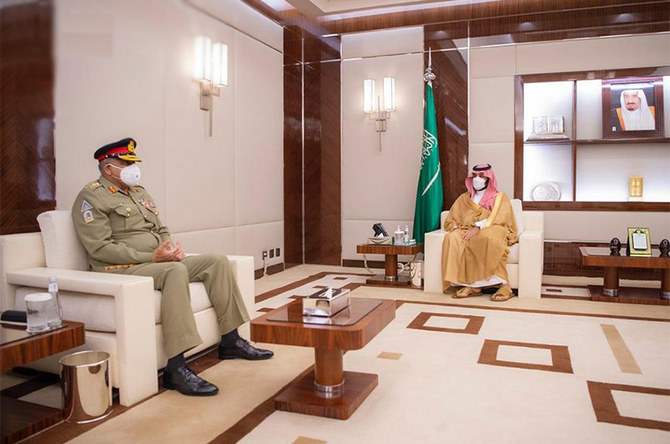
Pakistan's army chief, General Qamar Javed Bajwa (left) meets Prince Mohammed bin Salman bin Abdulaziz, crown prince, deputy prime minister and minister of defense of Saudi Arabia, in Jeddah on May 7, 2021. (Photo courtesy: SPA)
Short Url
Updated 08 May 2021
Follow

Pakistani army chief holds wide-ranging talks with Saudi crown prince 

  • Discusses defense ties, Afghan peace, regional security issues with Prince Mohammed bin Salman 
  • General Bajwa arrived in Saudi Arabia on Wednesday, Pakistani PM will leave on a three-day visit to the kingdom today

ISLAMABAD: Pakistani chief of army staff (COAS) General Qamar Javed Bajwa on Friday met Prince Mohammed bin Salman, crown prince, deputy prime minister and minister of defense of Saudi Arabia, and reviewed bilateral relations, Saudi state news agency SPA reported. 
Bajwa arrived in Saudi Arabia on Wednesday. Pakistani prime minister Imran Khan will also leave on a three-day visit to the kingdom today.
The media wing of the Pakistani military said “matters of mutual interest, regional security situation including recent developments in Afghan Peace Process, bilateral defense, security, collaboration for regional peace and connectivity were discussed” during Friday’s meeting. 
“COAS said that Pakistan is resolute in its commitment to safeguard the sovereignty and territorial integrity of KSA and defense of the two Holy Mosques. The Crown Prince acknowledged Pakistan’s role toward regional peace and stability,” the military said.
“The Crown Prince also said that the relations between KSA & Pakistan are based on bonds of brotherhood & mutual trust and both nations will continue to play their part for peace, stability & betterment of Muslim Ummah.”

SPA reported that the two leaders “reviewed bilateral relations, especially in the military and defense fields, and discussed opportunities for their development, in addition to a number of issues of common concern” during their meeting.
“The meeting was attended by His Royal Highness Prince Khalid bin Salman bin Abdulaziz, Deputy Minister of Defense, His Excellency the Minister of State, Member of the Council of Ministers, National Security Adviser Dr. Musaed bin Muhammad Al-Aiban, His Excellency the Head of General Intelligence, Mr. Khalid bin Ali Al-Humaidan, and the Ambassador of the Custodian of the Two Holy Mosques to Pakistan Mr. Nawwaf bin Saeed Maliki.”
On the Pakistani side, Pakistani ambassador to the kingdom, Lt. Gen. Bilal Akbar, the secretary to the army chief, Major General Muhammad Irfan, and the Defense Attaché of the Pakistani embassy in Riyadh, Brig. Gen. Harun Ishaq Raja, were present.


Pakistan must create 30 million jobs over next decade, World Bank president says

Updated 4 sec ago
Follow

Pakistan must create 30 million jobs over next decade, World Bank president says

  • World Bank President Ajay Banga says failure to create jobs could ‌fuel “illegal ⁠migration ​or domestic ‌instability” in Pakistan 
  • Banga urges Pakistan to fix debt-ridden power sector, describing it as “most urgent ​near-term priority” for country

KARACHI: Pakistan must create up to 30 million jobs over the next decade to turn its youth bulge into an ​economic dividend or risk instability and outward migration, World Bank President Ajay Banga said in an interview with Reuters.

Pakistan is entering the implementation phase of a 10-year Country Partnership Framework (CPF) deal agreed with the World Bank last year, while also working with the International Monetary Fund to stabilize its economy. But Islamabad is still facing mounting pressure to deliver sustained growth and jobs.

“We’re trying to move the bank group as a whole from the idea of projects to the idea of outcomes,” Banga told Reuters in Karachi during a visit this week to Pakistan.

“Job creation is the North Star.”

’GENERATIONAL CHALLENGE’

Pakistan needs to generate 2.5 million to 3 million jobs a year — roughly 25 to 30 million over the ‌next decade — as millions of ‌young people come of age, Banga said. Failure to do so could ‌fuel “illegal ⁠migration ​or domestic ‌instability.”

Banga said Pakistan’s population dynamics mean employment creation will remain a binding constraint on growth over the long term, rather than a secondary policy goal.

“This is a generational challenge,” he said.

The CPF commits around $4 billion a year in combined public and private financing from the World Bank Group, with roughly half expected to come from private-sector operations led by the International Finance Corporation.

Banga said the reliance on private capital reflects a country where the government has limited spending capacity and 90 percent of jobs are created in the private sector.

Pakistan’s job strategy rests on three pillars, Banga said: investment in human and physical infrastructure, business-friendly regulatory reforms, and ⁠expanded access to financing and insurance, particularly for small firms and farmers that typically lack bank credit.

Infrastructure, primary health care, tourism and small-scale agriculture were labor-intensive sectors with ‌the greatest employment potential, he said, adding that farming alone could account for ‍about one-third of the jobs Pakistan needs to create by ‍2050.

A growing pool of freelancers also highlighted Pakistan’s appetite for entrepreneurship, but they need better access to capital, infrastructure ‍and support to scale into job-creating businesses, he said.

The strain is readily visible in the exodus of skilled workers. Nearly 4,000 doctors emigrated from Pakistan in 2025, the highest annual outflow on record, according to Gallup Pakistan data based on Bureau of Emigration figures, underscoring concerns that weak job prospects and poor working conditions are pushing trained professionals abroad.

POWER FIRST

Fixing Pakistan’s power sector is the most urgent ​near-term priority, Banga said, noting that losses and inefficiencies in electricity distribution have limited growth despite improvements in generation capacity.

Pakistan’s power sector has long been plagued by growing debt from distribution losses, weak bill recovery ⁠and delayed government subsidies, which has strained public finances and discouraged private investment. 

The debt has been a recurring focus of IMF-backed reform programs, with successive governments struggling to contain losses while keeping energy affordable.

Banga said progress on privatization and private-sector participation in electricity distribution would be critical to improving efficiency, reducing losses and restoring the sector’s financial viability.

He said rapid rooftop solar adoption, while easing energy costs for households and businesses, risks creating grid instability if distribution reforms are not accelerated.

“Electricity is fundamental to everything — health, education, business and jobs.”

CLIMATE BY DESIGN

Banga said climate resilience should also be embedded into mainstream development spending rather than treated as a standalone agenda.

Pakistan is among the world’s most climate-vulnerable countries, hit repeatedly by floods, heatwaves and erratic monsoons.

Banga said climate-resilient investments should be integrated into infrastructure, housing, water management and agriculture to support jobs while reducing long-term risks.

“The moment you start thinking about climate as separate from housing, food or irrigation, you create a false debate. Just build resilience into what you’re already doing.”

Asked how ‌Pakistan fits into the World Bank’s global portfolio, Banga said he does not view the country through labels such as fragility or crisis, but as a long-term job-creation opportunity.
“We’re in the business of hope,” he said.