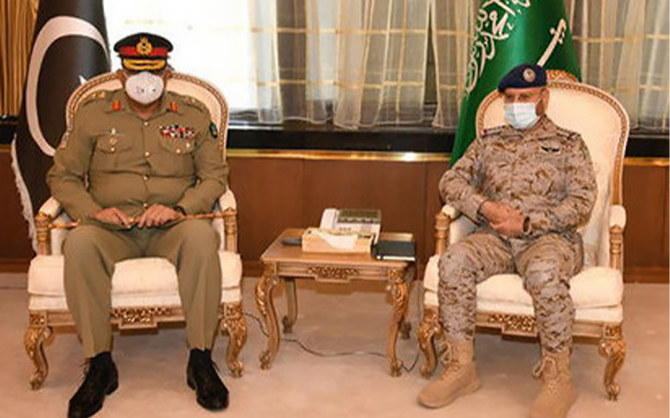
ISLAMABAD: Pakistan Army chief Gen. Qamar Javed Bajwa discussed defense cooperation with the Saudi military chief of staff, Lt. Gen. Fayyad bin Hamed Al-Ruwaili, during a meeting in Riyadh on Wednesday.
Bajwa arrived in the kingdom on Tuesday, just days before a visit by Prime Minister Imran Khan, who is scheduled to be in Saudi Arabia on May 7-9.
During the meeting with Al-Ruwaili, he “emphasized the need to further enhance military-to-military cooperation between the two armed forces and said that Pakistan-KSA cooperation will have positive impact on peace and security in the region,” the Pakistani military’s media wing, ISPR, said in a statement.
“Matters of mutual interest, regional security situation including Afghan Peace Process, defense & security and military to military cooperation were discussed,” ISPR said, adding that the Saudi general assured Bajwa of “full cooperation and support from KSA in all initiatives aimed at improving regional cooperation, peace and stability.”
Pakistan and Saudi Arabia are long-time allies.
The upcoming visit of the Pakistani PM is expected to further strengthen bilateral relations as multiple cooperation agreements, also in defense, are going to be signed, Saudi Ambassador Nawaf bin Said Al-Malki told Arab News last week.
“This visit will further strengthen relations between both countries in all fields, whether it cultural, political, religious, defense or trade,” Al-Malki said. “During this visit, there will be many memoranda of understanding that will definitely enhance the bilateral relations.”
Khan is going to visit Riyadh on the invitation of Saudi Crown Prince Mohammed bin Salman.
His entourage will include several members of the cabinet: Foreign Minister Shah Mahmood Qureshi, Information Minister Fawad Chaudhry, and the PM’s adviser on climate change, Malik Amin Aslam.

General Bajwa discusses defense cooperation with Saudi military chief
https://arab.news/p7y5p
General Bajwa discusses defense cooperation with Saudi military chief
- Bajwa arrived in Riyadh on Tuesday, days before a visit by PM Imran Khan who is scheduled to be in Saudi Arabia on May 7-9
- Al-Ruwaili assured the Pakistani army chief of “full support” for initiatives aimed at improving regional cooperation
Pakistan PM approves framework for National Energy Plan aimed at cutting power costs
- Electricity costs in Pakistan have been a major concern for both industries and domestic consumers
- PM Shehbaz Sharif instructs authorities to expedite privatization of power distribution companies
ISLAMABAD: Prime Minister Shehbaz Sharif on Wednesday approved the framework for a National Energy Plan aimed at ensuring low electricity costs for industries and facilitating domestic consumers, Pakistani state broadcaster reported.
The development took place during a meeting of the Cabinet Committee on Energy in Islamabad presided over by Sharif. The Pakistani prime minister directed all ministries and provincial governments to present a “workable and coordinated” strategy under the proposed plan.
Electricity costs in Pakistan have been a major concern for both industries and domestic consumers. Industrial users often face high tariffs that increase production cost while residential consumers struggle with rising bills that impact household budgets.
“Prime Minister Shehbaz Sharif has given in-principle approval for the formulation of a comprehensive National Energy Plan in consultation with relevant ministries and provincial governments,” Radio Pakistan said in a report.
“He emphasized that the government’s top priorities include ensuring electricity supply to industries at the lowest possible cost and providing facilitation for domestic consumers.”
Sharif also approved the establishment of a dedicated secretariat for the National Energy Plan and gave approval to the framework guidelines for auctioning wheeling charges, it added.
Wheeling charges are fees paid for using another company’s power grid to transmit electricity from a generator to a consumer, covering the cost of transporting electricity over someone else’s network.
The report said Sharif instructed authorities to include the recommendations of the climate change, finance, industries and petroleum ministries into the plan.
Sharif also gave instructions to expedite the privatization of power distribution companies (DISCOs) and urged competitive tariffs for industries to boost production capacity.
Fluctuations in fuel prices, inefficiencies in the power sector, and reliance on imported energy have contributed to high electricity costs in Pakistan in recent years, making energy affordability and stability a key focus for government policies and reforms.
Pakistan has pushed energy sector reforms to tackle long-standing issues like circular debt, power theft, and transmission losses, which have caused blackouts and high electricity costs.
In February, Pakistan developed a new energy policy that it says will help the country attract $5 billion in investment through public-private partnerships.


