

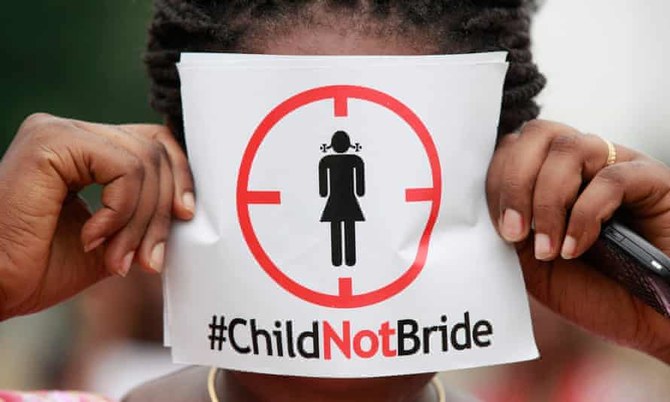
Weak laws let child marriage ‘thrive’ in UK: Rights groups

Laws in England and Wales allow children aged 16 and 17 to marry with parental consent, but campaigners say this loophole makes children vulnerable to grooming and coercion. (AP Photo)
Short Url
Updated 04 May 2021
Follow

Weak laws let child marriage ‘thrive’ in UK: Rights groups

  • Legal loophole that allows children aged 16, 17 in England, Wales to marry with parental consent being exploited
  • Campaigner: ‘Child marriage is a hidden crime, yet it is very much a live issue here in Britain’

LONDON: A legal loophole that allows children aged 16 and 17 in England and Wales to marry with parental consent is being exploited to coerce children into marriages they do not want, rights campaigners have warned.

Some 20 organizations have signed a letter to Prime Minister Boris Johnson calling for the forced marriage law to be strengthened to protect children.

They say there is no legal provision across Britain to prevent religious child marriages from taking place regardless of age.

Campaigners from the Girls Not Brides UK partnership wrote: “Child marriage is often viewed as a ‘developing world issue’ and one that exclusively takes place overseas. The reality is that child marriage is an invisible but thriving issue in the UK today.”

One of the partnership’s co-chairs, Diana Nammi, founder of the Iranian and Kurdish Women’s Rights Organisation, told The Guardian: “Too often under the current inadequate law we see failures by safeguarding professionals and the consequences of child marriage, which disproportionately affect a greater number of girls, usually married to older men.

“The impacts include reduced education and employment opportunities, an increase in mental health problems and a higher incidence of domestic violence.”

Children’s charity Barnardo’s has signed the letter alongside organizations including Karma Nirvana, SafeLives and the Muslim Women’s Network UK.

Campaigner Payzee Mahmod has demanded a ban on child marriage in Britain, saying children should be free to chase their dreams and enjoy educational opportunities.

In 2003, Mahmod was forced into a marriage as a child to a man nearly twice her age. Her sister Banaz, who was married five months earlier aged 17, was murdered three years later after she left the husband she had been forced to be betrothed to by her family.

Mahmod said: “Child marriage is a hidden crime, yet it is very much a live issue here in Britain and one of the most harmful things any child can go through. Girls are raped on their wedding nights by older men and it is common for them to have forced pregnancies — something my sister and I both experienced.

“Given this issue has now been brought directly to the prime minister’s attention there should be no ‘ifs’ or ‘buts’ — it is a straightforward safeguarding issue.”

The activist said she has recently been contacted by young girls who fear they are at risk of a forced marriage. The girls, one as young as 14, are desperate for help.

“Girls have been out of school for so long and it’s really scary to think how many might have fallen under the radar without the oversight of teachers and other professionals,” Mahmod said.

Laws in England and Wales allow children aged 16 and 17 to marry with parental consent. The legal provision has been on the books since before World War II. But campaigners say this loophole makes children vulnerable to grooming and coercion.

The letter from the activists said: “Existing forced marriage law does not automatically protect children from child marriage on account of their age.

“Unacceptably the onus is on the child to secure their own protection under forced marriage law by speaking out against their own family and community which can have dangerous consequences and (which) understandably many children are too terrified to do.”


India’s top court denies bail to 2 Muslim activists after 5 years in jail without trial

Umar Khalid (L) and Sharjeel Imam. (Supplied)
Updated 06 January 2026
Follow

India’s top court denies bail to 2 Muslim activists after 5 years in jail without trial

  • The two student activists were a leading voice in nationwide protests against the citizenship law, which marked one of the most significant challenges to Prime Minister Narendra Modi’s Hindu nationalist government
  • Amnesty International in a statement last year said Khalid’s “imprisonment without trial exemplifies derailment of justice” and is “emblematic of a broader pattern of repression faced by those who dare to exercise their rights to freedom of expression”

NEW DELHI: India’s Supreme Court on Monday denied bail to two Muslim student activists who have spent years in detention without trial over a conspiracy case linked to one of the country’s deadliest outbreaks of religious violence.
Umar Khalid and Sharjeel Imam were arrested five years ago under India’s harsh state security law and accused of conspiring to incite the communal violence that swept parts of Delhi in February 2020. The riots left 53 people dead, most of them Muslims, and took place amid massive months-long protests against a controversial 2019 citizenship law that critics said discriminated against Muslims.
While bail was granted to the other five accused in the same case, the court noted that Khalid and Imam had a “central role in the conspiracy.” It also said that the delay in their trial was not a sufficient ground for granting them bail.
“Umar Khalid and Sharjeel Imam stand on a qualitatively different footing as compared to other accused,” the Supreme Court said in its verdict, according to Bar and Bench, a legal news website.
The two student activists were a leading voice in nationwide protests against the citizenship law, which marked one of the most significant challenges to Prime Minister Narendra Modi’s Hindu nationalist government. Their detention has been widely seen as emblematic of a broader crackdown on dissent under Modi, drawing criticism from rights groups over the use of anti-terror laws against activists and student leaders.
In the months following the riots, police charged several activists and organizers, including Khalid and Imam, under the Unlawful Activities (Prevention) Act, that in the past was used only to quell violent insurgencies but under Modi has been largely used to silence political opposition. Activists and other dissenters targeted under the law can be held in pretrial detention almost indefinitely, often resulting in years of detention until the completion of trial.
Prosecutors representing the Delhi police had strongly opposed Khalid and Imam’s bail request, arguing that the violence was not a spontaneous outbreak but a deliberate plot intended to tarnish India’s global image, and that they made provocative speeches and instigated violence. Khalid and Imam’s lawyers argue that there is no evidence linking them to the violence and deny the charges against them.
Dozens of other Muslims were also charged in similar cases related to the riots and held under prolonged detention. Some of those cases later unraveled because police were unable to provide evidence linking many detainees to the riots.
Last week, eight US lawmakers wrote to India’s ambassador in Washington expressing concern over Khalid’s prolonged pretrial detention. They urged Indian authorities to grant him a fair and timely trial.
International human rights groups have also repeatedly urged Khalid and Imam’s release, saying their detention suppresses dissent and breaches fundamental legal protections.
Amnesty International in a statement last year said Khalid’s “imprisonment without trial exemplifies derailment of justice” and is “emblematic of a broader pattern of repression faced by those who dare to exercise their rights to freedom of expression.”