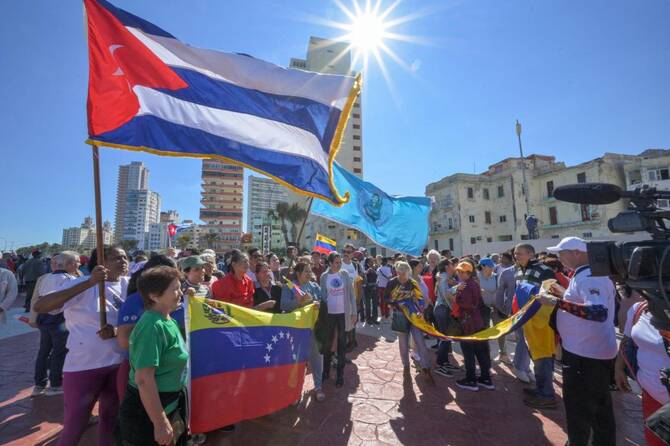
HAVANA: Cuban officials on Monday lowered flags before dawn to mourn 32 security officers they say were killed in the US weekend strike in Venezuela, the island nation’s closest ally, as residents here wonder what the capture of President Nicolás Maduro means for their future.
The two governments are so close that Cuban soldiers and security agents were often the Venezuelan president’s bodyguards, and Venezuela’s petroleum has kept the economically ailing island limping along for years. Cuban authorities over the weekend said the 32 had been killed in the surprise attack but have given no further details.
The Trump administration has warned outright that toppling Maduro will help advance another decades-long goal: Dealing a blow to the Cuban government. Severing Cuba from Venezuela could have disastrous consequences for its leaders, who on Saturday called for the international community to stand up to “state terrorism.”
On Saturday, Trump said the ailing Cuban economy will be further battered by Maduro’s ouster.
“It’s going down,” Trump said of Cuba. “It’s going down for the count.”
Many observers say Cuba, an island of about 10 million people, exerted a remarkable degree of influence over Venezuela, an oil-rich nation with three times as many people. At the same time, Cubans have long been tormented by constant blackouts and shortages of basic foods. And after the attack, they woke to the once-unimaginable possibility of an even grimmer future.
“I can’t talk. I have no words,” 75-year-old Berta Luz Sierra Molina said as she sobbed and placed a hand over her face.
Even though 63-year-old Regina Mendez is too old to join the Cuban military, she said that “we have to stand strong.”
“Give me a rifle, and I’ll go fight,” Mendez said.
Maduro’s government was shipping an average of 35,000 barrels of oil daily over the last three months, about a quarter of total demand, said Jorge Piñón, a Cuban energy expert at the University of Texas at Austin Energy Institute.
“The question to which we don’t have an answer, which is critical: Is the US going to allow Venezuela to continue supplying Cuba with oil?” he said.
Piñón noted that Mexico once supplied Cuba with 22,000 barrels of oil a day before it dropped to 7,000 barrels after US Secretary of State Marco Rubio visited Mexico City in August.
“I don’t see Mexico jumping in right now,” Piñón said. “The US government would go bonkers.”
Ricardo Torres, a Cuban economist at American University in Washington, said that “blackouts have been significant, and that is with Venezuela still sending some oil.”
“Imagine a future now in the short term losing that,” he said. “It’s a catastrophe.”
Piñón noted that Cuba doesn’t have the money to buy oil on the international market.
“The only ally that they have left out there with oil is Russia,” he said, noting that it sends Cuba about 2 million barrels a year.
“Russia has the capability to fill the gap. Do they have the political commitment, or the political desire to do so? I don’t know,” he said.
Torres also questioned whether Russia would extend a hand.
“Meddling with Cuba could jeopardize your negotiation with the US around Ukraine. Why would you do it? Ukraine is far more important,” he said.
Torres said Cuba should open its doors to the private sector and market and reduce its public sector, moves that could help prompt China to step in and help Cuba.
“Do they have an alternative? I don’t think they do,” he said.


![]()

Cuba faces uncertain future after US topples Venezuelan leader Maduro
Short Url
https://arab.news/6y573
Cuba faces uncertain future after US topples Venezuelan leader Maduro
- Cuban soldiers and security agents were often the Venezuelan president’s bodyguards
- Venezuela’s petroleum has kept the economically ailing Cuba limping along for years


Latest updates





© 2026 SAUDI RESEARCH & PUBLISHING COMPANY, All Rights Reserved And subject to Terms of Use Agreement.