



AMMAN: The EU has urged Israel to ensure that Palestinian elections are held across all territories, including East Jerusalem, following a unilateral decision by President Mahmoud Abbas to delay polls planned for May 22.
The Palestinian leader said that the fear Jerusalem would be excluded from the electoral process was the only reason for postponing the poll.
Abbas, 85, blamed Israel for uncertainty about whether it would allow the election to proceed in Jerusalem as well as in the occupied West Bank and Gaza.
The official confirmation of the lists and campaigning was due to begin on April 30.
EU foreign policy chief Josep Borrell described the Palestinian president’s decision late on Thursday as “deeply disappointing.”
“We strongly encourage all Palestinian actors to resume efforts to build on the successful talks between the factions over recent months. A new date for elections should be set without delay,” he said.
Borrell added: “We reiterate our call on Israel to facilitate the holding of such elections across all of the Palestinian territory, including in East Jerusalem.”
He called for calm and restraint from all actors “at this sensitive time,” AFP reported.
“We firmly believe that strong, inclusive, accountable and functioning democratic Palestinian institutions based on respect for the rule of law and human rights are vital for the Palestinian people, for democratic legitimacy and, ultimately, for the two-state solution,” he said.
The decision to delay the poll has further deepened Palestinian divisions.
Prof. Sari Nusseibeh, former president of Al-Quds University and the No. 2 candidate on the Mustaqbal list, called on Abbas “to resign from the Fatah Central Committee and the presidency, allowing the prime minister to restart the negotiations and its committees immediately.”
Nusseibeh a life-long Fatah member, who was also imprisoned by Israel, told Arab News that this is the only way “to avoid an explosion.”
He said: “The Palestinian people are about to explode, and the best way to get out of this dilemma is by insisting on elections and allowing for campaigning to begin. This might require civil disobedience within the democratic structures.”
The Palestinian Central Elections Commission on April 18 condemned the arrests by Israel of candidates, particularly those running in occupied Jerusalem.
Similar to previous elections, Jerusalemites are scheduled to vote at six post offices in East Jerusalem, which hold a maximum capacity of 6,300 voters. This action requires Israeli approval due to post offices remaining under Israeli control.
Dimitri Diliani, a Jerusalem resident and spokesperson of the pro-Dahlan Reform faction, told Arab News that “the cancelation of the elections is a way for Mahmoud Abbas to escape the reality that he and his associates are hated by the Palestinian people. Abbas simply gave up whatever was left of Palestinian democracy, and put it under his autocratic regime and made it a subject of Israeli manipulation.”
The US State Department appeared to distance itself from the Palestinian vote, with spokesperson Ned Price telling reporters in Washington: “The exercise of democratic elections is a matter for the Palestinian people and for the Palestinian leadership to determine. We believe in an inclusive political process.”
Tor Wennesland, UN special coordinator for the Middle East peace process, said that he “fully understand the disappointment of the many Palestinians who have so clearly expressed a desire to exercise their democratic rights after nearly 16 years without elections.”
Wennesland called for a new election date to be announced and “encouraged Palestinians to continue on the democratic path. The holding of transparent and inclusive elections throughout the occupied Palestinian territory, including in East Jerusalem as stipulated in prior agreements remain essential for renewing the legitimacy and credibility of Palestinian institutions.”
A statement from the Turkish Foreign Ministry called on Israel to “end its obstructive policies and to respect the provisions of the 1995 Oslo Interim Agreement so that the Palestinian elections will be conducted at the earliest possibility.”
The ministry said that it hoped the decision to postpone the elections “will not have a negative impact on the intra-Palestinian reconciliation process, to which our country attaches great importance. We encourage all Palestinian groups to continue working toward unity and reconciliation.”
Loud protests took place in Ramallah while Abbas met with his advisers.
Fatah cadres held rallies throughout the West Bank supporting Abbas and his insistence on the inclusion of Jerusalem.
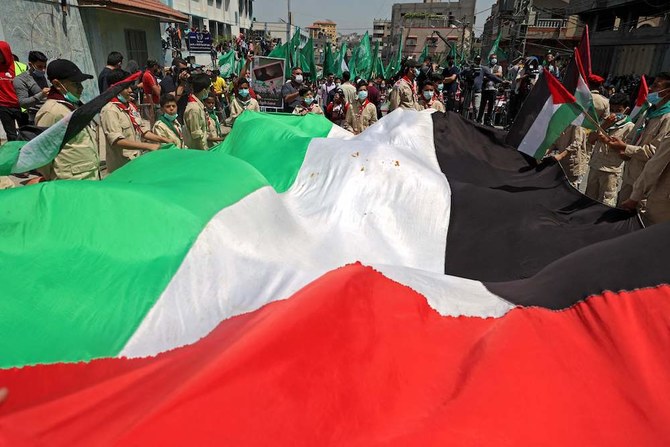
Protests in Gaza and statements by top Hamas officials hint at a difficult summer if the decision to halt the elections is maintained.
Bethlehem Mayor Anton Salman said: “All Palestinians want Jerusalem to be part of the elections.”
He called on the international community to “stand up to Israeli attempts to change the status of Jerusalem.”
Suheir Ismael Farraj, head of a center for training women in media, said on her Facebook page that self-censorship might be the reason more people have not protested.
“As Palestinians, we have learned from childhood to oppose injustice and to resist the Israeli occupiers, but the danger to livelihoods has forced many to stay quiet. The PA needs financial help, parties need their monthly stipend, government employees are afraid to lose their jobs and even civil society organizations are afraid because they don’t want the government to obstruct their work.”


