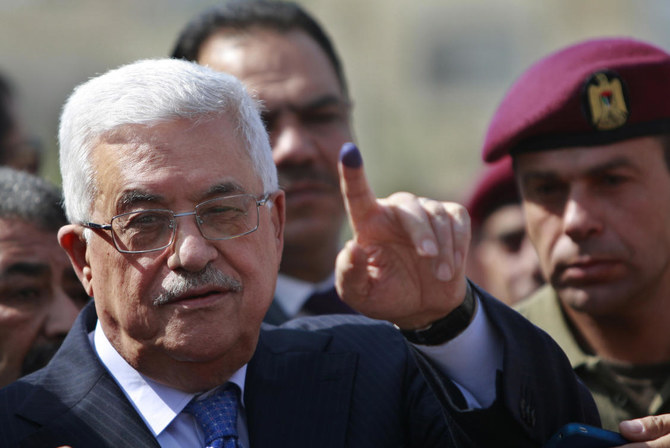
JERUSALEM: President Mahmoud Abbas indicated on Thursday that he supports delaying the first Palestinian elections in 15 years.
The decision would likely spare Abbas’s Fatah party an embarrassing defeat and be quietly welcomed by Israel and Western countries.
Speaking at the start of a meeting of Palestinian factions to decide the issue, Abbas focused his remarks on the voting in east Jerusalem, where Israel has yet to say whether it would allow voting by mail as in past elections and has enforced a ban on Palestinian Authority activities, including campaign events.
“We will take the proper decision to preserve all our rights in east Jerusalem, our eternal capital, including the right to hold parliamentary elections there,” he said in a lengthy speech before the closed-door part of the gathering.
A final decision is expected late Thursday or early Friday.
Cancelling or postponing the vote over Jerusalem could be seen as a pretext, as only a small number of voters in the city would actually require Israel’s permission and several candidates have suggested workarounds.
Abbas said the Palestinian Authority has repeatedly sought assurances from Israel and called on the European Union to exert pressure, to no avail. He said it received a letter from Israel on Thursday saying it could not take a position on the elections because it does not yet have a government of its own following last month’s elections.
The Islamic militant group Hamas, which stands to gain influence in the elections, had earlier rejected the idea of postponing them, saying the Palestinians should explore ways of “forcing the elections in Jerusalem without the permission of or coordination with the occupation.”
It also issued a veiled warning to Abbas without mentioning him by name, saying Hamas “will not be party to any postponement or cancelation and will not provide cover.”
The responsibility for any such decision “will rest with those who take it in response to the veto of the occupation,” it said.
Hamas is expected to perform well in the May 22 parliamentary elections because of widening divisions within Fatah, which has split into three rival lists.
Israel has not said whether it will allow voting in east Jerusalem but has expressed concern about Hamas’ growing strength. Israel and Western countries view Hamas as a terrorist group and would likely boycott any Palestinian government that includes it.
Israel captured east Jerusalem, along with the West Bank and Gaza, in the 1967 war, territories the Palestinians want for their future state. Israel annexed east Jerusalem in a move not recognized internationally and views the entire city as its capital, barring the Palestinian Authority from operating there. The Palestinians consider east Jerusalem their capital.
According to interim peace agreements reached in the 1990s — which were rejected by Hamas — some 6,000 Palestinians in east Jerusalem submit their ballots through Israeli post offices. The other 150,000 can vote with or without Israel’s permission.
Fatah has said the elections cannot be held without Israel giving express permission for east Jerusalem residents to vote. Its opponents have called for creative solutions, such as setting up ballot boxes in schools or religious sites.
But Abbas appeared to rule that out on Thursday, joking that the Palestinians would not vote in “the Hungarian Embassy.”
The dispute has taken on greater import since the start of the holy month of Ramadan, as Muslim protesters have clashed with Israeli police over restrictions on gatherings.
The elections, and a presidential vote planned for July 31, offer a rare opportunity for the Palestinians to empower a new leadership and potentially chart a different course in their stalled, decades-long struggle for independence.
The 85-year-old Abbas and his inner circle of Fatah figures, now in their 60s and 70s, have dominated the Palestinian Authority for nearly two decades. They have failed to advance Palestinian hopes for statehood, heal a 13-year internal rift with Hamas, lift the Israeli-Egyptian blockade of Gaza or empower a new generation of leaders.
The last elections, held in 2006, saw Hamas win a landslide victory after campaigning as a scrappy underdog untainted by corruption. That sparked an internal crisis culminating in Hamas’ seizure of Gaza the following year, which confined Abbas’ authority to parts of the Israeli-occupied West Bank.
Hamas’ popularity has fallen in the years since, as conditions in Gaza have steadily deteriorated. But it has remained unified and disciplined even as Fatah has split into three rival parliamentary lists.
Hamas does not recognize Israel’s right to exist and has fought three wars with it since seizing control of Gaza. It has also carried out scores of attacks over the last three decades that have killed hundreds of Israeli civilians.


![]()

Palestinian leader indicates elections will be postponed
Short Url
https://arab.news/r87m5
Palestinian leader indicates elections will be postponed
- Decision is likely spare Fatah party an embarrassing defeat and be welcomed by Israel and Western countries
- Israel has not said whether it will allow voting in east Jerusalem but expressed concern about Hamas' growing strength


Latest updates


© 2026 SAUDI RESEARCH & PUBLISHING COMPANY, All Rights Reserved And subject to Terms of Use Agreement.