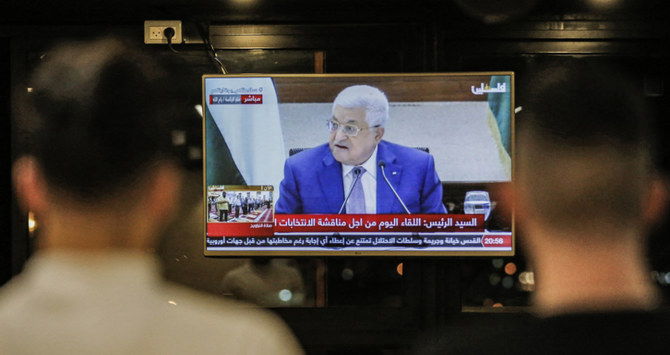
Palestinian polls postponed until Jerusalem voting guaranteed: Abbas

Palestinian president Mahmud Abbas postponed polls. (AFP)
Short Url
Updated 30 April 2021
Follow

Palestinian polls postponed until Jerusalem voting guaranteed: Abbas

  • Abbas said the vote could not go ahead because Israel had provided no assurances regarding Jerusalem

RAMALLAH, Palestinian Territories: Palestinian president Mahmud Abbas said Friday that elections had been postponed until there was a guarantee voting can take place in Israeli-annexed east Jerusalem, further delaying polls in a society which last voted in 2006.
Addressing a meeting of Palestinian factions, Abbas said he had urged the international community to push Israel to allow campaigning and voting in east Jerusalem, an area annexed by the Jewish state in 1967 which Palestinians claim as their future capital.
But Abbas said the vote could not go ahead because Israel had provided no assurances regarding Jerusalem ahead of the legislative and presidential polls — called for May 22 and July 31 respectively.
“We decided to postpone the election until there is a guarantee on Jerusalem,” the 85-year-old Palestinian leader said.
Palestinians in the Israeli-occupied West Bank and blockaded Gaza Strip have voiced hope that elections after a 15-year wait could help repair their fractured political system.
The polls were called following an agreement between Abbas’s secular Fatah movement, which controls the West Bank and its long standing rival Hamas, which runs the Israeli-blockaded Gaza Strip.
Hamas said Wednesday that it would reject “any attempt to postpone the elections.”
A delay risks inflaming tensions in the politically fractured Palestinian society and protesters in Ramallah swiftly denounced Abbas’s move.
“We have an entire generation of young people that doesn’t know what elections mean,” protester Tariq Khudairi told AFP.
“This generation has the right to elect its leaders,” he said.
Palestinians also clashed in Jerusalem with Israeli police, who used tear gas to disperse protesters outside the walled Old City.
Abbas critics have charged that he would use the Jerusalem issue to buy time as Fatah’s prospects have been threatened by splinter factions.
Hamas, considered a terrorist group by most Western state, was seen as better organized than Fatah and well placed to gain ground the West Bank.
Abbas also has faced challenges from Fatah splinter factions, including one led by Nasser Al-Kidwa, a nephew of iconic Palestinian leader Yasser Arafat, and another by a powerful, exiled former Fatah security chief, Mohammed Dahlan.

During the last Palestinian election, east Jerusalem residents cast ballots on the outskirts of the city and thousands voted in post offices, a symbolic move agreed to by Israel.
Israel’s foreign ministry said this week that elections were “an internal Palestinian issue, and that Israel has no intention of intervening in them nor preventing them.”
But it made no comment on voting in Jerusalem, the city it describes as its “undivided capital” and where it now bans all Palestinian political activity.
Abbas told PLO leaders that he had received a message from Israel saying it could not offer guidance on the Jerusalem issue because the Jewish state currently had no government.
Israel is itself mired in its worst ever political crisis, with no government yet formed following inconclusive March 23 elections.
Abbas dismissed the Israeli message as “nonsense.”
Speaking to reporters before Friday’s announcement, Palestinian journalist and Abbas critic Nadia Harhash said using Jerusalem to justify postponement “is definitely not a smart move for the PA.”
Harhash, an election candidate in anti-Abbas faction, argued it would give Israel de facto veto power over the Palestinian right to vote.
Hamas said a delay amount to a surrender to “the (Israeli) occupation’s veto.”
Tensions in Jerusalem surged at the weekend as Palestinians clashed with Israeli police over the right to gather in an Old City plaza after evening Ramadan prayers.

Following several days of unrest that left dozens injured, Israeli police removed the barricades blocking the staired plaza at Damascus Gate, allowing Palestinians to resume their gatherings.
But heavier clashes resumed on Thursday following Abbas’s announcement, with two people were arrested, Jerusalem police said.
The elections have been seen in part as a unified effort by Hamas and Fatah to bolster international faith in Palestinian governance ahead of possible renewed US-led diplomacy under President Joe Biden, after four years of Donald Trump that saw Washington endorse key Israeli objectives.
Analysts argued that Abbas had hoped the elections would allow Fatah and Hamas to continue sharing power, but felt threatened by the emergence of strong splinter factions and the rise of new groups critical of his leadership.
The main challenges to Abbas include the “Freedom list” headed by Kidwa, which has been endorsed by Marwan Barghouti, a popular leader serving multiple life sentences in Israel prison.
Ex Fatah security chief Dahlan, who poses another threat, has been credited with bringing coronavirus vaccines into Gaza and distributing financial aid across the enclave, as well as in the West Bank.


Inaction over UAE’s role is prolonging ‘worst proxy war in the world,’ Sudan justice minister says

Updated 58 min 44 sec ago
Follow

Inaction over UAE’s role is prolonging ‘worst proxy war in the world,’ Sudan justice minister says

  • Had international community characterized it as ‘military rebellion’ and countered Emirati sponsorship of ‘terrorist militia’ it would not have endured, he tells UN Human Rights Council
  • He accuses paramilitary Rapid Support forces of ‘targeting basic infrastructure, strategic facilities and public services,’ and ‘atrocities beyond our capacity to describe’

NEW YORK CITY: Sudan’s justice minister on Wednesday blamed the prolongation of the near-three-year conflict in his country on what he described as the failure of the international community to properly label the war as a rebellion.

He also accused the UAE of sponsoring and arming a militia, the Rapid Support Forces, he said was responsible for widespread abuses.

“The war has outstayed its welcome and it should not have gone on for this long had the international community, and particularly the UN and its bodies, fulfilled their responsibility in rightly characterizing this military rebellion,” said Abdullah Mohammed Dirif, “and had they called a spade a spade and countered the Abu Dhabi government, which sponsored this terrorist militia and provided it with high-tech arms and provided it with mercenaries.”

Speaking during the high-level segment of the 61st session of the UN Human Rights Council in Geneva, he warned that “the misleading characterization of this war has given a green light for the militia to keep its flagrant violations.”

The minister, who said he was speaking “on behalf of the government of Sudan and its people,” described the conflict between the Sudanese Armed Forces and the RSF, which began in April 2023, as “one of the worst proxy wars in the world,” which had “targeted the very existence of Sudan and its people.”

The RSF has “continued its methodic targeting of basic infrastructure and strategic facilities and all public services,” Dirif said, adding that “the aim is to displace civilians against whom it has committed atrocities beyond our capacity to describe them.

“The violations and crimes of the militia are going unabated. Yesterday it invaded Moustahiliya region in northern Darfur. It targeted civilians, killed them. It looted. It scorched villages and cities.”

Sudan’s military was “conducting its constitutional responsibility by standing up to the militia, protecting the civilians, preserving the unity of the country and the rule of law,” he said, and it remains “committed to international humanitarian law and the rules governing military engagement, and taking into account proportionality principles in order to protect civilians.”

Khartoum remains “open to genuine efforts which aim to end the war and the rebellion” based on a road map presented by the president of the Transitional Sovereignty Council, and a peace initiative submitted by the prime minister to the UN Security Council on Dec. 22, he added.

Dirif stressed his government’s commitment to continued “cooperation and coordination with human rights mechanisms in Sudan,” including the presence of the UN’s Office of the High Commissioner for Human Rights in the country and the UN special rapporteur on the human rights situation in Sudan.

“We recall, nationally, that achieving justice and redress to victims and ensuring impunity is a top priority for us,” he said, adding that authorities had made progress by investigating violations of national laws and international humanitarian laws.

He also underscored Sudan’s “commitment to continue facilitating and expediting delivery of humanitarian assistance to those affected by the war, including those under the control of the rebellious militia.”

Later, Sudan’s representative to the UN in Geneva exercised his right of reply and responded to prior remarks by the representative from the UAE.

“This is not a mere accusation, it is a well-known fact that is predicated on a number of evidence and documented proofs,” he said, referring to the UAE’s sponsorship of the RSF.

He cited in particular a report by a UN panel of experts on Sudan published on Jan. 15, 2024, which he described as “an official document of the Security Council” that referred to “lines of transferring weapons from Abu Dhabi International Airport” based on “clear-cut evidence.”

Other major international organizations and Sudan’s national commission of inquiry have provided further proof, he added, and Khartoum had submitted “a number of complaints, with proof, to the Security Council of the proven sabotage by the Abu Dhabi authority.”

The Sudanese representative continued: “It is paradoxical that the same authority that is sponsoring criminal militia, that the whole world is seeing and is attesting to its crimes, is now talking about peace in the Sudan. Peace is a noble value, that you have to be full of peace before you talk about it.

“The people of Sudan are only requesting this country stop sponsoring this criminal militia that is killing the innocent people in my country on a daily basis.”

The UAE has denied accusations that it provides military support to armed groups in Sudan, and says it supports efforts to achieve a peaceful resolution to the conflict.