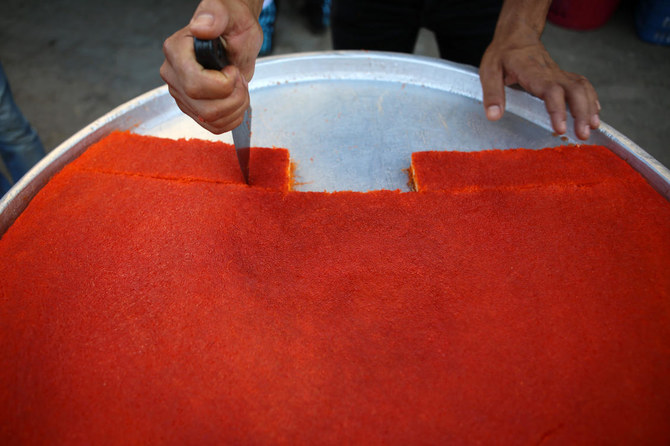
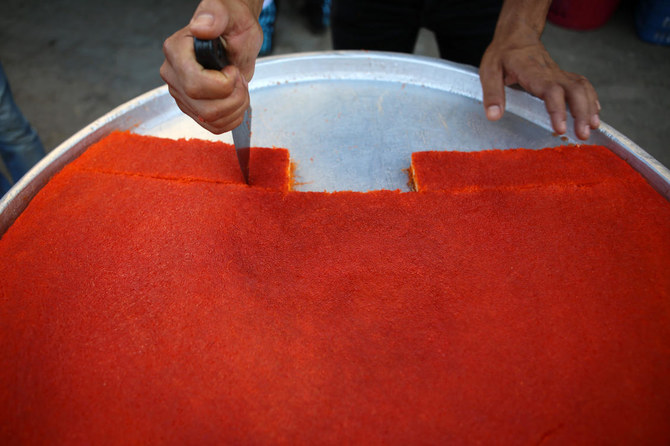
NABLUS: Nablus, in the northern West Bank, is known as the capital of sweets in Palestine. The kunafa made in the city is popular in all Arab countries, as well as in the West.
During the month of fasting, kunafa is part of an authentic Palestinian Ramadan and becomes a special treat for the faithful, who have it for iftar.
From the early morning hours, Mohammed Al-Nimr is busy preparing qatayef dough for customers of his shop on Al-Nasr Street.
“Qatayef is a dessert that we only prepare in the holy month, and customers travel from everywhere to buy it here at my shop,” said Al-Nimr, while pouring the liquid dough onto a hot plate.
Mazen Halawa, 73, stands behind several large pots filled with Zainab’s fingers, cheese-stuffed pastries, and awama, or sweet doughnut balls, which he has been making for 50 years. During Ramadan, demand for these desserts increases greatly.
Halawa said: “Every household consumes these sweets during Ramadan. Nablus is known for its sweets, and their prices are reasonable.”
During the holy month, many restaurants also produce sweets to meet the huge demand.
However, shop owners have had reason to complain of low sales due to the outbreak of the pandemic and the ensuing partial closures imposed in the West Bank.
Majdi Arafat, owner of a sweet shop in Nablus, said: “The number of buyers this year is much lower compared to previous years.”
Arafat attributes the decline in shoppers to the deteriorating economic situation caused by the pandemic and lockdowns.
The dessert culture of Nablus has spread to various other Palestinian cities and Arab and Islamic countries.
Taher Bakeer, a researcher specializing in the history of Nablus, said: “The Abaza sweet shop was the most famous in Nablus. A famous sweet maker in the Levant told me that Abaza was the one that taught us how to make kunafa. The Turks took it from the confectioners of the Levant after we brought it there from Nablus.”
Historian and traveler Ibn Battuta wrote about Nablus in his book: “It is an industrial town, famous for making sweets and tahina, in addition to soap.”
In addition to the ones previously mentioned, the most popular sweet delicacies made in the city are cheese pies, cream pies, khudoud Al-sitt, kullaj, shafaef Al-sitt, aratis with milk, Al-burma, sira bint Al-malek, bin narayn, karakeesh, harisa, and qazza.

Why Nablus is known as Palestine's capital of sweet treats
https://arab.news/bhgcn
Why Nablus is known as Palestine's capital of sweet treats
- “Qatayef is a dessert that we only prepare in the holy month, and customers travel from everywhere to buy it here at my shop,” said Al-Nimr
- Halawa said: “Every household consumes these sweets during Ramadan. Nablus is known for its sweets, and their prices are reasonable”
‘The Wild Within’ sees artists breathe new life into Mideast buildings
DUBAI: Lens-based artist Ryan Koopmans and digital artist Alice Wexell are staging a showcase at Dubai’s Leila Heller Gallery that breathes new life into regional buildings.
The series of digital artworks is part of the exhibition “The Wild Within,” featuring images of old structures in Beirut, Istanbul, and Abu Dhabi filled with wild flowers.
Two of the largest works, “Heartbeats” and “The Wish,” are displayed using Ventana, a microLED architectural display surface created by visual technology company Megapixel.
The former artwork depicts the entrance hall of Qasr Al-Watan, the UAE’s presidential palace in Abu Dhabi, while the latter reimagines the upper floors of the Emirates Palace Mandarin Oriental in Abu Dhabi.
“Each building we work with comes to us through a combination of research, travel, and intuition,” the artists told Arab News in a joint statement.
“We are drawn to structures that carry both emotional and historical resonance, often buildings that once embodied human ambition and now exist in a state of quiet transformation.”
Koopans and Wexell made sure to research the context of each building they choose to recreate, saying “an old villa in Jeddah or a former school in Sharjah each hold their own cultural memory, influencing everything from the lighting and atmosphere to the plants and flowers that we digitally sculpt and implement into the photographs.”
The hypnotic works depict the interior of buildings in the region, with digitally rendered flowers carpeting the floor in a bid to “(reimage) these spaces (and) explore the relationship between nature, place, and time, while celebrating each site as a unique work of architecture with its own spirit and story,” the artists said.
Koopmans is of dual Canadian and Dutch heritage, while Wexell is Swedish and based in Stockholm, so it is noteworthy that both artists chose to explore the Middle East for their latest project.
“In the Middle East especially, the architecture reflects a layered past that merges different styles and eras, while also expressing a sense of renewal and forward-looking energy, particularly in the region’s fantastic contemporary buildings. We are drawn to the symmetry, geometry and patterns that are found not only in nature itself, but in the architectural language of the region both past and present,” they said.
The series — featuring works such as “Adore You,” “Between Worlds,” and “Blossom of the Ancestors” — explores contrasts between the natural world and human-made forms, as well as the traditional and contemporary worlds.
“We are interested in how these elements coexist and merge into one another, creating a sense of hyperrealism that feels both familiar and imaginary. By merging photography with digital sculpture, the artworks question where the boundary lies between documentation and invention, and how technology can extend rather than replace our sense of the natural world.”
Although the scale of the artworks ensures they leave the viewer entranced, it did pose challenges, according to the artists.
“Presented at a large scale, every texture in these artworks becomes visible, which can be demanding but is also incredibly rewarding. The magnified detail allows the visceral and atmospheric layers of the pieces to come through with greater impact,” they said, adding that each piece took “many months” to create.
“Ultimately, we want our collectors to experience a sense of wonder and contemplation, as if they are standing inside a dream that feels both entirely real yet unreal.”
The exhibition runs until Jan. 15, 2026.