

Trump orders blockade of ‘sanctioned’ Venezuela oil tankers

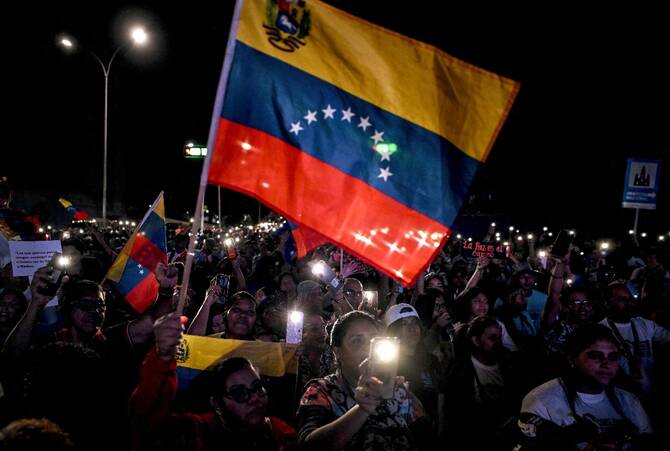
Supporters of Venezuela's President Nicolas Maduro wave a Venezuelan flag during a rally demanding peace in Caracas. (AFP)
Short Url
Updated 17 December 2025
Follow

Trump orders blockade of ‘sanctioned’ Venezuela oil tankers

  • The US opened a new front in the campaign, seizing an oil tanker that had left Venezuela and announcing sanctions on several other vessels and companies associated with the Venezuelan oil industry

WASHINGTON: US President Donald Trump announced Tuesday a blockade of “sanctioned oil vessels” heading to and leaving Venezuela, sharply escalating his pressure campaign against Caracas while issuing new demands for access to the country’s crude.
The United States has for months been building a major military deployment in the Caribbean — with the stated goal of combatting Latin American drug trafficking, but taking particular aim at Venezuela.
Caracas views the operation as a campaign to push out leftist strongman Nicolas Maduro — whom Washington and many nations view as an illegitimate president — and to “steal” Venezuelan oil.
Tensions have been mounting for weeks as Trump signals intent to launch military action inside Venezuela, ominously declaring that the country’s airspace should be considered “closed” and that efforts at halting drug trafficking “on land” would begin soon.
Last week, the United States opened a new front in the campaign, seizing an oil tanker that had left Venezuela and announcing sanctions on several other vessels and companies associated with the Venezuelan oil industry.
“Today, I am ordering A TOTAL AND COMPLETE BLOCKADE OF ALL SANCTIONED OIL TANKERS going into, and out of, Venezuela,” Trump wrote Tuesday evening on his Truth Social platform.
Referring to the many Navy and Marine forces assembled in the Caribbean — including the world’s largest aircraft carrier — Trump warned “Venezuela is completely surrounded by the largest Armada ever assembled in the History of South America.”

- ‘Stolen’ oil -

With Venezuela’s economy heavily reliant on crude exports, the move to cripple its oil sector is likely to further ramp up pressure on Maduro.
But Trump on Tuesday pointed to another goal — regaining US access to Venezuelan oil production.
The US armada “will only get bigger,” Trump said, until Venezuela returns “to the United States of America all of the Oil, Land, and other Assets that they previously stole from us.”
He did not specify what oil or land he was referring to, but Venezuela in the 1970s nationalized its oil industry.
Later, under Maduro’s predecessor Hugo Chavez, companies were forced to cede majority control to the Venezuelan state oil company, PDVSA.
A spokesperson for US company Chevron, which still operates in Venezuela under a special sanctions waiver, said Tuesday that its operations “continue without disruption and in full compliance with laws and regulations applicable to its business.”
Caracas blasted Trump’s announcement on Tuesday, saying he aimed at “stealing the riches that belong to our homeland.”
Venezuela has been sidestepping US oil sanctions for years, selling crude at a discounted price on the black market, mainly to China.
Venezuela is estimated to have oil reserves of some 303 billion barrels, according to the Organization of the Petroleum Exporting Countries (OPEC) — more than any other nation.
“If there are no oil exports, it will affect the foreign exchange market, the country’s imports... There could be an economic crisis,” Elias Ferrer of Orinoco Research, a Venezuelan advisory firm, told AFP recently.
“Not just a recession, but also shortages of food and medicine, because we wouldn’t be able to import.”

- ‘Terrorist’ regime -

The Pentagon has defended its operation, dubbed “Southern Spear,” by arguing it is targeting drug cartels designated under the Trump administration as foreign terrorist organizations.
The US military has thus far only struck boats in international waters it claims are trafficking drugs, killing at least 95 people, in what many experts say amount to extrajudicial killings.
But Trump’s administration has also given terrorist designation to an alleged Venezuelan group, the Cartel de los Soles — and claims that Maduro is its leader.
“For the theft of our Assets, and many other reasons, including Terrorism, Drug Smuggling, and Human Trafficking, the Venezuelan Regime has been designated a FOREIGN TERRORIST ORGANIZATION,” Trump said.


WHO chief says reasons US gave for withdrawing ‘untrue’

Updated 25 January 2026
Follow

WHO chief says reasons US gave for withdrawing ‘untrue’

  • US Secretary of State Marco Rubio and US Health Secretary Robert F. Kennedy Jr. announced in a joint statement Thursday that Washington had formally withdrawn from the WHO
  • And in a post on X, Tedros added: “Unfortunately, the reasons cited for the US decision to withdraw from WHO are untrue”

GENEVA: The head of the UN’s health agency on Saturday pushed back against Washington’s stated reasons for withdrawing from the World Health Organization, dismissing US criticism of the WHO as “untrue.”
Tedros Adhanom Ghebreyesus warned that US announcement this week that it had formally withdrawn from the WHO “makes both the US and the world less safe.”
And in a post on X, he added: “Unfortunately, the reasons cited for the US decision to withdraw from WHO are untrue.”
He insisted: “WHO has always engaged with the US, and all Member States, with full respect for their sovereignty.”
US Secretary of State Marco Rubio and US Health Secretary Robert F. Kennedy Jr. announced in a joint statement Thursday that Washington had formally withdrawn from the WHO.
They accused the agency, of numerous “failures during the Covid-19 pandemic” and of acting “repeatedly against the interests of the United States.”
The WHO has not yet confirmed that the US withdrawal has taken effect.

- ‘Trashed and tarnished’ -

The two US officials said the WHO had “trashed and tarnished” the United States, and had compromised its independence.
“The reverse is true,” the WHO said in a statement.
“As we do with every Member State, WHO has always sought to engage with the United States in good faith.”
The agency strenuously rejected the accusation from Rubio and Kennedy that its Covid response had “obstructed the timely and accurate sharing of critical information that could have saved American lives and then concealed those failures.”
Kennedy also suggested in a video posted to X Friday that the WHO was responsible for “the Americans who died alone in nursing homes (and) the small businesses that were destroyed by reckless mandates” to wear masks and get vaccinated.
The US withdrawal, he insisted, was about “protecting American sovereignty, and putting US public health back in the hands of the American people.”
Tedros warned on X that the statement “contains inaccurate information.”
“Throughout the pandemic, WHO acted quickly, shared all information it had rapidly and transparently with the world, and advised Member States on the basis of the best available evidence,” the agency said.
“WHO recommended the use of masks, vaccines and physical distancing, but at no stage recommended mask mandates, vaccine mandates or lockdowns,” it added.
“We supported sovereign governments to make decisions they believed were in the best interests of their people, but the decisions were theirs.”

- Withdrawal ‘raises issues’ -

The row came as Washington struggled to dislodge itself from the WHO, a year after US President Donald Trump signed an executive order to that effect.
The one-year withdrawal process reached completion on Thursday, but Kennedy and Rubio regretted in their statement that the UN health agency had “not approved our withdrawal and, in fact, claims that we owe it compensation.”
WHO has highlighted that when Washington joined the organization in 1948, it reserved the right to withdraw, as long as it gave one year’s notice and had met “its financial obligations to the organization in full for the current fiscal year.”
But Washington has not paid its 2024 or 2025 dues, and is behind around $260 million.
“The notification of withdrawal raises issues,” WHO said Saturday, adding that the topic would be examined during WHO’s Executive Board meeting next month and by the annual World Health Assembly meeting in May.
“We hope the US will return to active participation in WHO in the future,” Tedros said Saturday.
“Meanwhile, WHO remains steadfastly committed to working with all countries in pursuit of its core mission and constitutional mandate: the highest attainable standard of health as a fundamental right for all people.”