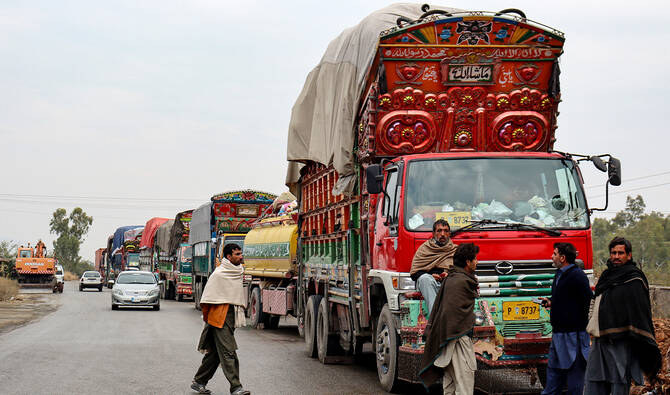

KARACHI: Pakistan’s ongoing transportation strike has the potential to cause economic losses of up to $1 billion and threaten macroeconomic stability in the country, a leading economist warned this week.
Transport unions have been protesting against stricter enforcement of axle-load limits — legal caps on how much weight trucks can carry — as well as increases in toll taxes and what they describe as heavy-handed policing on highways and motorways.
The strike, which began on Dec. 8, is now in its tenth day. It has slowed the flow of goods between ports, industrial centers and markets, raising concerns over supply chains in an economy heavily reliant on road transport for domestic trade and exports. Trucking is the backbone of Pakistan’s logistics system, moving food, fuel, raw materials and manufactured goods.
“We are expecting a tremendous impact of the ongoing transportation strike,” Ahsan Mehanti, CEO of Arif Habib Commodities, told Arab News on Tuesday.
“I believe that the major impact could be to the tune of $1 billion. And the reason behind that is primarily Karachi being a business hub will be most impacted with the ongoing strike.”
While a section of the transporters, the All Pakistan Goods Transport Association (APGTA) called off the strike after successful talks with the Punjab government on Friday, the rest of the transporters have vowed to continue the disruption.
Manufacturers and exporters from the textile industry, which earns Pakistan the highest amount in exports, have estimated their daily losses at more than $60 million.
Kamran Arshad, chairman of the All Pakistan Textile Mills Association (APTMA), said these losses were on account of disruption to exports as well as demurrage and detention charges that affected traders are bound to pay at local ports.
“I have estimated disruption to as much as $60 million ($540 million for nine-day losses) worth of exports and demurrage and detention charges of up to $300 per container per day stuck at ports,” Arshad said.
Arshad lamented that the textile industry was facing a critical situation as raw materials and essential inputs were stuck at ports and not reaching factories. On the other hand, finished export consignments were also unable to reach ports, he said.
“Containers are stuck at mills, ports and depots and inventories are building up,” the APTMA chief said. “And backlogs are growing by the day.”
Pakistan Textile Exporters Association (PTEA) Patron-in-Chief Khurram Mukhtar calculated Pakistan’s monthly average textile exports at $1.5 billion.
“An eight-day transport shutdown alone has already caused approximately $400 million in export losses, with severe supply chain disruptions on top,” Mukhtar said.
’BIG HIT’ TO EXPORTS
Prime Minister Shehbaz Sharif has tasked his government to ensure sustained economic growth through an export-driven economy. However, Pakistan’s exports have shown far from promising results, falling by 15 percent to $2.4 billion in November, according to data by the Pakistan Bureau of Statistics (PBS).
From the July-November period of this fiscal year, the country’s exports declined by six percent to $12.8 billion, while imports surged by 13 percent to $28.3 billion. This widened the trade deficit by 37 percent to $15.5 billion.
Arshad said other than financial losses, the trade industry was suffering from “serious reputational damage” when it came to international buyers due to the strike’s disruptions.
“Missed delivery schedules result in cancelations and loss of future orders,” he told Arab News. “And once a buyer is lost, it is extremely difficult to regain their confidence.”
Rehan Hanif, president of the Karachi Chamber of Commerce and Industry (KCCI), agreed.
“Our exports are already in trouble forcing us to run after dollars, so the exports are going to take a big hit,” Hanif explained.
He urged the government to engage transporters and address their “genuine” demands immediately.
Information Minister Attaullah Tarar and Finance Adviser Khurram Schehzad did not respond to queries sent by Arab News till the filing of this report.
Hanif said the prolonged strike had created a huge backlog of cargos at local ports.
“They would have no space for more containers if this strike persisted for a couple of more days,” he said. “Pakistan’s daily losses from the strike are running in billions of rupees.”
POSSIBLE INFLATION SPIKE
However, Karachi Port Trust spokesperson Shariq Amin Farooqui rejected Hanif’s claims, saying that cargo “is coming and leaving” the country’s largest port smoothly.
Pakistan’s inflation rose by 6.1 percent in November and is expected to fall in the SBP’s target range of 5 to 7 percent this financial year, which is ending in June.
Pakistan’s current account balance reported a $112 million deficit in October from an $83 million surplus in September, according to the central bank.
Mehanti warned the strike could pose dangers to Pakistan’s hard-earned macroeconomic stability.
“Inflation will be higher, and the current account deficit will be higher due to challenging economic situation,” he said.