

‘The Wild Within’ sees artists breathe new life into Mideast buildings

'Infinite Blooms' by Ryan Koopmans and Alice Wexell. (Supplied) 
Short Url
Updated 17 December 2025
Follow

‘The Wild Within’ sees artists breathe new life into Mideast buildings

DUBAI: Lens-based artist Ryan Koopmans and digital artist Alice Wexell are staging a showcase at Dubai’s Leila Heller Gallery that breathes new life into regional buildings.

The series of digital artworks is part of the exhibition “The Wild Within,” featuring images of old structures in Beirut, Istanbul, and Abu Dhabi filled with wild flowers.

Two of the largest works, “Heartbeats” and “The Wish,” are displayed using Ventana, a microLED architectural display surface created by visual technology company Megapixel.
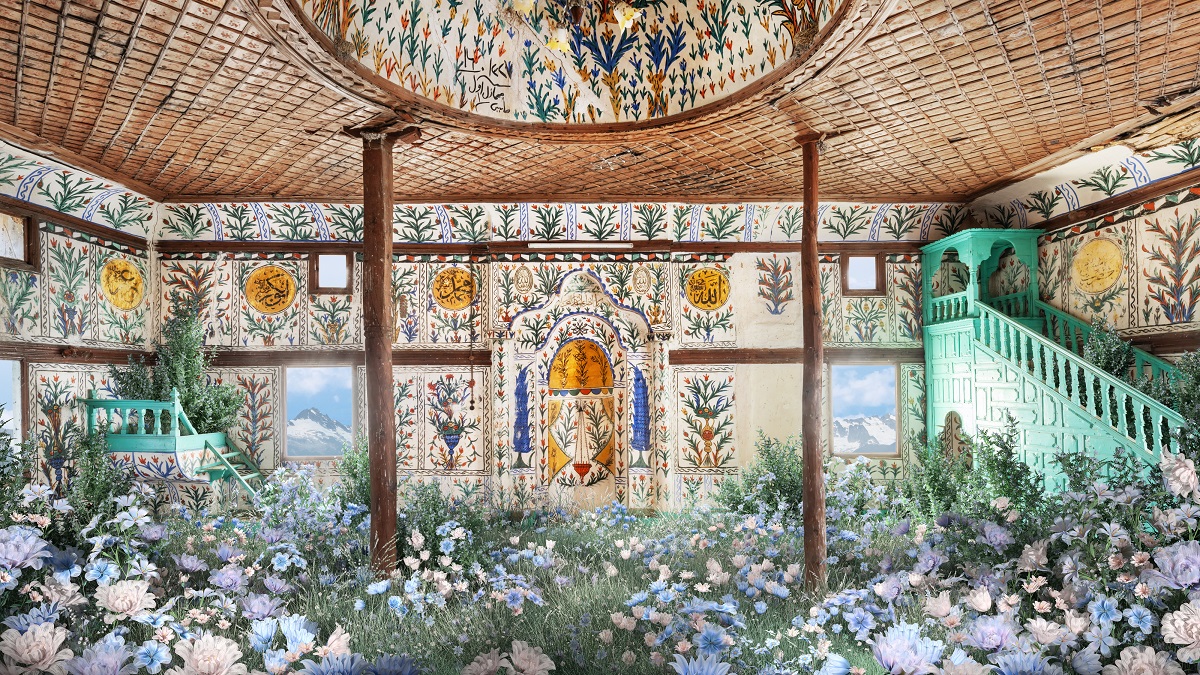


'Around Us' by Ryan Koopmans and Alice Wexell. (Supplied) 

The former artwork depicts the entrance hall of Qasr Al-Watan, the UAE’s presidential palace in Abu Dhabi, while the latter reimagines the upper floors of the Emirates Palace Mandarin Oriental in Abu Dhabi.

“Each building we work with comes to us through a combination of research, travel, and intuition,” the artists told Arab News in a joint statement.
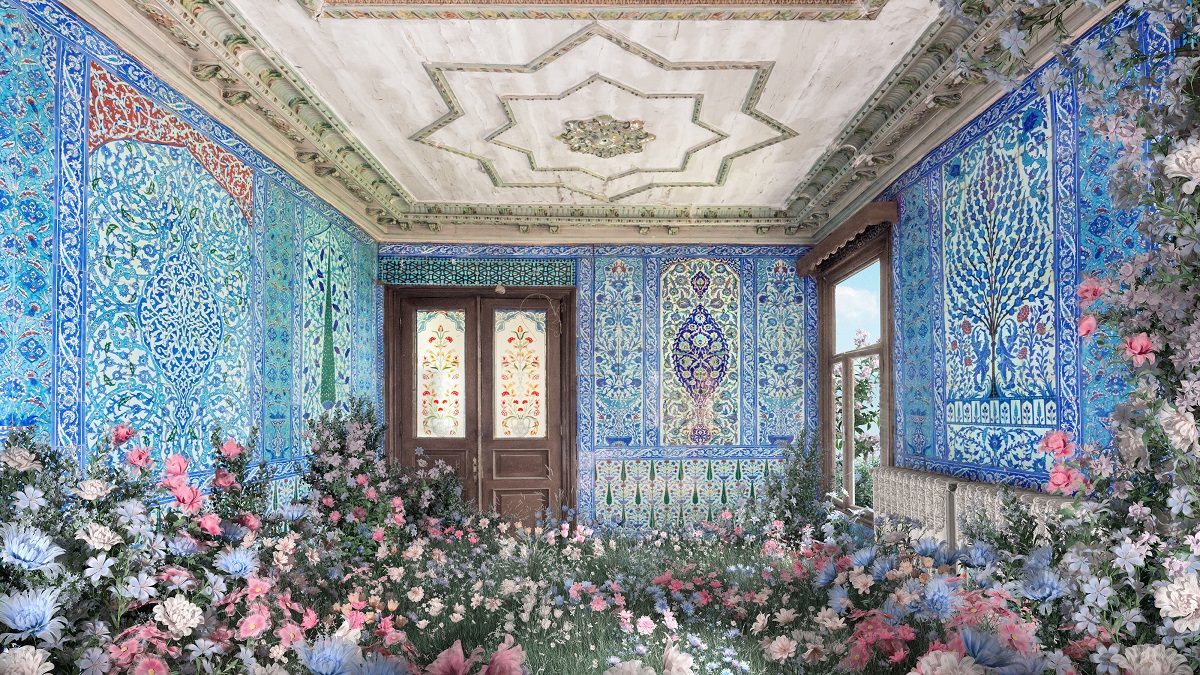


'Constellations' by Ryan Koopmans and Alice Wexell. (Supplied) 

“We are drawn to structures that carry both emotional and historical resonance, often buildings that once embodied human ambition and now exist in a state of quiet transformation.”

Koopmans and Wexell made sure to research the context of each building they choose to recreate, saying “an old villa in Jeddah or a former school in Sharjah each hold their own cultural memory, influencing everything from the lighting and atmosphere to the plants and flowers that we digitally sculpt and implement into the photographs.”
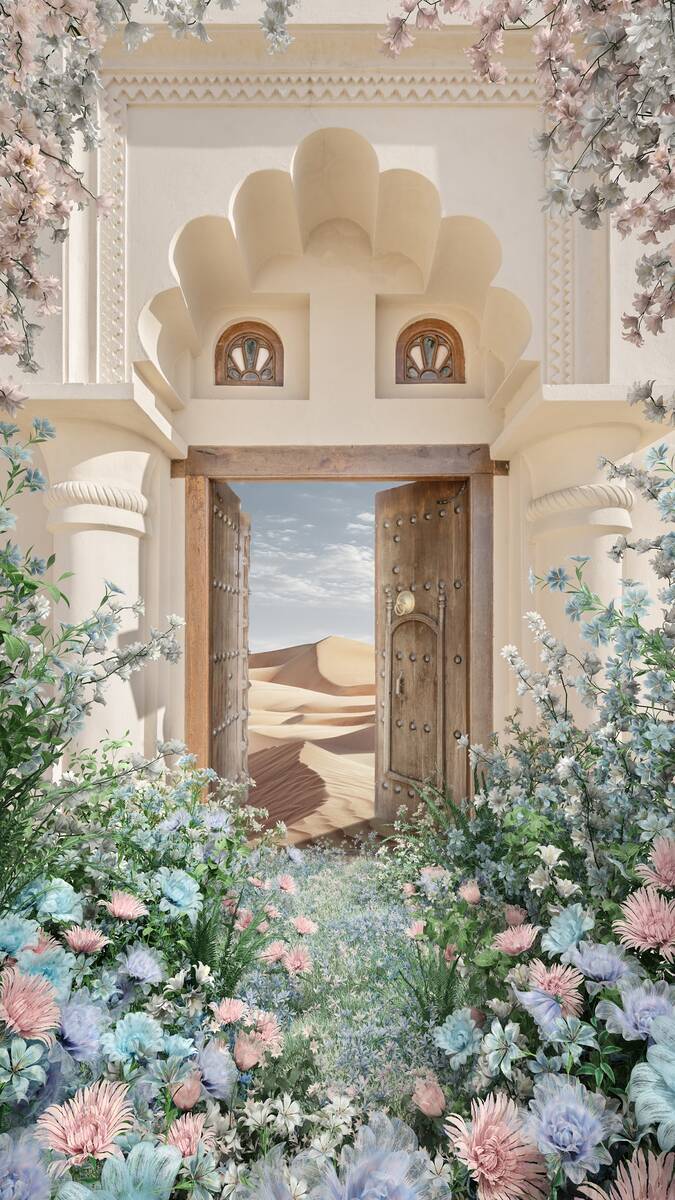


'Heart of Sharjah' by Ryan Koopmans and Alice Wexell. (Supplied) 

The hypnotic works depict the interior of buildings in the region, with digitally rendered flowers carpeting the floor in a bid to “(reimage) these spaces (and) explore the relationship between nature, place, and time, while celebrating each site as a unique work of architecture with its own spirit and story,” the artists said.

Koopmans is of dual Canadian and Dutch heritage, while Wexell is Swedish and based in Stockholm, so it is noteworthy that both artists chose to explore the Middle East for their latest project.


'Blossom of the Ancestors' by Ryan Koopmans and Alice Wexell. (Supplied) 

“In the Middle East especially, the architecture reflects a layered past that merges different styles and eras, while also expressing a sense of renewal and forward-looking energy, particularly in the region’s fantastic contemporary buildings. We are drawn to the symmetry, geometry and patterns that are found not only in nature itself, but in the architectural language of the region both past and present,” they said.

The series — featuring works such as “Adore You,” “Between Worlds,” and “Blossom of the Ancestors” — explores contrasts between the natural world and human-made forms, as well as the traditional and contemporary worlds.

“We are interested in how these elements coexist and merge into one another, creating a sense of hyperrealism that feels both familiar and imaginary. By merging photography with digital sculpture, the artworks question where the boundary lies between documentation and invention, and how technology can extend rather than replace our sense of the natural world.”


'Under the Rain of Light' by Ryan Koopmans and Alice Wexell. (Supplied) 

Although the scale of the artworks ensures they leave the viewer entranced, it did pose challenges, according to the artists.

“Presented at a large scale, every texture in these artworks becomes visible, which can be demanding but is also incredibly rewarding. The magnified detail allows the visceral and atmospheric layers of the pieces to come through with greater impact,” they said, adding that each piece took “many months” to create.

“Ultimately, we want our collectors to experience a sense of wonder and contemplation, as if they are standing inside a dream that feels both entirely real yet unreal.”

The exhibition runs until Jan. 15, 2026. 


Akio Fujimoto discusses RSIFF Golden Yusr winner ‘Lost Land’ 

Akio Fujimoto at the Red Sea International Film Festival in Jeddah. (Getty Images)
Updated 19 December 2025
Follow

Akio Fujimoto discusses RSIFF Golden Yusr winner ‘Lost Land’ 

  • The Japanese filmmaker on his groundbreaking Rohingya-language feature

JEDDAH: Some stories demand to be told. Not just as narratives, but as acts of witness.  

Japanese filmmaker Akio Fujimoto’s “Lost Land” is one such story. Billed as the first feature film in the Rohingya language, the movie took home the top prize — the Golden Yusr — at this year’s Red Sea International Film Festival. 

“Lost Land” — which premiered in the Horizons section at this year’s Venice Film Festival, where it won the special jury prize — follows two young Rohingya siblings, Somira and Shafi, fleeing persecution in Myanmar as they undertake a perilous journey d to join their uncle in Malaysia. 

Shomira Rias Uddin (R) and Muhammad Shofik Rias Uddin in 'Lost Land.' (Supplied) 

Presenting the Golden Yusr to Fujimoto, RSIFF jury head, the US filmmaker Sean Baker, said the film “confronts the plight of displaced children with unflinching empathy and poetic urgency.” 

Fujimoto’s journey to this film is a profound narrative of personal reckoning. Having worked in Myanmar for more than a decade, he recognized the unspoken tensions surrounding discussions about refugee experiences but never spoke out himself due to fear of persecution. The 2021 military coup in Myanmar, he said, forced him to confront a lingering sense of guilt about his previous silence on the subject. 

“Looking back on my decade of work, I realized I had been avoiding topics I wanted to focus on as a filmmaker,” Fujimoto said in an interview with Arab News at RSIFF. 

That self-reflection became the catalyst for “Lost Land,” transforming personal hesitation into a powerful act of cinematic storytelling. 

Eschewing traditional casting methods, Fujimoto discovered his lead actors through serendipity during community fieldwork. Shomira Rias Uddin and Muhammad Shofik Rias Uddin, real-life siblings who play the film’s young leads, were found walking near interview locations, compelling the filmmaker to reshape the entire script around their natural chemistry. While the original script was written with two teenage brothers in mind, the discovery of the Rias Uddin siblings led Fujimoto to alter the script significantly. 

Communication between the cast and crew became an intricate dance of translation and cultural bridge-building. With Fujimoto speaking primarily Japanese and some Burmese, the team relied on Sujauddin Karimuddin, a Rohingya translator who did far more than linguistic conversion. “He wasn’t just translating words but conveying messages, creating trust, and establishing a collaborative atmosphere,” said Watanabe, Fujimoto’s translator. 

One of the most remarkable aspects of “Lost Land” is its linguistic significance. Beyond being a narrative, the film serves as a critical instrument of cultural preservation. Karimuddin, who is also a producer on the film, approached his role like a linguistic curator. “As a Rohingya myself, I had the privilege of choosing words carefully, trying to instill poetry, capturing linguistic nuances that are slowly disappearing. So, the film is very important when it comes to the preservation of a people’s language. It was a privilege for me to contribute to it,” he said. 

As they were making the first fiction film focused on Rohingya experiences, the team felt an immense responsibility. “Lost Land” aims to humanize a community often reduced to statistics, giving voice and complexity to individual experiences.

Shomira Rias Uddin and Muhammad Shofik Rias Uddin (R) in 'Lost Land.' (Supplied) 

“In our film, we had around 200 people — including extras — who were all part of the Rohingya community. I felt in order to show their feelings and their voice; it was really important to bring in the Rohingya people and tell the story together with them,” said Fujimoto. 

For Fujimoto, whose previous films include “Passage of Life” (2017) and “Along the Sea” (2020), the film represents more than an artistic achievement. It’s a form of personal and collective redemption. “I can now clearly talk about these people without hesitation,” he said. 

The filmmaker’s future ambitions involve expanding on this project. He sees “Lost Land” as a crucial first step, and hopes to support Rohingya filmmakers in telling their own stories directly. 

“The next phase is bringing narratives from the Rohingya perspective, directed by Rohingya filmmakers,” he said.