MANILA: An Egyptian national was among three militants killed in a clash with government forces late on Friday in the southern Philippines province of Sulu, officials said.
Western Mindanao Command chief Lt. Gen. Corleto Vinluan, Jr. said the firefight took place around 10:45 p.m. in the Igasan village of Patikul town.
Troops carrying out operations in the area clashed with members of the Abu Sayyaf Group (ASG) — a terror unit led by Mudzrimar “Mundi” Sawadjaan and with links to Daesh — in an exchange that lasted about 10 minutes.
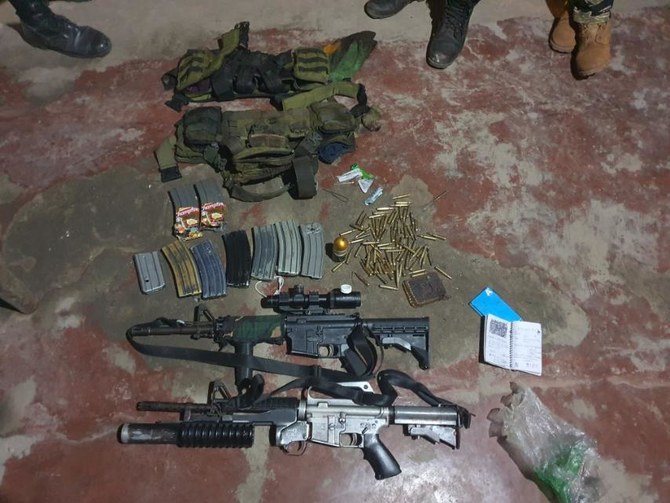
The bodies of the dead militants, along with their assault rifles, a grenade launcher and bandoliers of ammunition, were recovered.
Officials told Arab News that information provided by villagers helped troops trace the militants.
Wesmincom spokesperson Lt. Col. Alaric Delos Santos said the Egyptian, identified as Yusof, was the son of two foreign militants who died in separate suicide attacks in Basilan and Sulu provinces in 2018 and 2019.
Yusof was one of the five remaining foreign terrorists being monitored in the southern Philippines.
His father, a Moroccan identified as Abu Khatir Al-Maghribi, staged the first reported suicide bombing in the Philippines, which took place at a military roadblock in Lamitan, Basilan, in July, 2018.
Eleven people were killed in the incident, including Al-Maghribi, who drove the bomb-laden van used in the attack.
Yusof’s mother, Reda Mohammed Mahmud, was identified as the Egyptian national involved in a foiled suicide bombing at an army base in Indanan town in Sulu province in September, 2019.
Mahmud, who died when she detonated the bomb, was the lone fatality.
According to Delos Santos, Yusof’s family arrived in Mindanao in 2018 and subsequently joined the late Hatib Hadjan Sawadjaan, the ASG leader designated as Daesh emir in the Philippines.
“He was still young when his parents brought him to Sulu about four years ago,” Delos Santos told Arab News.
The family also had been seen in videos of encounters between the ASG and government forces obtained by the military.
Following her husband’s death, Yusof’s mother married another Egyptian suicide bomber identified only as Abduramil, who was killed in a clash at an army checkpoint in November, 2019.
The military said then that the killing of Abduramil and his two companions helped thwart an “imminent suicide attack.”
Lt. Jerrica Manongdo, a spokesperson for the Joint Task Force Sulu, told Arab News that Yusof had been “tagging along” with Mundi Sawadjaan, a notorious ASG leader and bomb-maker, and was reportedly “volunteering to be a suicide bomber.”
Sawadjaan helped plan the bloody 2019 Sulu Cathedral attack, which left dozens dead, and other suicide bombings in the island province.
“This is one less suicide bomber,” Joint Task Force Sulu and 11th Infantry Division Commander Maj. Gen. William Gonzales said of Yusof’s death.
“I commend our ground forces for this monumental accomplishment. These neutralized terrorists are the cohorts of Mundi in executing atrocities. Without them, the possibility of another attack is slimmer,” he said in a statement.
“Moreover, financial support sent to ASG in Sulu from their foreign terrorist affiliates are cut off. We are optimistic that Mundi will soon meet his end.”
Gonzales said that air, naval and ground forces are being used in all-out offensive against the remaining foreign terrorists and ASG members in the province.
“We are coordinating with local leaders to ensure the safety of the people,” he added.
Besides Yusof, Abu Khattab Jundullah, known as “Saddam,” a trained bomb-maker, and another ASG member yet to be identified were also killed in Friday’s military operation.
Since January, the Joint Task Force Sulu has accounted for 70 ASG members, seven of whom were captured, while 60 surrendered and three were killed.
Delos Santos said that “the remaining number of ASG militants is between 50 to 70.”
But he voiced optimism that the military “can soon bring an end to this small but violent militant group.”


![]()
![]()

Egyptian among militants killed in Philippines firefight

Short Url
https://arab.news/j9xgm
Egyptian among militants killed in Philippines firefight
- “One less suicide bomber,” says Philippines army chief after troops kill 3 fighters
- The bodies of the dead militants, along with their assault rifles, a grenade launcher and bandoliers of ammunition, were recovered


Latest updates


© 2026 SAUDI RESEARCH & PUBLISHING COMPANY, All Rights Reserved And subject to Terms of Use Agreement.