

Indian vaccine maker asks US to ease export curbs

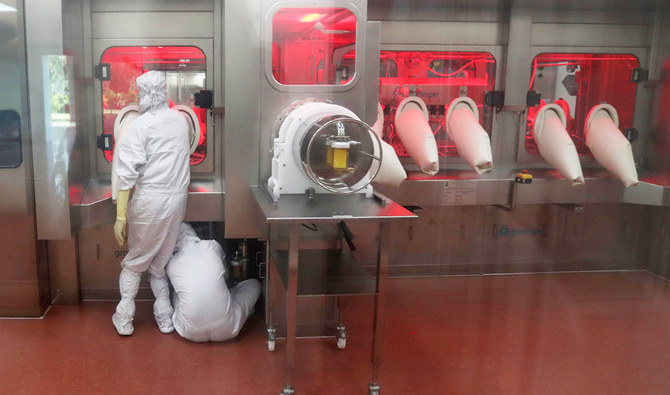
Employees operate a filling machine inside a laboratory at the Serum Institute of India, in Pune, India, Thursday, Jan. 21, 2021. (AP)
Short Url
Updated 17 April 2021
Follow

Indian vaccine maker asks US to ease export curbs

  • Serum Institute of India paused exports to COVAX after a devastating surge of infections in India resulted in increased domestic demand

NEW DELHI: The chief executive of Serum Institute of India, the world’s largest maker of vaccines and a critical supplier of the UN-backed COVAX facility, asked President Joe Biden on Twitter to lift the US embargo on exporting raw materials needed to make the the jabs.
Vaccine makers and experts in India have been concerned that the use of the Defense Production Act by the US to boost their own vaccine production was resulting in exports of critical raw materials being stopped. This was hobbling vaccine production in other parts of the world.
Stéphane Bancel, CEO for Moderna, said Tuesday in an online event that export embargoes were also preventing American vaccine makers from exporting shots globally and resulting in shortages.
“If we are to truly unite in beating this virus, on behalf of the vaccine industry outside the US, I humbly request you to lift the embargo of raw material exports out of the US so that vaccine production can ramp up,” wrote Adar Poonawalla, CEO of Serum Institute of India.
He had earlier said that pivoting away from suppliers in the US could result in a delay of up to six months for the production of the COVID-19 vaccine developed by Novavax. Serum Institute and Novavax have inked a deal to supply 1.1 billion doses of the vaccine to COVAX to equitably distribute it across the globe.

NUMBER

200,000 new infections were detected recently in India.

Serum Institute of India paused exports to COVAX after a devastating surge of infections in India resulted in increased domestic demand.
Over 200,000 new infections were detected recently and major cities, like Mumbai and New Delhi, are under virus restrictions. Hospitals are overwhelmed and authorities are scrambling to try and vaccinate enough people to slow down the spread. But in doing so, India relies heavily on AstraZeneca shots made by Serum Institute of India.
Poonawalla had said the unavailability of the raw materials, such as the specific medium needed to grow microorganisms, would prevent Serum Institute from scaling up the production of the vaccine developed by Novavax.
The company had been planning to make up to 40 million shots of the vaccine monthly.
Ramping up the production of this shot could also help India. Novavax has applied for emergency use of the vaccine to regulators in Europe, the US and the World Health Organization. If approved, India would be able to use the shot under new regulations that make it easier to greenlight vaccines that have received the nod by the UK, the US, Europe, Japan or WHO.


First EU–Saudi roundtable on critical raw materials reflects shared policy commitment

Updated 16 January 2026
Follow

First EU–Saudi roundtable on critical raw materials reflects shared policy commitment

RIYADH: The EU–Saudi Arabia Business and Investment Dialogue on Advancing Critical Raw Materials Value Chains, held in Riyadh as part of the Future Minerals Forum, brought together senior policymakers, industry leaders, and investors to advance strategic cooperation across critical raw materials value chains.

Organized under a Team Europe approach by the EU–GCC Cooperation on Green Transition Project, in coordination with the EU Delegation to Saudi Arabia, the European Chamber of Commerce in the Kingdom and in close cooperation with FMF, the dialogue provided a high-level platform to explore European actions under the EU Critical Raw Materials Act and ResourceEU alongside the Kingdom’s aspirations for minerals, industrial, and investment priorities.

This is in line with Saudi Vision 2030 and broader regional ambitions across the GCC, MENA, and Africa.

ResourceEU is the EU’s new strategic action plan, launched in late 2025, to secure a reliable supply of critical raw materials like lithium, rare earths, and cobalt, reducing dependency on single suppliers, such as China, by boosting domestic extraction, processing, recycling, stockpiling, and strategic partnerships with resource-rich nations.

The first ever EU–Saudi roundtable on critical raw materials was opened by the bloc’s Ambassador to the Kingdom, Christophe Farnaud, together with Saudi Deputy Minister for Mining Development Turki Al-Babtain, turning policy alignment into concrete cooperation.

Farnaud underlined the central role of international cooperation in the implementation of the EU’s critical raw materials policy framework.

“As the European Union advances the implementation of its Critical Raw Materials policy, international cooperation is indispensable to building secure, diversified, and sustainable value chains. Saudi Arabia is a key partner in this effort. This dialogue reflects our shared commitment to translate policy alignment into concrete business and investment cooperation that supports the green and digital transitions,” said the ambassador.

Discussions focused on strengthening resilient, diversified, and responsible CRM supply chains that are essential to the green and digital transitions.

Participants explored concrete opportunities for EU–Saudi cooperation across the full value chain, including exploration, mining, and processing and refining, as well as recycling, downstream manufacturing, and the mobilization of private investment and sustainable finance, underpinned by high environmental, social, and governance standards.

From the Saudi side, the dialogue was framed as a key contribution to the Kingdom’s industrial transformation and long-term economic diversification agenda under Vision 2030, with a strong focus on responsible resource development and global market integration.

“Developing globally competitive mineral hubs and sustainable value chains is a central pillar of Saudi Vision 2030 and the Kingdom’s industrial transformation. Our engagement with the European Union through this dialogue to strengthen upstream and downstream integration, attract high-quality investment, and advance responsible mining and processing. Enhanced cooperation with the EU, capitalizing on the demand dynamics of the EU Critical Raw Materials Act, will be key to delivering long-term value for both sides,” said Al-Babtain.

Valere Moutarlier, deputy director-general for European industry decarbonization, and directorate-general for the internal market, industry, entrepreneurship and SMEs at European Commission, said the EU Critical Raw Materials Act and ResourceEU provided a clear framework to strengthen Europe’s resilience while deepening its cooperation with international partners.

“Cooperation with Saudi Arabia is essential to advancing secure, sustainable, and diversified critical raw materials value chains. Dialogues such as this play a key role in translating policy ambitions into concrete industrial and investment cooperation,” she added.