


TARRAFAL, Cape Verde: Way back in B.C. — Before COVID — Domingos Pereira made a living as a tourist guide, showing visitors the many natural wonders of Cape Verde.
Today, the 26-year-old is in limbo, like tens of thousands of others on the Atlantic archipelago, whose economy depends hugely on the vacation industry.
“I’ve been going fishing every day for the past year,” said Pereira, a T-shirt on his head to protect him from the fierce sun.
“And the fish is just for eating. Don’t bother trying to sell it. There are no tourists.”
Cape Verde is a group of tropical Atlantic islands with a population of some 550,000 about 600 km from Senegal.
Life in the archipelago is famously slow-moving. But once the coronavirus pandemic started to bite, tourists stopped coming and things seemed to come virtually to a stop.
In 2019, the islands welcomed 800,000 holidaymakers, most of them from Europe, said Eugenio Inocencio, president of the Tourism Association for Santiago, the main island where the capital Praia is located.
Now, Santiago’s main resort, Tarrafal, is all but drained of life. Its hotels are shuttered and its workers laid off.
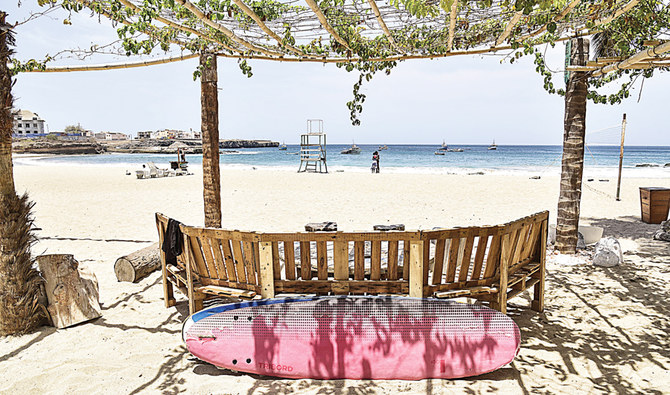
The streets are deserted save for a knot of local people sitting at a corner in the shade. The only things catching the sun on its palm-fringed white-sand beach are colorful fishing boats.
In the main square, a dreadlocked trader of postcards and trinkets said he had lost 80 percent of his income thanks to COVID-19.
Silvio Antonio Lopes Borges, a 32-year-old former tourist guide said he can no longer afford his two-year-old son’s playgroup.
FASTFACTS
● Tourists, drawn to Cape Verde’s gentle hospitality, year-round warmth and turquoise seas, account for a full quarter of the country’s GDP.
● After growth of 4.5 percent in 2018 and 5.7 percent in 2019, the former Portuguese colony suffered a record slump last year — a retraction of 14.8 percent.
“We play together — at least he’s happy,” he said. “And it’s free. Before, I was able to put aside savings. Now I don’t have enough to live on."
The pandemic has had, relatively speaking, only a limited medical effect on Cape Verde — the country has recorded 19,780 cases, of which 188 have been fatal.
Economically, though, the emergency has had catastrophic consequences.
Tourists, drawn to Cape Verde’s gentle hospitality, year-round warmth and turquoise seas, account for a full quarter of the country’s gross domestic product (GDP).
After growth of 4.5 percent in 2018 and 5.7 percent in 2019, the former Portuguese colony suffered a record slump last year — a retraction of 14.8 percent.
“We thought that tourism would be bouncing back at the start of the year, but Europe has had a fourth wave of the virus, which means that the number of tourists coming to Cape Verde is rock-bottom,” said Inocencio.
How to rebound from this disaster is one of the main issues in Sunday’s legislative elections, for which the outcome could be close.
Prime Minister Ulisses Correia e Silva’s Movement for Democracy (MpD) is pitched against the African Party for the Independence of Cape Verde (PAICV), a socialist party led by Janira Hopffer Almada that dominated politics for decades until suffering an election defeat in 2016.
Maya Duarte is manager of the Pensao Por Do Sol, a brand new hotel with a view of the Monte Graciosa, a volcanic peak that plunges into the ocean.
The hotel’s opening day should have been in December, when the year-end tourist season kicks into gear. It was then delayed until February and postponed again, and has now only just taken place. "We’re worried,” said Duarte, who is just 25. “We’re afraid that if we stay open, we won’t have any income and be unable to pay the staff.”
The solution, she said, was to ease dependence on vacationers from Europe. “We can’t expect just Europeans to come here — we have to invest locally.


