Sydney man finds snake in lettuce bought at supermarket

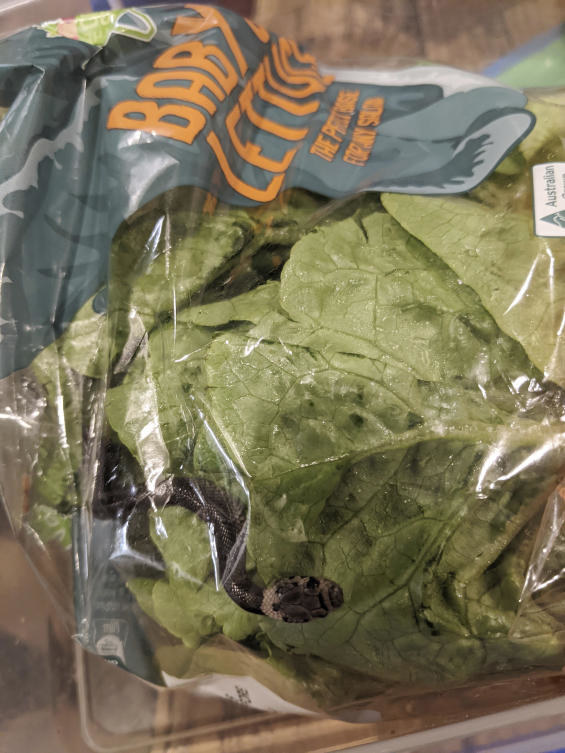
Alex White thought he was watching a huge warm in a bag of lettuce he bought from a Sydney supermarket, until a snake tongue flicked. (AP)
Short Url
Updated 16 April 2021
Follow

Sydney man finds snake in lettuce bought at supermarket

  • Alex White bought lettuce from ALDI supermarket Monday and bicycled home with salad and snake in his backpack
  • ALDI is investigating how a venomous pale-headed snake could have found its way into a supermarket

CANBERRA: Alex White thought he was watching a huge worm writhing in plastic-wrapped lettuce he’d just brought home from a Sydney supermarket — until a snake tongue flicked.
“I kind of completely freaked out when I saw this little tongue come out of its mouth and start flicking around and realized it was a snake because worms don’t have tongues,” White said on Thursday.
“I definitely kind of panicked a bit,” he added.
It was a venomous pale-headed snake that authorities say made an 870-kilometer (540-mile) journey to Sydney from a packing plant in the Australian city of Toowoomba wrapped in plastic with two heads of cos lettuce.
The refrigerated supermarket supply chain likely lulled the cold-blooded juvenile into a stupor until White bought the lettuce at an ALDI supermarket on Monday evening and rode his bicycle home with salad and snake in his backpack.
White and his partner Amelia Neate spotted the snake moving as soon as the lettuce was unpacked onto the kitchen table.
They also noticed the plastic wrapping was torn and that the snake could escape, so they quickly stuffed the reptile with the lettuce into a plastic food storage container.
White phoned the WIRES rescue organization and a snake handler took the snake away that night.
Before the handler arrived, White said WIRES had explained to him: “If you get bitten, you’ve got to go to hospital really quickly.”
ALDI is investigating how a snake could have found its way into a supermarket.
“We’ve worked with the customer and the team at WIRES to identify the snake’s natural habitat, which is certainly not an ALDI store!” the German-based supermarket chain said in a statement.
WIRES reptile coordinator Gary Pattinson said while the snake was less than 20 centimeters (8 inches) long, it was “as venomous as it will ever be.”
Pattinson is caring for the snake until it is returned to Queensland state next week, following the WIRES policy of returning rescued wildlife to where it comes from.
“It’s the first snake I’ve ever had in sealed, packed produce,” Pattinson said. “We get frogs in them all the time.”
Neate, a German immigrant, said her brush with a venomous snake in a Sydney kitchen was a setback in her efforts to assure relatives in Europe that Australia’s notoriously deadly Outback wildlife was nothing to worry about.
“For the last 10 years or so, I’ve told my family at home that Australia’s a really safe country,” Neate said.
“I’ve always said I’m just in the city; it’s totally fine here,” she added.


Three-year heatwave bleached half the planet’s coral reefs: study

Updated 10 February 2026
Follow

Three-year heatwave bleached half the planet’s coral reefs: study

PARIS: A study published on Tuesday showed that more than half of the world’s coral reefs were bleached between 2014-2017 — a record-setting episode now being eclipsed by another series of devastating heatwaves.
The analysis concluded that 51 percent of the world’s reefs endured moderate or worse bleaching while 15 percent experienced significant mortality over the three-year period known as the “Third Global Bleaching Event.”
It was “by far the most severe and widespread coral bleaching event on record,” said Sean Connolly, one the study’s authors and a senior scientist at the Panama-based Smithsonian Tropical Research Institute.
“And yet, reefs are currently experiencing an even more severe Fourth Event, which started in early 2023,” Connolly said in a statement.
When the sea overheats, corals eject the microscopic algae that provides their distinct color and food source.
Unless ocean temperatures return to more tolerable levels, bleached corals are unable to recover and eventually die of starvation.
“Our findings demonstrate that the impacts of ocean warming on coral reefs are accelerating, with the near certainty that ongoing warming will cause large-scale, possibly irreversible, degradation of these essential ecosystems,” said the study in the journal Nature Communications.
An international team of scientists analyzed data from more than 15,000 in-water and aerial surveys of reefs around the world over the 2014-2017 period.
They combined the data with satellite-based heat stress measurements and used statistical models to estimate how much bleaching occurred around the world.

No time to recover

The two previous global bleaching events, in 1998 and 2010, had lasted one year.
“2014-17 was the first record of a global coral bleaching event lasting much beyond a single year,” the study said.
“Ocean warming is increasing the frequency, extent, and severity of tropical-coral bleaching and mortality.”
Australia’s Great Barrier Reef, for instance, saw peak heat stress increase each year between 2014 and 2017.
“We are seeing that reefs don’t have time to recover properly before the next bleaching event occurs,” said Scott Heron, professor of physics at James Cook University in Australia.
A major scientific report last year warned that the world’s tropical coral reefs have likely reached a “tipping point” — a shift that could trigger massive and often permanent changes in the natural world.
The global scientific consensus is that most coral reefs would perish at warming of 1.5C above preindustrial levels — the ambitious, long-term limit countries agreed to pursue under the 2015 Paris climate accord.
Global temperatures exceeded 1.5C on average between 2023-2025, the European Union’s climate monitoring service, Copernicus, said last month.
“We are only just beginning to analyze bleaching and mortality observations from the current bleaching event,” Connolly told AFP.
“However the overall level of heat stress was extraordinarily high, especially in 2023-2024, comparable to or higher than what was observed in 2014-2017, at least in some regions,” he said.
He said the Pacific coastline of Panama experienced “dramatically worse heat stress than they had ever experienced before, and we observed considerable coral mortality.”