

Snakes in office force Liberia’s president to work from home

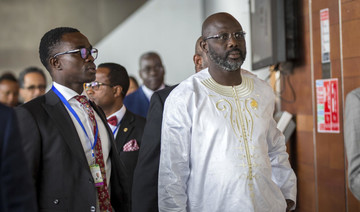
George Weah is working from home. (Reuters)
Updated 19 April 2019
Follow

Snakes in office force Liberia’s president to work from home

  • President George Weah was told to stay away until the Foreign Affairs building can be fumigated
  • Black snakes were seen this week briefly emerging from a hole in a wall of the building’s reception area

MONROVIA, Liberia: A spokesman says Liberia’s president is working from home after two snakes were found in the building that contains his office.
Deputy press secretary Smith Toby tells The Associated Press that former international soccer star and President George Weah was told to stay away until the Foreign Affairs building can be fumigated. He is expected back in the office on Monday.


Weah was a superstar on the pitch in the mid-1990s, particularly during his spell in Italy with AC Milan. (Getty Images)

The black snakes were seen this week briefly emerging from a hole in a wall of the building’s reception area. Liberia is home to poisonous snakes and officials are not taking chances.
The deputy press secretary says the fumigation has begun to take care of “crawling and creeping things.”
Weah, who was FIFA’s 1995 player of the year, assumed the presidency in January 2018.

Makkah museum displays world’s largest Qur’an

Updated 04 February 2026
Follow

Makkah museum displays world’s largest Qur’an

MAKKAH: The Holy Qur’an Museum at the Hira Cultural District in Makkah is showcasing a monumental handwritten copy of the Holy Qur’an, recognized as the largest Qur’an of its kind in the world.

The manuscript measures 312 cm by 220 cm and comprises 700 pages, earning the museum recognition from Guinness World Records for displaying the world’s largest Qur’an, the Saudi Press Agency reported.

The manuscript is a magnified reproduction of a historic Qur’an dating back to the 16th century, the SPA stated.

The original copy measures 45 cm by 30 cm, with the chapters written primarily in Thuluth script, while Surah Al-Fatiha was penned in Naskh, reflecting the refined artistic choices and calligraphic diversity of the era.

The Qur’an is a unique example of Arabic calligraphy, gilding and bookbinding, showcasing Islamic art through intricate decorations, sun-shaped motifs on the opening folio, and elaborately designed frontispiece and title pages that reflect a high level of artistic mastery.

The manuscript was endowed as a waqf in 1883. Its original version is currently preserved at the King Abdulaziz Complex for Endowment Libraries, serving as a lasting testament to Muslims’ enduring reverence for the Qur’an and the richness of Islamic arts across the centuries.