

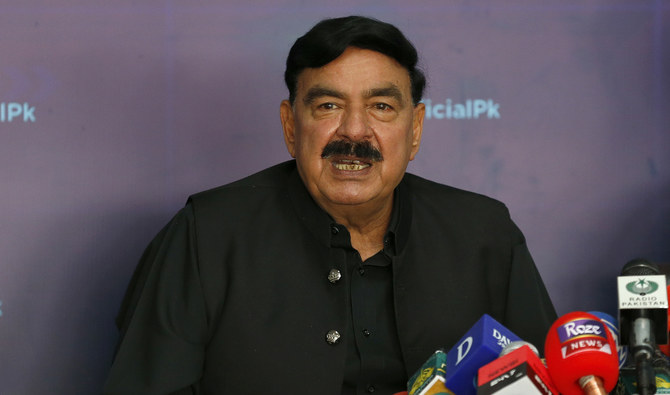

ISLAMABAD/KARACHI: Pakistan's federal cabinet has approved the interior ministry's recommendation to outlaw the Tehreek-e-Labaik Pakistan (TLP), a religious party whose supporters have been holding nationwide protests since Monday, a senior government minister told a news conference on Thursday, adding that the government would take the case to the Supreme Court to ensure the dissolution of the religious party.
Sheikh Rashid Ahmed announced on Wednesday that his ministry would send a proposal to the federal cabinet to impose a ban on TLP for killing two policemen, attacking law enforcement forces and disrupting public life through nationwide protests.
The demonstrations erupted in major Pakistani cities and quickly turned violent after Saad Rizvi, the religious party’s head, was arrested on Monday after he threatened to launch a major campaign against the government if it did not expel France’s envoy to Islamabad over blasphemous caricatures of Prophet Muhammad (peace be upon him) printed in a French publication.
"We have proscribed [the TLP] and the notification for that will be issued shortly," said federal interior minister Shaikh Rashid Ahmed. "Tomorrow, we will send another summary to the cabinet to file a reference in the Supreme Court since we are moving toward [TLP's] dissolution."
Muhammad Younus Soomro, a TLP lawmaker in the Sindh Assembly, said he would use his legal options to retain his seat in parliament.
“We'll see our options once the notification [regarding the ban] is issued,” Soomro said while distancing himself from the TLP protests.
On Thursday, the TLP chief in Pakistan’s southern city of Karachi, Allama Razi Hussaini, also warned that he would disown his party chief and members of the central consultative body if they did not call off the protests.
“If the party’s central Shura and Saad Hussain Rizvi Sahib continue to show stubbornness and insist that they do not want to resolve this issue through talks, the nation will be disappointed and we will have no association with the TLP leadership,” he announced in a video message.
The TLP gained prominence in Pakistan’s 2018 federal elections, campaigning to defend the country’s blasphemy law, which calls for death penalty for anyone who insults Islam. The party also has a history of staging protests and sit-ins to pressure the government to accept its demands.
In November 2017, Rizvi’s followers staged a 21-day protest and sit-in after a reference to the sanctity of the Prophet Muhammad (pbuh) was removed from the text of a government form.
In the 2018 elections, the party managed to win two seats in the Sindh Assembly from Karachi and got a female member elected on a reserved seat of the assembly.
Commenting on the government’s move to ban TLP, legal experts said the government was required to refer the matter to the Supreme Court within fifteen days of making a declaration to ban a political party while presenting its reasons for doing so.
“The Supreme Court may decide on the government’s reference in a week or ten days and its decision will be final,” Justice (retired) Shaiq Usmani told Arab News.
He said the law regarding the dissolution of a political party was “very clear” and if the apex court upheld the government’s declaration against the TLP, “the party shall stand dissolved forthwith.”
Legal experts said the three elected TLP members in the Sindh Assembly could retain their seats by resigning their party membership and publicly announcing their dissociation with the TLP before a final Supreme Court decision.
“If the TLP lawmakers dissociate themselves from the party before the apex court’s verdict, they will be able to complete their constitutional term as independent members in the house,” Ashtar Ausaf Ali, a former attorney-general of Pakistan, told Arab News.
He said if a member of the parliament or provincial assemblies was disqualified in case of the dissolution of a party, they could not run for electoral office or a legislative body for four years from the date of their disqualification from being a lawmaker.
“There is no ambiguity in law,” Ali said, “and it’s up to the party lawmakers now as to what they choose in case of the dissolution of their party.”


