

China gives green light to nuclear units to cut carbon, sources say

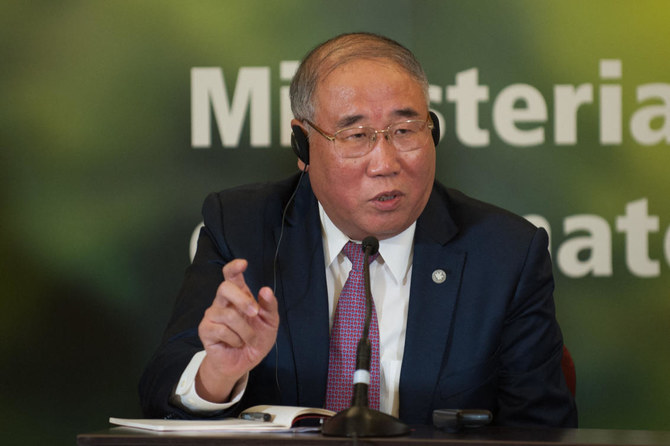
China’s representative on climate change Xie Zhenhua speaks to the press after a ministerial meeting hosted by Canada on September 16, 2017 in Montreal to push forward on implementing the Paris climate accord. (File/AFP)
Short Url
Updated 15 April 2021
Follow

China gives green light to nuclear units to cut carbon, sources say

  • China aims to become "carbon neutral" by 2060
  • China’s state council approved five nuclear projects, which will be developed by China National Nuclear Corp. (CNNC)

BEIJING/SINGAPORE: China approved the construction of five nuclear power units, with total installed capacity of 4.9 GW, roughly 10% of the country’s total, two sources said, as Beijing strives for alternatives to fossil fuel to meet its climate goals.

China needs to speed up its nuclear development to achieve its pledge to bring greenhouse gas emissions to a peak before 2030 and become “carbon neutral” by 2060.

The world’s biggest greenhouse gas emitter has lagged behind its previous target of operating 58 gigawatts of nuclear power capacity by 2020, partly as the Fukushima nuclear accident slowed down approvals of new projects.

China’s state council approved five nuclear projects, which will be developed by China National Nuclear Corp. (CNNC), at a meeting on Wednesday, one of the two sources familiar with the matter said.

Officials, including those from the National Energy Administration and National Nuclear Safety Bureau, attended the meeting at which the development of the nuclear industry in the country was discussed, four sources said. They asked not to be named because they were not authorized to speak to the press.

“Nuclear power is a ‘have to do’ choice if China aims to achieve the targets of bringing carbon emission by 2030 and reaching carbon neutrality by 2060,” an official from the Nuclear Safety Bureau said.

The five reactors approved include four regular nuclear units — number 7 and number 8 at Tianwan nuclear power plant in eastern Jiangsu province, and number 3 and number 4 in Xudapu in northeastern Liaoning province.

All four will use Russian-made VVER-1200 technology and have individual capacity of 1.2 gigawatts (GW), two of the sources said.

The government also approved a small, 125-MW module reactor (SMR) demonstration project at Changjiang nuclear power plant in Hainan province.

In one of the country’s first experiments of small reactors aimed at better economics, CNNC will use its home-grown ACP100 technology.

Construction of three of the five units, the SMR and one each from Tianwan and Xudapu, is expected to start later this year and is scheduled for completion in 2026, one official said.

“They are moving ahead as earlier scheduled,” the official said, adding that means China has re-established its normal pace in advancing new projects.

The State Council and CNNC did not immediately respond to Reuters requests seeking comment.

China is also accelerating the development of an upgraded model of its home-grown third generation nuclear technology, Hualong Two.

China’s Nuclear Energy Association expects the country to have installed or have under construction a total of 200 gigawatts (GW) of nuclear capacity by 2035.


Campaigning starts for Bangladesh’s first national election after Hasina’s ouster

Updated 3 sec ago
Follow

Campaigning starts for Bangladesh’s first national election after Hasina’s ouster

DHAKA: Campaigning began Thursday for Bangladesh’s first national elections since the 2024 uprising that ousted longtime Prime Minister Sheikh Hasina.
The major political parties held campaign rallies in the capital, Dhaka, and elsewhere ahead of Feb. 12 election, which is seen as the most consequential in Bangladesh’s history as it follows Hasina’s ouster and is being held under an interim government with voters also deciding on proposed political reforms.
The interim government led by Nobel Peace Prize laureate Muhammad Yunus has pledged to hold a free and fair election, but questions were raised after his administration banned Hasina’s former ruling Awami League party. The Awami League and the Bangladesh Nationalist Party have historically dominated the country’s electorate.
There are also concerns about the country’s law and order situation, but the government says they will keep the voting peaceful.
Yunus assumed office three days after Hasina left the country for India on Aug. 5, 2024, following the deaths of hundreds of protesters and others in a violent crackdown.
With the Awami League excluded from the election, a 10-party alliance led by Jamaat-e-Islami, an Islamist party, is seeking to expand its influence. Jamaat-e-Islami has long faced criticism from secular groups who say its positions challenge Bangladesh’s secular foundations. A new party formed by student leaders of the uprising, the National Citizen Party, or NCP, is also part of the alliance.
Tarique Rahman, BNP chairman and the son of former Prime Minister Khaleda Zia, is widely seen as a leading contender for prime minister. His party has drawn strong support rooted in the political legacy of his mother, who died last month. Rahman returned to Bangladesh last month after 17 years in exile in the United Kingdom.
Rahman launched his campaign in the northeastern city of Sylhet with an address to thousands of supporters at a rally Thursday. He is scheduled to visit several other districts in the coming days.
In Sylhet, Rahman criticized the Jamaat-e-Islami party for using religious sentiment to get votes. He said that if elected, he would uphold national sovereignty and work for women and young people.
“Now we must establish the right to vote, rebuild the nation, and make it economically self-reliant,” he said.
Jamaat-e-Islami and the NCP began their campaigns in the capital, Dhaka.
“There are terrorism (crimes), extortion, corruption and forcible possession, (our fight) is against them to establish a just Bangladesh, and alongside to build a safe Dhaka for women and children,” said Nasiruddin Patwari, a leader of the National Citizen Party.
The election will also include a referendum on a national charter, with the interim government seeking voter support for what it describes as a new political course built on reforms. The charter was signed last year by 25 of the country’s 52 registered political parties. The Awami League opposed the idea and several other parties declined to sign the document.
Rahman’s return has reenergized his supporters.
“Under his leadership, in the coming time we want to see a self-reliant Bangladesh and organizing this country through a democratic process,” said Ali Akbar Rajan, a BNP supporter, at Rahman’s rally in Sylhet. “He will emerge as a successful statesman, that is what we hope for,“
The July National Charter, named after the uprising that began in July 2024 and led to the fall of Hasina, is currently nonbinding. Supporters of the charter say a referendum is needed to make it legally binding and a part of the constitution. Only Parliament can change the constitution in Bangladesh.
The interim government says the charter would bring more checks and balances to avoid authoritarian administrations, including by giving the presidency more authority to balance what had been a powerful prime minister position. It also proposes term limits for legislators, and measures to prevent conflicts of interest, money laundering and corruption.