

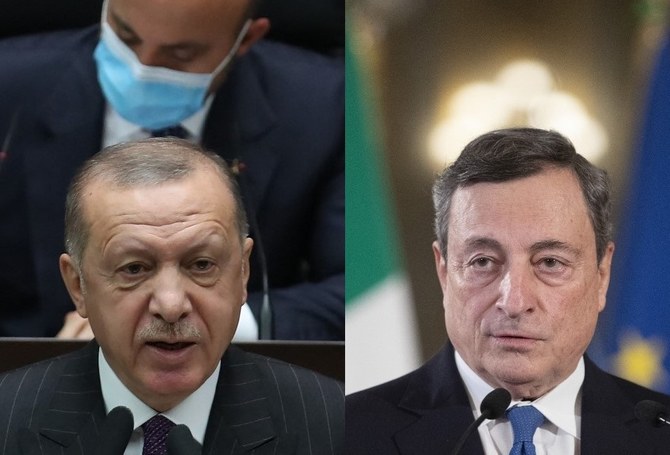
Italian PM calls Turkey’s Erdogan a dictator

Italian Prime Minister Mario Draghi, right, criticized Turkish President Recep Tayyip Erdogan over seating arrangements during an earlier meeting with European officials. (AFP)
Short Url
Updated 24 May 2023
Follow

Italian PM calls Turkey’s Erdogan a dictator

  • Mario Draghi: I am very sorry for the humiliation that the president of the commission had to suffer with these, let’s call them for what they are, dictators
  • The Turkish leader came under a torrent of criticism after images went viral of von der Leyen being left without a seat during their meeting in Ankara

ROME: Italian Prime Minister Mario Draghi on Thursday described Turkish President Recep Tayyib Erdogan as a dictator, in remarks that risk further souring EU-Turkey ties.
He was speaking at a news conference after being asked about a diplomatic row over seating arrangements during a meeting between Erdogan and European Commission President Ursula von der Leyen on Tuesday.
“I am very sorry for the humiliation that the president of the commission had to suffer with these, let’s call them for what they are, dictators, but with whom we need to cooperate,” Draghi told reporters.

The Turkish leader came under a torrent of criticism after images went viral of von der Leyen being left without a seat during their meeting in Ankara, which also included European Council President Charles Michel.
Official images later showed her seated on a sofa opposite Turkish Foreign Minister Mevlut Cavusoglu.
The Italian ambassador to Ankara was summoned to the foreign ministry over Draghi’s comments, Turkey’s state-owned Anadolu news agency reported, and Foreign Minister Mevlut Cavusoglu slammed the remarks.
“We strongly condemn the appointed Italian Prime Minister Draghi’s unacceptable, populist discourse and his ugly and unrestrained comments about our elected president,” Cavusoglu wrote on Twitter.
Earlier on Thursday, Cavusoglu said that the seating at the meeting was arranged in line with the bloc’s demands and international protocol and that Turkey was being subject to “unjust accusations”.
Turkey and the EU blamed each other for the arrangements during the meeting, which was meant to set a more positive tone in relations after months of spats.
Several European Parliament groups demanded an investigation into how von der Leyen was left standing while Michel took a seat.


British navy says it tracked Russian sub for three days in Channel

Updated 8 sec ago
Follow

British navy says it tracked Russian sub for three days in Channel

  • The Russian ships had arrived from the North Sea and entered the Channel.
  • “Expert aircrew were prepared to pivot to anti-submarine operations if Krasnodar had dived below the surface,” the statement said

LONDON: The British navy said Thursday it tracked a Russian submarine navigating through the Channel for three days, as it steps up efforts to police its seas against such threats.
A British naval supply ship with an on-board helicopter was deployed to track the stealthy Kilo-class submarine Krasnodar and the tug Altay, the Royal Navy said in a statement.
The Russian ships had arrived from the North Sea and entered the Channel.
“Expert aircrew were prepared to pivot to anti-submarine operations if Krasnodar had dived below the surface,” the statement said.
But it sailed on the surface throughout the operation, despite unfavorable weather conditions.
Near the island of Ouessant, off northwest France, the British said they handed over monitoring of the vessels to a NATO ally, without saying which one.
The British military carried out a similar shadowing operation in July, after spotting the Russian sub Novorossiysk in its territorial waters.
Defense minister John Healey announced on Monday the launch of a multi-million pound program to improve the Royal Navy’s capabilities in the face of Moscow’s “underwater threats.”
According to London, Russian submarine activity in British waters has increased by about a third over the past two years.
In early December, the UK and Norway signed a cooperation agreement to jointly operate a fleet of frigates to “hunt down” these submarines in the North Atlantic.