

BRUSSELS: The European Commission hit out Wednesday after its chief Ursula von der Leyen was left without a chair as Turkey’s president sat down for talks with her male counterpart.
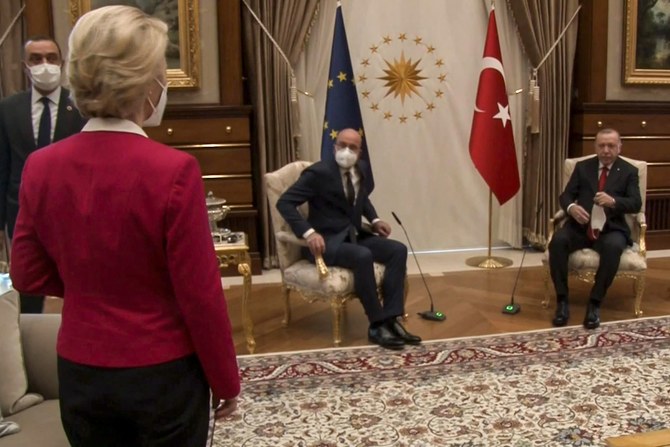
Video from Tuesday’s encounter in Ankara showed von der Leyen flummoxed as Recep Tayyip Erdogan and European Council president Charles Michel took two chairs in front of the EU and Turkish flags.
“Ehm,” muttered the former German defense minister, holding out her arms in apparent exasperation.
Eventually she was seated on a sofa a little further away from her counterparts, opposite Turkey’s foreign minister — someone below her in the pecking order of diplomatic protocol.
Von der Leyen, as president of the European Commission, is head of the EU executive. Michel, president of the European Council, represents member state governments. Brussels expects both to be treated with the protocol reserved for a head of government.
“The president of the commission was clearly surprised,” European Commission spokesman Eric Mamer said, insisting von der Leyen should have been treated “exactly in the same manner” as Michel.
“She does consider that these issues are important and need to be treated appropriately, which they clearly were not,” Mamer said.
The faux pas — quickly dubbed “sofagate” online — came at a delicate moment as the EU and Turkey look to rebuild ties despite concerns over Ankara’s record on rights, including discrimination against women.
Erdogan angered Brussels ahead of the visit by the bloc’s chiefs by announcing he was withdrawing Turkey from the Istanbul Convention on preventing violence against women and children.
Speaking after the meeting with the Turkish leader, von der Leyen stressed that “human rights issues are non-negotiable.”
“I am deeply worried about the fact that Turkey withdrew from the Istanbul Convention” she said.
“This is about protecting women, and protecting children against violence, and this is clearly the wrong signal right now.”
Spokesman Mamer said that the problem surrounding von der Leyen’s seating during the meeting with Erdogan had “sharpened her focus on the issue.”
The perceived slight to the first woman ever to occupy one of the EU’s top two roles raised hackles back in Brussels.
“First they withdraw from the Istanbul Convention and now they leave the President of European Commission without a seat in an official visit. Shameful. #WomensRights,” wrote Spanish European Parliament member Iratxe Garcia Perez.
German MEP Sergey Lagodinsky wrote of von der Leyen’s utterance that “’Ehm’ is the new term for ‘that’s not how EU-Turkey relationship should be’.”
But not all the ire was directed at the Turkish side.
Dutch MEP Sophie in ‘t Veld was left questioning why Michel was “silent” as his female colleague was left without a seat.
There was no immediate comment from Michel’s spokesman or the Turkish presidency over the incident.
Relations between Brussels and Ankara were severely strained last year as tensions spiralled over Turkish gas exploration in the eastern Mediterranean.
The EU is eyeing improved cooperation after a diplomatic offensive by Erdogan over the past few months aimed at mending ties between the neighbors.
The bloc has been encouraged by Turkey resuming talks with Greece over a disputed maritime border and moves to restart peace efforts over divided EU member Cyprus.
Brussels has shelved sanctions against Ankara and is offering economic and diplomatic incentives — but insists Erdogan must maintain the current calm and engage constructively on key issues.