

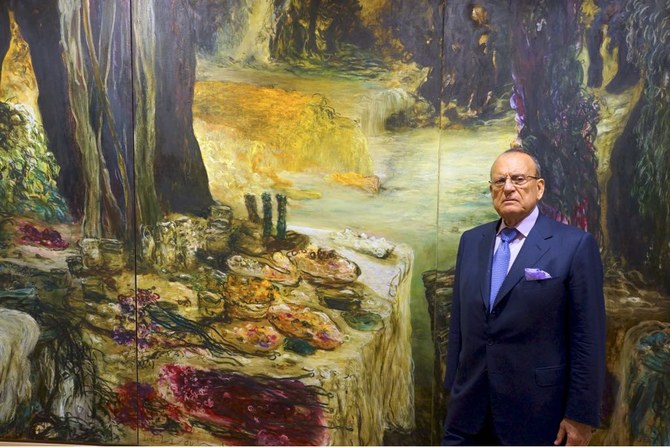

DUBAI: Ramzi Dalloul, the Palestinian-born Lebanese businessman, economist and art collector, known for his expansive collection of over 3,000 works by Arab artists from across the Middle East, passed away March 24 in London from cancer-related health complications.
What he leaves behind is a legacy. During his lifetime he amassed one of the largest collections of modern and contemporary Arab art, which continues to occupy an entire building spanning six floors in downtown Beirut. Housed inside are some of the greatest names in Middle Eastern art, including Paul Guiragossian, Ayman Baalbaki, Nabil Nahas, Dia Azzawi, Adam Henein, Abdul Rahman Katanani, Mahmoud Mukhtar, Salwa Raouda Choucair and Alfred Basbous, among many others.
An elegant man with an acute eye and witty demeanor, Dalloul was born in Haifa in 1935. After studying at the American University of Beirut (AUB), he moved to Cairo where he studied aeronautical engineering. He then moved to the US where he obtained an MBA from Columbia Business School. In 1968, he received his PhD in economics from Columbia University.
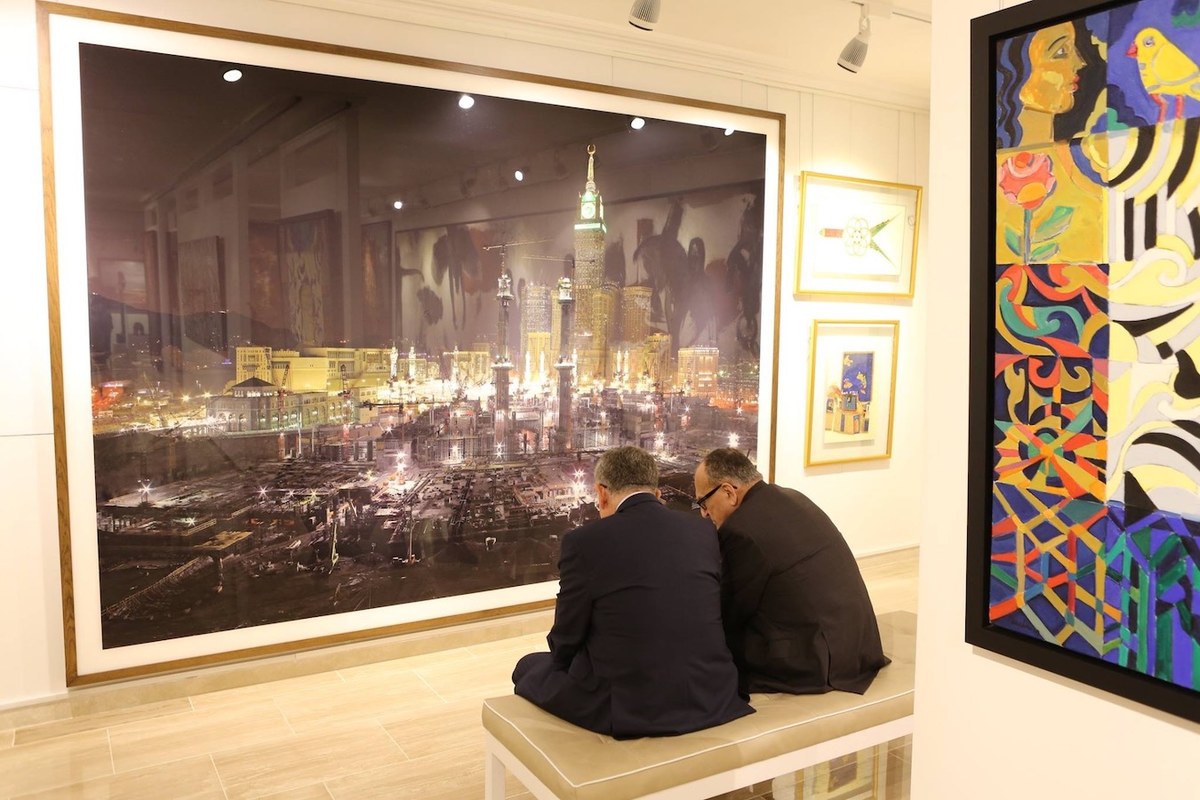
Dr. Ramzi Dalloul with PM Fouad Seniora, facing the work of AHMED MATER (1979), Saudi Arabia, “ARTIFICAL LIGHT,” 2012. (Courtesy of Ramzi and Saeda Dalloul Art Foundation)
He worked at the UN Economic Directorate for the Middle East in New York until 1970, when he moved to Beirut as a senior economist for the UN Economic and Social Commission for West Asia. From 1974 he led the Arab Company for Projects and Development as the board’s chairman and CEO, where he conducted economic research in countries such as Saudi Arabia, Sudan and Iraq.
During the Lebanese Civil War, which began in 1975, Dalloul moved to Paris but always kept his home in Beirut.
Throughout his career, and together with a multinational team of economists, Dalloul developed strategies and policies to help stimulate economic growth in developing nations, particularly in the Arab world. But it was in the power of art that he believed most fervently. Throughout his life he held steadfast to the belief that by educating people on Middle Eastern history, culture and current affairs through art, the Middle East might come closer to solving its myriad political and social issues.
“We need to use art as an instrument to educate the people,” he once told Harper’s Bazaar Arabia in 2016. “We always hear statesmen in the West say that what the Middle East is battling is a generational struggle that will take a long time to win. It is a battle of ideas and doctrines and the people of the region will need to take a lead in this fight. It will not be done by planes, warriors or by armies. It is a battle of ideas.” Art, believed Dalloul, is filled with ideas that reflect upon a certain moment in history.
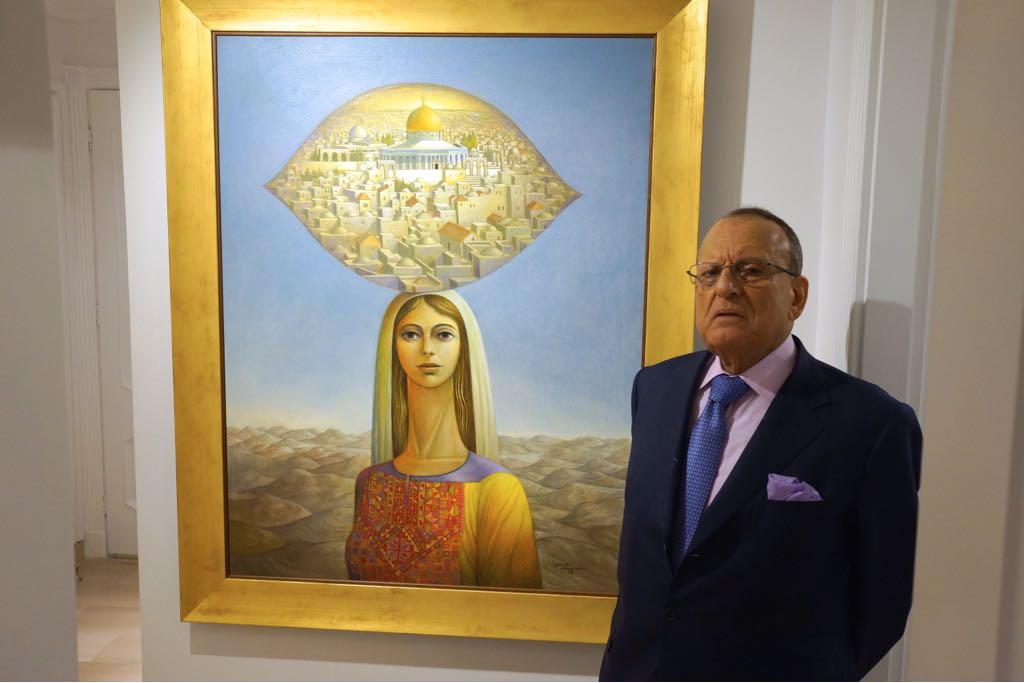
Dr. Ramzi Dalloul, with the work of SLIMAN ANIS MANSOUR (1947), Palestine, “The Daughter of Jerusalem,” 1978. (Courtesy of Ramzi and Saeda Dalloul Art Foundation)
He amassed his collection over several decades during trips around the Middle East. It was while he was on a business trip in Baghdad that he purchased his first piece. His curiosity lured him to museums, such as the Gulbenkian Museum, which was later transformed to become the Saddam Modern Art Museum.
When he moved to Paris, he kept in touch with the Iraqi artists he had met. The collection kept expanding, and in every place he would travel to in the Middle East, he would buy art.
His collection is currently managed by his son Basel Dalloul, CEO and chairman of the Noor Group, a leading company in the field of information technology, who founded the Beirut-based Dalloul Art Foundation (DAF) in 2017. Pre pandemic, it hosted temporary exhibitions and is also known for its publicly digital database of the collection. The works in the collection have been loaned to eminent institutions around the region, including the Mathaf Arab Museum of Modern Art in Doha and the Sharjah Art Museum.
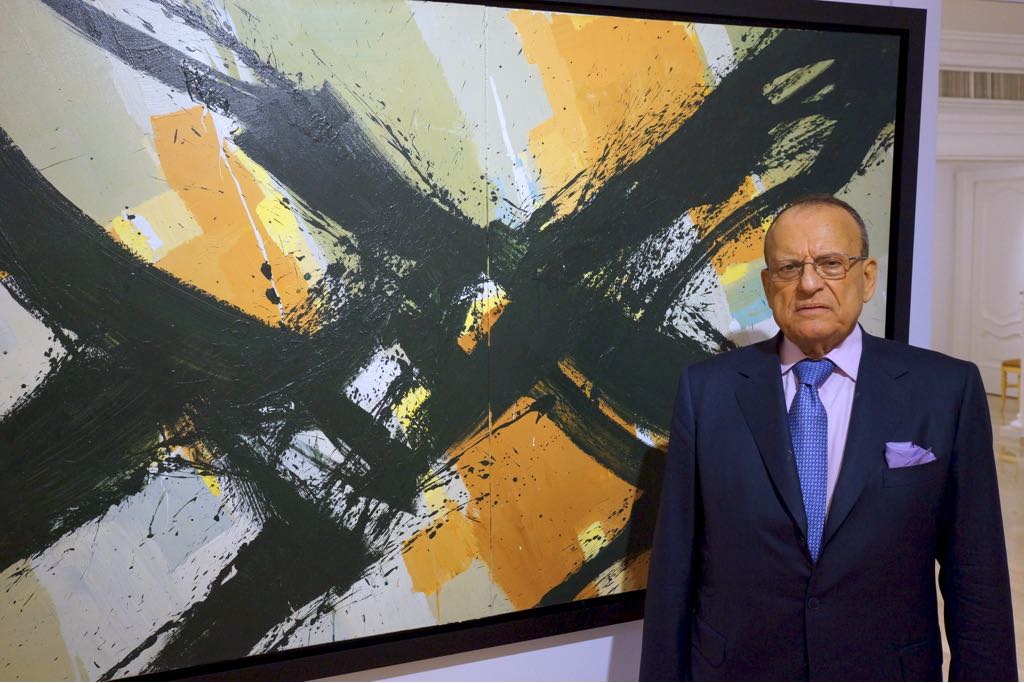
Dr. Ramzi Dalloul, with the work of MOHANNA DURRA (1938-2021), JORDAN, “Untitled,” 2010. (Courtesy of Ramzi and Saeda Dalloul Art Foundation)
“While my father does indeed have so many great accomplishments, I would have to say his greatest was his impact on Arab art, and the market for it,” said Basel Dalloul. “If there were a single person to point to, in terms of who revolutionized this market, and the international interest in it, it would be Dr. Ramzi Dalloul.
“As far as my dad’s legacy is concerned, for the collection, housed at the Ramzi and Saeda Dalloul Art Foundation, we will continue to do the important work of researching, introducing and archiving Arab art for local and international audiences.”
In July 2017, DAF announced that Dalloul’s long-term dream to build a private museum in Lebanon in order to highlight pioneering Arab artists would be realized in cooperation with the Beirut Arab Art Museum. The museum is now on hold due to the present situation in Lebanon.
One of the Arab world’s greatest champions, his legacy lives on through the art he collected and his vision to better serve humanity through art that unites and informs.


