

Yemen peace efforts falter as Houthis demand direct flights to Iran

1 / 2
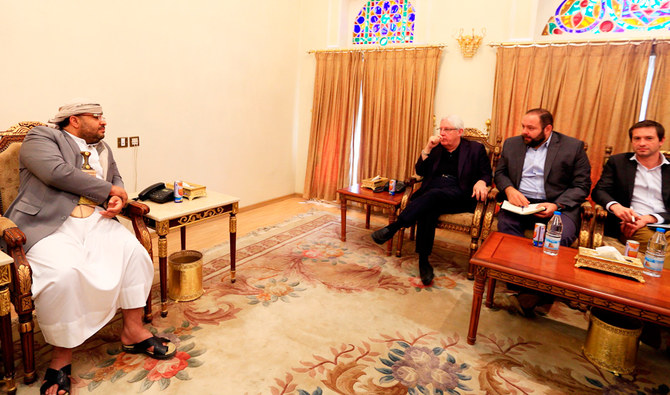
UN envoy to Yemen Martin Griffiths (3rd-R) meets with Mohammed Ali al-Houthi (L), President of the Huthi Revolutionary Committee, in the capital Sanaa. (AFP file photo)
2 / 2
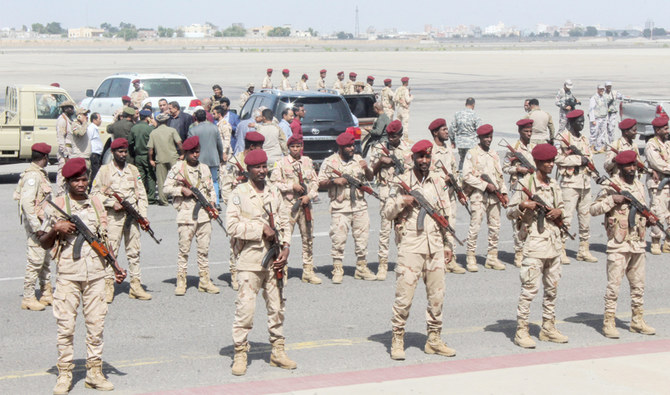
Military personnel stand guard at Yemen’s Aden Airport. (File/AFP)
Short Url
Updated 06 April 2021
Follow

Yemen peace efforts falter as Houthis demand direct flights to Iran

  • Houthis demanded arranging unchecked direct flights to Iran, Syria and Lebanon, halting Arab coalition airstrikes, and easing restrictions on traffic to and from the seaport
  • Government renews its accusations about Teharan-backed militias not being serious about dialogue

AL-MUKALLA: UN-brokered peace efforts to end the war in Yemen have made no progress, with the Houthis and government squabbling over key issues such as flights from Sanaa airport, halting military operations and airstrikes, and Hodeidah seaport revenues, a senior government official told Arab News.

During talks with the UN Special Envoy for Yemen Martin Griffiths and Omani mediators, the Houthis demanded arranging unchecked direct flights to Iran, Syria and Lebanon, halting Arab coalition airstrikes, and easing restrictions on traffic to and from the seaport as preconditions for agreeing to a truce, the Yemeni government official said.

The official spoke on condition of anonymity because he was not authorized to brief reporters.

The government has rejected the Houthis’ demands.

It insists on arranging inspected flights from Sanaa to limited regional and international destinations such as Egypt, India, Sudan, Jordan and Saudi Arabia. It also wants the Houthis to stop their military operations before airstrikes are halted, and for seaport revenues to be deposited into the central bank in Hodeidah and used to pay public servants.

If the Houthis agreed to those demands, the government would then engage in direct talks with them to end the war, the official said.

“The Houthis are demanding that the ceasefire be divided: First halting airstrikes and then stopping military operations on the ground,” the official told Arab News.

The government is concerned that the Houthis might ferry fighters and weapons from Iran on direct flights.

The Houthis might also exploit the absence of Arab coalition warplanes to advance on the ground because airstrikes have foiled their attempt to make gains, according to military officers.

Griffiths and the US envoy to Yemen, Tim Lenderking, have shuttled between Riyadh and Muscat to convince the Yemeni President Abed Rabbo Mansour Hadi and the Houthis to accept their ideas for ending the war.

FASTFACT

Yemen’s government is concerned that the Houthis might ferry fighters and weapons from Iran on direct flights.

Those ideas are an immediate truce, followed by other measures to ease the country’s humanitarian crises such as opening airports and seaports, paying public servants and then later resuming a political process.

Griffiths’ spokeswoman, Ismini Palla, said on Monday that the envoy had made progress in reducing the differences between warring factions that were impeding efforts to reach a peace deal.

“We are familiar with their negotiation positions and with the gap between these positions,” she told Arab News. “And we are indeed making progress in narrowing down these differences with the help of a renewed regional and international momentum aimed at helping Yemen find a peaceful way out of this conflict.”

The Kingdom’s initiative for ending the war, unveiled last month by Saudi Foreign Minister Prince Faisal bin Farhan, has energized peace efforts and led to heightened diplomatic activity in the region to find a settlement.

This initiative includes a truce, reopening Sanaa airport and Hodeidah seaport, and resuming peace talks under UN supervision.

On Monday, the Yemeni government renewed its accusations about the Houthis not being serious about striking a peace deal, citing the rebels’ continuing military operations across the country, mainly in the central province of Marib.

During a meeting with the UAE ambassador to Yemen, Salem Al-Ghafli, Yemen’s Foreign Minister Ahmed Awadh bin Mubarak said the Houthis were moving ahead with a large-scale offensive on Marib city, putting the lives of tens of thousands of displaced people at risk.

The minister also warned that the Houthi military operation and its missile strikes on displacement camps in Marib would ruin peace efforts.

He renewed the government’s demands - that the international community pressure Iran to stop meddling in Yemen’s affairs by arming and financing the Houthi militia.


Palestinian PM: Gaza reconstruction advancing amid US talks, Saudi support

In an interview with Arab News, Mohammed Mustafa said “Palestinian objective is clear,’ but we need to ‘get Gaza right first.’
Updated 21 January 2026
Follow

Palestinian PM: Gaza reconstruction advancing amid US talks, Saudi support

  • In an interview with Arab News, Mohammed Mustafa said “Palestinian objective is clear,’ but we need to ‘get Gaza right first’
  • Speaking at Davos panel, PM calls Kingdom a key stakeholder in the Palestinian cause

DAVOS: Palestinian Prime Minister Mohammed Mustafa told Arab News that progress is underway in Gaza’s reconstruction talks, with clear dialogue between the Palestinian Authority, US President Donald Trump and Special Envoy Steve Witkoff.

“I think the Palestinian objective is pretty clear, it has been for a long time, which is to establish their own independent state, (achieve) international resolution,” Mustafa said, noting that “we need to get Gaza right first.”

Despite a ceasefire taking hold earlier in 2025, Gaza remains under what the international community describes as an Israeli-enforced blockade. Basic supplies such as food and medicine are still subject to Tel Aviv’s scrutiny, which controls all access in and out of the Strip.

On Sunday, Trump announced that his Gaza plan had entered its second phase, in which Hamas would release all remaining hostages, Israel would free more Palestinian prisoners and fully withdraw its forces — a step international actors say should pave the way from ceasefire to lasting peace.

The formation of a technocratic National Committee for the Administration of Gaza, or NCAG, composed of Palestinian figures, marks the first concrete step toward implementing the plan and restoring Palestinian ownership of the next phase.

A precise timeline for reconstruction remains unclear, with analysts warning that major works hinge on Hamas disarmament — a politically fraught task assigned to the Gaza Peace Board.

“It’s going to take more than two years to fix Gaza, but at least we want to make sure that things are in the right direction,” continued Mustafa, adding that the West Bank remains part of the broader conversation.

He stressed the urgency of reunifying Gaza’s institutions with the West Bank to achieve the PA’s political goal of independence. 

“Our priority is what’s happening to our people in Gaza today. Despite four months passing (after) the ceasefire, people are still dying. Yes, there is a ceasefire but it’s not fully observed due to Israeli military actions,” he said, stressing that “shelter is the biggest challenge” at the moment.

Mustafa revealed he held “very active and useful” talks with US officials on Tuesday, saying both sides “share the same goals” on the matter.

Later in his panel, Mustafa said a Palestinian reform plan is in the works with the help of partners including Saudi Arabia.

In a session at the World Economic Forum in Davos, Mustafa said Saudi Arabia and other partners such as Egypt and Jordan were not just contributors but key stakeholders in the Palestinian cause.

“Saudi Arabia along with France have been working with us on the two state solution and integrating it,” he said.

“We want to work with the board of peace to ensure that they do their part of things to prepare for reconstruction efforts,” he added.

Mustafa said although some view the Oslo treaty as outdated, it still holds its place as an internationally recognized framework.

“According to the Oslo agreement, Israel should have withdrawn from most of the West Bank and Gaza. We want to see Israel respecting this agreement,” he said.

“The Israelis did not respect the economic part of the treaty. We are praying for a heavy price, not only in Gaza and people being killed every day. But also actions on the ground in the West Bank. We said clearly, we want to achieve our goals by peaceful means,” he said.

“Israel today holds $4 billion of our government’s money. They control the borders and collect the tax fines. For the past four months they have sent zero dollars. Our ability to govern has been impacted due to this,” Mustafa said.

In a sideline interview with Arab News, Palestinian Ambassador to Switzerland Ibrahim Mohammad Khraishi said that he met an Egyptian minister who expressed hope that the Rafah crossing could soon reopen on both sides.

“We need the understanding from all,” Khraishi said. “Yes, we have this administrative committee (as part of the Gaza Peace Board), but without the Palestinian Authority, they cannot deliver. Because we have everything. We have the institutions, we have the government,” Khraisi said.

Commenting on recent West Bank developments, including Israeli bulldozers razing the UNRWA compound in occupied East Jerusalem on Tuesday, he warned: “This is the scenario for the Israelis. For them, there is nothing to talk about. It’s total crash and destruction. Now, what they are doing in West Bank is on the way.”