

New turmoil in Turkey as veteran navy chiefs held

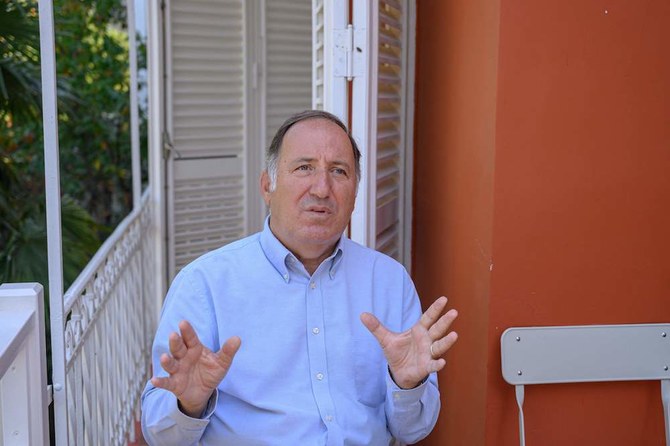
Retired Turkish admiral and author Cem Gurdeniz at Heybeliada, on the Prince Islands in the Sea of Marmara, near Istanbul, August 19, 2020. (AFP)
Short Url
Updated 05 April 2021
Follow

New turmoil in Turkey as veteran navy chiefs held

  • 10 retired admirals detained over public criticism of President Recep Tayyip Erdogan’s ambitious Istanbul canal project
  • Cem Gurdeniz, one of the proponents of Turkey’s contested “Blue Homeland” maritime defense concept, is among the admirals detained over the so-called “Montreux letter”

ANKARA: Ten of Turkey’s most prominent former navy chiefs were arrested on Monday and accused of plotting a coup after they publicly criticized President Recep Tayyip Erdogan’s ambitious Istanbul canal project.

The 10 men detained were among 104 retired admirals who published a letter on Sunday urging Erdogan to abide by the terms of the Montreux Convention, a 1936 treaty aimed at demilitarizing the Black Sea by setting strict rules on warships’ passage through the Bosphorus and Dardanelles straits.

The president’s plan to build a 45-kilometre canal to the west of the Bosphorus leaves open the question of whether the old treaty will apply to the proposed new waterway. The former navy chiefs said the treaty “best protects Turkish interests.”
Erdogan told them on Monday: “The duty of retired admirals is not to publish declarations that hint at a political coup. In a country whose past is filled with coups, another attempt by a group of retired admirals can never be accepted.”

The Ankara chief prosecutor has accused the retired admirals of “using force and violence to get rid of the constitutional order” — the same wording used against Erdogan critics jailed in a crackdown that followed a failed coup in 2016.

Among those arrested was Cem Gurdeniz, regarded as a military hero in Turkey and one of the proponents of the country’s contested “Blue Homeland” maritime defense concept.

A group of former members of parliament on Monday urged Erdogan to maintain the 1936 treaty, which they said was strategically important for Turkey’s maritime security and sovereignty. “The core tenets of our republic cannot be discussed. Montreux can’t be opened for debate,” they said.

They also condemned the detention of the retired admirals for criticizing Erdogan’s canal plan, and warned: “We remind the government that we are still a state of law.”

Rich Outzen, a senior US Army adviser and member of the State Department policy planning staff, said he was dismayed by the crackdown. “I have no doubt most of the signers oppose the canal project on principled grounds and are sincerely concerned about Turkey’s Montreux convention rights,” he said.

“On the other hand, publishing a policy challenge as a group … rather than as individual commentators or members of political opposition parties raises some very bad memories in Turkey’s collective consciousness.

“If their goal was to strengthen the incumbent government by raising the specter of old coups and coup attempts, the AKP is exceptionally agile in moments like this.”

Opposition politicians believe the latest declarations will give Turkey’s government an excuse to criminalize anyone who opposes the Istanbul canal project.

“The retired admirals have offered the government an opportunity on a gold platter,” said Ali Babacan, leader of the breakaway DEVA Party.

“The government will use it to polarize those who don’t want the canal project and brand them as siding with the conspirators.”

The new row will add to the concerns of European Council President Charles Michel and European Commission chief Ursula von der Leyen before their meeting with Erdogan in Ankara on Tuesday. The talks are widely viewed as an attempt to repair strained relations between Turkey and the bloc.

An EU official said that the success of the talks depended on the Turkish president. “If Erdogan does not show himself to be cooperative then everything will be blocked,” the official said.

Stranger in Moscow: Leaked data details life of Assad in exile

Updated 5 sec ago
Follow

Stranger in Moscow: Leaked data details life of Assad in exile

  • Deposed dictator spends time ‘brushing up on ophthalmology,’ The Guardian reports

LONDON: More than a year after fleeing Syria, ousted former president Bashar Assad is living a secluded life of luxury in Moscow, with reports suggesting he has returned to studying ophthalmology while remaining cut off from political life.

Assad, who trained in London as an eye doctor before assuming power in 2000, was deposed in December 2024 as rebel forces advanced on Damascus, ending decades of his family’s rule. He fled the country overnight, with Russian assistance, after 14 years of civil war that left more than 600,000 people dead and nearly 14 million displaced.

According to sources cited by The Guardian newspaper in a report published on Monday, Assad is now living in or near Rublyovka, an exclusive gated community west of Moscow favored by Russia’s political and financial elite.

Despite his wealth and the security surrounding his exile, the former leader is said to be living a largely isolated life and is regarded as politically irrelevant in Moscow’s ruling circles.

A family friend told the newspaper that Assad has been studying Russian and revisiting his medical training, describing ophthalmology as a long-held passion. Russian authorities have reportedly barred him from engaging in any form of political or media activity.

Russia’s ambassador to Iraq confirmed in November that Assad was prohibited from making public appearances, despite being safe and under protection.

Sources told The Guardian that Assad left Syria without warning senior regime allies or members of his extended family, many of whom were forced to scramble to escape as the government collapsed. His brother Maher Assad, a senior military figure, was said to have remained in Damascus until the final moments, helping others flee.

In the months since the family’s escape from Syria, attention has reportedly focused on the health of Assad’s wife, Asma, who had been undergoing treatment in Moscow for leukaemia. According to sources familiar with the situation, her condition stabilized following experimental therapy.

While Assad himself remains largely invisible to the Russian public, his children have gradually adapted to life in the country. His daughter, Zein, graduated in June from Moscow’s prestigious MGIMO University, one of the few public sightings of Assad family members since their regime’s fall from power. His sons, Hafez and Karim, have withdrawn from social media and keep a low profile.

Despite prior hopes of relocating to the UAE, sources said the family now accepts that a permanent move out of Russia is unlikely in the near future, even as they continue to travel between Moscow and the Gulf.