

Foreign investors key to Arab market’s recovery

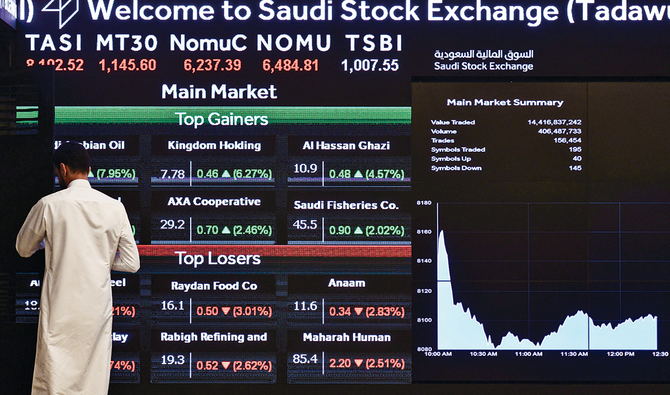
Saudi Stock Exchange Company CEO Khalid Al-Hussan said encouraging foreign investment would lighten the impact of the pandemic. (AFP/File)
Short Url
Updated 31 March 2021
Follow

Foreign investors key to Arab market’s recovery

  • The 11th annual conference was a two-day virtual event that was hosted by Saudi Arabia and concluded on Tuesday

JEDDAH: The important role of foreign investments in supporting the Arab region’s post-pandemic recovery was highlighted by keynote speakers during the second day of the Arab Federation of Exchanges.

The 11th annual conference was a two-day virtual event that was hosted by Saudi Arabia and concluded on Tuesday.

During a session discussing the Arab markets’ response to coronavirus (COVID-19), Saudi Stock Exchange Company (Tadawul) CEO Khalid Al-Hussan said stimulating and encouraging foreign investment would lighten the impact of the pandemic.

“Looking at COVID-19, if we are an isolated exchange, we would be impacted more by the pandemic compared to if we were an integrated platform and economy,” Al-Hussan said.

As part of its Vision 2030, Saudi Arabia is working on mobilizing investments in the country, especially with the recent privatization law and the launch of several high-profile megaprojects, such as the revolutionary zero-carbon city “The Line” and the “Coral Bloom” luxury Red Sea project.

Saudis are keen to open up the country and integrate it with the rest of the world. From a capital perspective, stock exchanges do not necessarily need to compete with each other, Al-Hussan said.

“Tadawul benefitted from opening this channel,” he said. “The inclusion we made has positively impacted the cash inflow by billions in the Saudi market.”

According to an Al Eqtisadiah report, Tadawul collected SR5.5 billion ($1.46 billion) in share sale proceeds last year. Despite the pandemic, that represents a year-on-year increase of 34 percent, excluding the bumper 2019 Aramco Initial Public Offering (IPO).

According to Ahmed Shams El-Din, the managing director and global head of research at EFG Hermes, Saudi Arabia is currently the most diversified market in the region.

He said the Kingdom has “a very active IPO compared to other markets,” and pointed out that the UAE market lacks retail and domestic support, while Egypt lacks foreign support.

By the end of 2020, Tadawul saw an increase of 22 percent in the number of qualified foreign investors (QFI). 

“We have been witnessing a big activity since the beginning of this year with QFIs owning around 15 percent of the free float shares in a market worth $2.5 trillion,” Tadawul Chief of Markets Mohammed Sulaiman Al-Rumaih told delegates.

“There is a growing interest from investors that we need to do some enhancement. But every enhancement they ask for is either something we planned for or we need to tweak existing services and products for it.”

The Arab Federation of Exchanges was the largest gathering of regional financial institutions in the region this year. During the first day of the conference, keynote speakers focused on the role of environmental, social and corporate governance practices in achieving economic growth and financial prosperity.

Ministerial meeting of the International Labour Conference concludes in Saudi Arabia

Updated 5 sec ago
Follow

Ministerial meeting of the International Labour Conference concludes in Saudi Arabia

RIYADH: The ministerial meeting of the third International Labour Conference concluded Jan. 26 in Riyadh.

The meeting was chaired by Saudi Arabia’s Minister of Human Resources and Social Development Ahmed bin Sulaiman Al-Rajhi and attended by the Director-General of the International Labour Organization, Gilbert Houngbo, and 40 labor ministers from countries representing the G20, Europe, and Asia as well as the Middle East, Africa, and the Americas.

In his opening remarks, Al-Rajhi emphasized the importance of constructive dialogue, stressing that the ministerial meeting is a cornerstone for strengthening international cooperation.

He explained that it aims to facilitate the exchange of constructive visions and experiences among ministers and senior officials, focusing on practical experiences in current labor markets and areas of future cooperation capable of achieving tangible results.

The meeting’s discussions focused on a number of key themes, aiming to stimulate the practical exchange of experiences among participating countries and align employment policies with future workforce readiness requirements. It also focused on identifying the most effective factors for successful employment programs and determining the mechanisms necessary to ensure consistency and integration among labor market policies.

The gathering also resulted in an agreement among the participating ministers on six crucial actions. These include developing methodologies for skills recognition and transferability by improving skills recognition and enhancing their flexibility in the labor market to facilitate mobility between sectors and across borders.

They also agreed on guiding the responsible use of artificial intelligence in labor market systems by employing AI in workforce decisions while ensuring transparency, governance, and oversight.

An additional action focuses on adapting social protection systems to support mobility and career transitions by ensuring that social protection is transferred with workers as the nature of work and career paths change.

In addition, the ministers agreed on promoting the use of data to actively connect individuals with opportunities and strengthening the labor market infrastructure through data and analytics to support the link between employment and skills development.

They further agreed on enhancing workforce planning to anticipate periods of disruption by preparing employment systems to withstand economic shocks and structural shifts.

Finally, they committed to improving pathways to first employment and return to the labor market by enabling pathways that connect individuals with meaningful and valuable career advancement opportunities.

The ministerial meeting is a pivotal element of the International Labour Conference, which has become a leading global platform for promoting evidence-based dialogue and supporting international cooperation on the future of labor markets.

This is achieved in partnership with leading international organizations, including the ILO, the World Bank, and the Organization for Economic Co-operation and Development as well as the UN Development Program, the International Organization for Migration, and the UN Tourism Organization. 

Additional organizations include the King’s Trust Fund International and the Mohammed bin Salman Foundation.

The International Labour Conference, taking place on Jan. 26 to 27 at the King Abdulaziz International Conference Center, is themed “Shaping the Future.” It features high-level participation from labor ministers, heads and representatives of international organizations, the private sector, and academic institutions as well as policymakers, thought leaders, and experts from around the world.

More than 200 speakers are participating in over 50 dialogue sessions, with an expected attendance of over 10,000 participants from within the Kingdom and abroad.