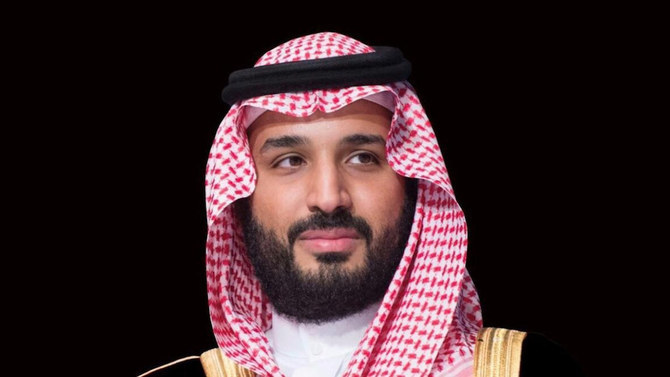
RIYADH: Saudi Arabia’s Crown Prince Mohammed bin Salman made a phone call to his Abu Dhabi counterpart Sheikh Mohammed bin Zayed, Saudi Press Agency (SPA) reported on Monday.
During the call, they discussed the Saudi Green Initiative and the Middle East Green Initiative announced by the crown prince on Saturday, which call for partnerships with regional countries to face the environmental challenges in the region, improve the quality of life, and implement the largest afforestation project in the world that will contribute to restoring millions of hectares of degraded land, in addition to reducing global carbon levels.
Prince Mohammed bin Salman announced the green initiatives on Saturday, which aim to reduce carbon emissions in the region by 60 percent, tackle deforestation, enhance the efficiency of oil production, and increase the contribution of renewable energy, in addition to multiple efforts to preserve the marine and coastal environment and increase the proportion of natural reserves.
The two leaders discussed “the importance of these initiatives in facing environmental challenges in the region and the world, and their role in improving the quality of life and public health,” SPA said.
Prince Mohammed bin Salman also made a phone call to Jordan’s King Abdullah II, who welcomed the initiatives and said his country was ready to cooperate with the Kingdom to achieve their goals.
Earlier on Monday, the crown prince made a phone call to Pakistani Prime Minister Imran Khan, who congratulated him on launching the two initiatives, praising the great impact they will have on the region and its inhabitants.
Prince Mohammed bin Salman also made a call to Djibouti’s President Ismail Omar Guelleh, where they discussed the environmental challenges facing the region, the economic, social and health impacts that follow, and the qualitative initiatives contained in the Middle East Green Initiative that addresses these challenges using modern and innovative methods and new technologies.
The crown prince also called Eritrean President Isaias Afwerki, where the two affirmed the Middle East Green Initiative is one of the most ambitious global initiatives in restoring degraded lands and reducing carbon levels.
Kuwait’s Cabinet praised the two initiatives, which it said “constitute a new start and an ambitious road map” that will contribute to protecting the earth, nature and the marine environment, combating the climate crisis, and facing many environmental challenges.
It also said that their “positive effects” will be seen throughout the Gulf and Middle East regions, and both initiatives are part of the Kingdom’s “pioneering role toward common international issues and as a continuation of its efforts during its presidency of the G20 last year.”
Egypt’s Ministry of Environment said the initiatives reflect the interest that Saudi Arabia attaches to environmental preservation and international climate action.
Ali Sabt, secretary general of the Organization of Arab Petroleum Exporting Countries (OAPEC), said the initiatives affirm Saudi Arabia’s pioneering role as a major global oil producer and will strengthen its active role in achieving stable global energy markets in general, and oil and gas markets in particular.
Sabt said they show the Kingdom’s desire to lead the next green era and its efforts to protect the planet during its G20 presidency, where a special declaration on the environment was issued.
He said that the two initiatives would contribute effectively to international efforts to combat climate change, enhance competitiveness, spark innovation and create millions of jobs, calling on international and regional organizations to also support the two initiatives.
Sabt said reducing greenhouse gas emissions requires continuous cooperation from countries around the world.
The leaders of each country welcomed the initiatives and said their countries were ready to actively support all efforts made by the Kingdom to achieve their goals.
Saudi Arabia’s crown prince discusses green initiatives with world leaders
https://arab.news/j2c46
Saudi Arabia’s crown prince discusses green initiatives with world leaders
- Regional leaders praised the green initiatives and said they were ready to work with the Kingdom to achieve their goals
Expats say Ramadan in Saudi Arabia feels unlike anywhere else
- As Riyadh slows by day and glows by night, residents reflect on faith, food and community
RIYADH: For many expatriates, Saudi Arabia has become a second home. Ramadan in the Kingdom offers a spiritual experience that they say is difficult to match elsewhere.
“Staying here during Ramadan means you can visit the holy cities, perform Umrah and practice Ramadan rituals in an unmatched spiritual atmosphere. The Ramadan vibes here are amazing,” said Ayman Hassan, an Egyptian national working in Riyadh for several decades.
Reduced working hours, bustling night markets and community iftars add to the appeal, he said, making it preferable to remain in what he calls the “homeland of Islam” rather than travel back during the holy month.
Rumana Shahid, an Indian homemaker in Riyadh, echoed that sentiment.
“I can say from my experiences of over a decade here that there is no other place better than Saudi Arabia to spend time in Ramadan and celebrate its purity,” she said. “You can sense the Ramadan spirit here everywhere. The streets at night are packed and everything that is dull during the day comes to life in the night.”
For many, the ability to pray Taraweeh in congregation and travel to Makkah and Madinah during the month deepens the experience.
“For those who are new to the Kingdom, there is a lot to look forward to, for a whole new spiritual experience,” Shahid said.
“Markets are open till sahoor, there is the crowd bustling in the streets keeping the night alive and those that are shopping to prepare themselves for the culmination of the month-long celebration with the Eid Al-Fitr,” she added.
Syed Faiz Ahmad, a Pakistani expat working here for three decades, said that Ramadan was not just a religious observance but a cultural phenomenon, reflected in acts of spirituality and social bonding.
“Every Muslim anxiously waits for the advent of the holy month of Ramadan,” he told Arab News. “I am also very excited when Ramadan begins to knock on the door.”
Dr. Kifaya Ifthikar, a Sri Lankan working in Riyadh, said that her family’s iftar spread was a mix of Saudi and Sri Lankan flavors.
“A customary dish on Sri Lankan iftar tables is a porridge made with rice and coconut, often complemented by the addition of beef or chicken, along with a spicy chili sauce. Bringing it to our iftar table here with dates, and some Saudi delicacies, is a must,” she said.
Many community organizations also organize iftar parties, enhancing community dining experiences.
AMUOBA Riyadh, a nonprofit organization of the alumni of Aligarh Muslim University (India), organizes annual iftar parties.
Dr. Inamullah Baig, president of the organization in Riyadh, told Arab News, “It is a beautiful opportunity for all of us to come together in the spirit of unity, gratitude and brotherhood.”
Ramadan in the Kingdom carries deep significance for non-Muslim residents as well. Ciara Phillips, a UK expat who has lived in Riyadh for five years, strings her house with lights, lanterns and Ramadan-themed decorations in preparation for a month that she has come to look forward to every year.
“There’s something about the rhythm of the season that draws you in, whether you’re fasting or not,” she said.
This year, Easter decorations are hung alongside them as there is a rare calendar overlap between Ramadan, the Lunar New Year and Lent, which all promote renewal, reflection and new beginnings— not to mention the distinctive atmospheres, rituals and traditional foods.
“Growing up Catholic, Lent was always about slowing down, giving something up, and paying more attention to the people around you,” Phillips said. “Ramadan, I’ve come to understand during my years in the Gulf, asks something remarkably similar. Both seasons were never really about what you give up. They’re about what you notice when you do. Both ask us to be a little more present. A little more human.”
As the schedule shifts during Ramadan, Phillips believes that this creates even more time during the day. “I walk the dogs, spend unhurried time with my husband and children, and somehow still manage to fit in iftar dinners and late-night art exhibitions,” she said. “It’s a wonderfully contradictory month — incredibly social, yet with this beautiful, quiet hush running underneath it all.”
“When an entire city is collectively pausing and reflecting, you can’t help but absorb some of that, regardless of your own faith,” she added.
What truly ties the holy month together is the sense of community. Families gather at the iftar table while friends catch up later for sahoor, creating more purposeful meetings that treasure the present.
Phillips says that she and her family often receive invitations for iftar from friends, colleagues and the communities she is part of here.
“There’s something about gathering around a table at that particular moment, after a day of fasting, just as the city holds its breath at sunset, that breaks down every barrier,” she said.
She recalls an iftar organized by Kingdom Creatives at Al-Mashtal last year: “Everyone brought a dish with them, and food became the conversation starter. It sparked so many introductions and new friendships.
“My children receive wonderful invitations, too, from their school friends. And their local international school has an annual iftar for the whole family with prayer, poetry and performance, and Ramadan-related crafts, activities and stalls. It makes the month feel very alive for our whole family.”