Expats say Ramadan in Saudi Arabia feels unlike anywhere else

1 / 6
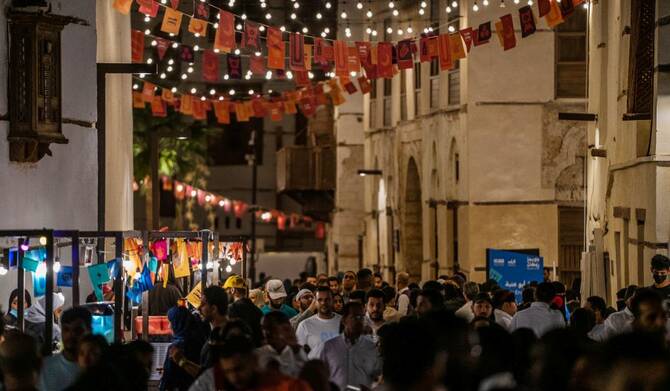
Expats love celebrating the holy month of Ramadan in Saudi Arabia for the unmatched spiritual atmosphere, the ability to perform Umrah and the unique, vibrant cultural experience. (AN Photo)
2 / 6
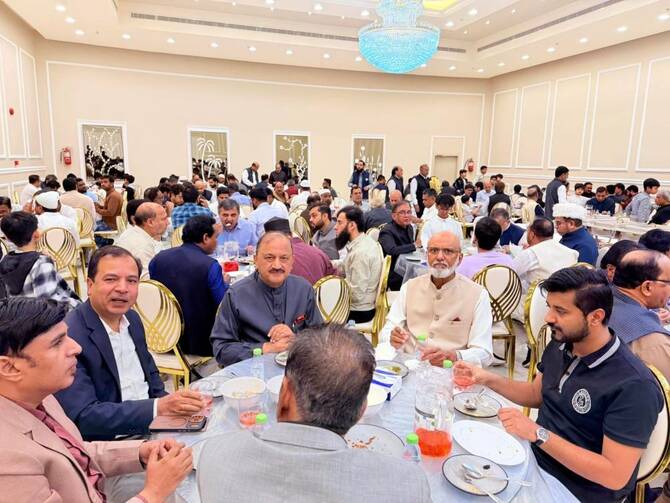
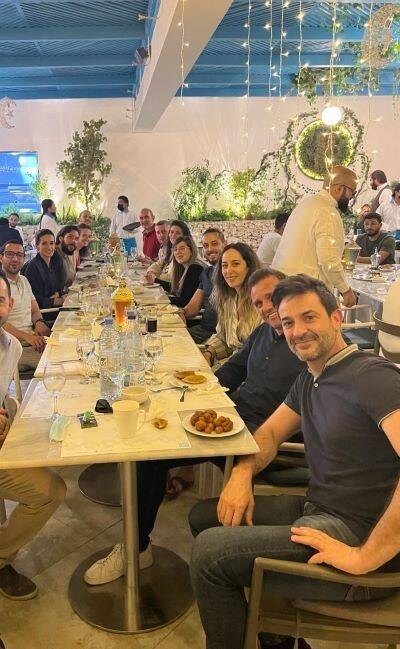
AMUOBA Riyadh, a non-political, non-profitable organization of the alumni of Aligarh Muslim University, organized its annual iftar party on Friday, February 20. (Supplied)
3 / 6
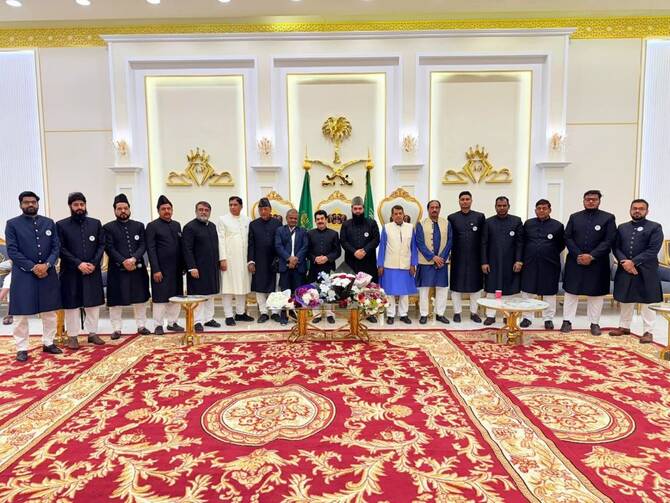
AMUOBA Riyadh, a non-political, non-profitable organization of the alumni of Aligarh Muslim University, organized its annual iftar party on Friday, February 20. (Supplied)
4 / 6
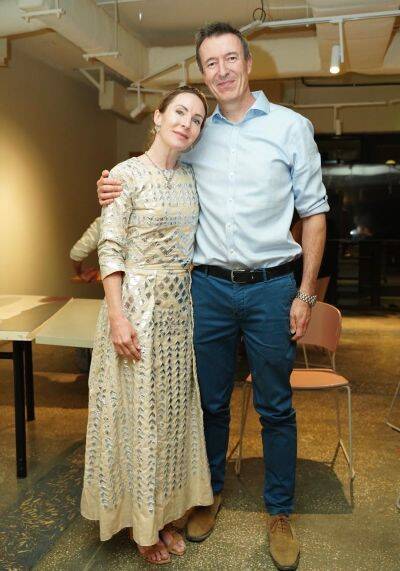
Ciara Phillips and her husband at the Kingdom Creatives pot luck iftar at Al-Mashtal Creative Incubator. (Ciara Phillips)
5 / 6
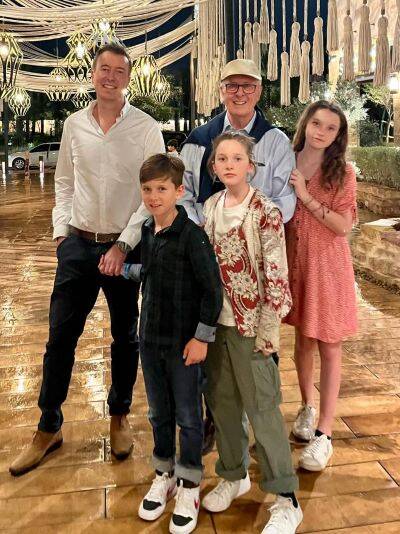
The extended Phillips family at Al-Bujairi Terrace for iftar. (Ciara Phillips)
6 / 6
Expats love celebrating the holy month of Ramadan in Saudi Arabia for the unmatched spiritual atmosphere, the ability to perform Umrah and the unique, vibrant cultural experience. (AN Photo)
Short Url
Updated 04 March 2026
Follow

Expats say Ramadan in Saudi Arabia feels unlike anywhere else

  • As Riyadh slows by day and glows by night, residents reflect on faith, food and community
  • Dr. Inamullah Baig: It is a beautiful opportunity for all of us to come together in the spirit of unity, gratitude and brotherhood

RIYADH: For many expatriates, Saudi Arabia has become a second home. Ramadan in the Kingdom offers a spiritual experience that they say is difficult to match elsewhere.

“Staying here during Ramadan means you can visit the holy cities, perform Umrah and practice Ramadan rituals in an unmatched spiritual atmosphere. The Ramadan vibes here are amazing,” said Ayman Hassan, an Egyptian national working in Riyadh for several decades.

Reduced working hours, bustling night markets and community iftars add to the appeal, he said, making it preferable to remain in what he calls the “homeland of Islam” rather than travel back during the holy month.

Rumana Shahid, an Indian homemaker in Riyadh, echoed that sentiment. 

“I can say from my experiences of over a decade here that there is no other place better than Saudi Arabia to spend time in Ramadan and celebrate its purity,” she said. “You can sense the Ramadan spirit here everywhere. The streets at night are packed and everything that is dull during the day comes to life in the night.”

For many, the ability to pray Taraweeh in congregation and travel to Makkah and Madinah during the month deepens the experience.

“For those who are new to the Kingdom, there is a lot to look forward to, for a whole new spiritual experience,” Shahid said.

“Markets are open till sahoor, there is the crowd bustling in the streets keeping the night alive and those that are shopping to prepare themselves for the culmination of the month-long celebration with the Eid Al-Fitr,” she added.

Syed Faiz Ahmad, a Pakistani expat working here for three decades, said that Ramadan was not just a religious observance but a cultural phenomenon, reflected in acts of spirituality and social bonding.

“Every Muslim anxiously waits for the advent of the holy month of Ramadan,” he told Arab News. “I am also very excited when Ramadan begins to knock on the door.”

Dr. Kifaya Ifthikar, a Sri Lankan working in Riyadh, said that her family’s iftar spread was a mix of Saudi and Sri Lankan flavors.

“A customary dish on Sri Lankan iftar tables is a porridge made with rice and coconut, often complemented by the addition of beef or chicken, along with a spicy chili sauce. Bringing it to our iftar table here with dates, and some Saudi delicacies, is a must,” she said.

Many community organizations also organize iftar parties, enhancing community dining experiences.

AMUOBA Riyadh, a nonprofit organization of the alumni of Aligarh Muslim University (India), organizes annual iftar parties.

Dr. Inamullah Baig, president of the organization in Riyadh, told Arab News, “It is a beautiful opportunity for all of us to come together in the spirit of unity, gratitude and brotherhood.”

Ramadan in the Kingdom carries deep significance for non-Muslim residents as well. Ciara Phillips, a UK expat who has lived in Riyadh for five years, strings her house with lights, lanterns and Ramadan-themed decorations in preparation for a month that she has come to look forward to every year. 

“There’s something about the rhythm of the season that draws you in, whether you’re fasting or not,” she said. 

This year, Easter decorations are hung alongside them as there is a rare calendar overlap between Ramadan, the Lunar New Year and Lent, which all promote renewal, reflection and new beginnings— not to mention the distinctive atmospheres, rituals and traditional foods. 

“Growing up Catholic, Lent was always about slowing down, giving something up, and paying more attention to the people around you,” Phillips said. “Ramadan, I’ve come to understand during my years in the Gulf, asks something remarkably similar. Both seasons were never really about what you give up. They’re about what you notice when you do. Both ask us to be a little more present. A little more human.”  

As the schedule shifts during Ramadan, Phillips believes that this creates even more time during the day. “I walk the dogs, spend unhurried time with my husband and children, and somehow still manage to fit in iftar dinners and late-night art exhibitions,” she said. “It’s a wonderfully contradictory month — incredibly social, yet with this beautiful, quiet hush running underneath it all.”

“When an entire city is collectively pausing and reflecting, you can’t help but absorb some of that, regardless of your own faith,” she added. 

What truly ties the holy month together is the sense of community. Families gather at the iftar table while friends catch up later for sahoor, creating more purposeful meetings that treasure the present.

Phillips says that she and her family often receive invitations for iftar from friends, colleagues and the communities she is part of here. 

“There’s something about gathering around a table at that particular moment, after a day of fasting, just as the city holds its breath at sunset, that breaks down every barrier,” she said.

She recalls an iftar organized by Kingdom Creatives at Al-Mashtal last year: “Everyone brought a dish with them, and food became the conversation starter. It sparked so many introductions and new friendships. 

“My children receive wonderful invitations, too, from their school friends. And their local international school has an annual iftar for the whole family with prayer, poetry and performance, and Ramadan-related crafts, activities and stalls. It makes the month feel very alive for our whole family.”


How AI is powering Saudi Arabia’s video games industry

Updated 13 March 2026
Follow

How AI is powering Saudi Arabia’s video games industry

  • Technology is boosting efficiency and supporting local content development

RIYADH: Artificial intelligence is becoming a central force in Saudi Arabia’s rapidly expanding gaming and esports sector, shaping everything from game development and publishing to player analytics and competitive tournaments.

As the Kingdom accelerates its ambitions under Vision 2030, AI is increasingly being deployed not only as a technical tool but also as a strategic driver for industry growth and global competitiveness.

Saudi Arabia is integrating AI across studios, publishing platforms and esports operations to improve efficiency, expand local content creation, attract international investment and streamline tournament management. The broader goal is to position the Kingdom not only as one of the world’s largest gaming markets but also as a global hub for game development and esports infrastructure.

For Saudi studios seeking international audiences, understanding how AI systems generate results is also critical to maintaining cultural accuracy and relevance in game content. (Unsplash.com photo)

According to Saudi Arabia’s National Gaming and Esports Strategy, the Kingdom is home to more than 23.5 million gamers — around 67 percent of the population. Market revenues are projected to reach $1.36 billion by 2026. By 2030, the sector aims to contribute more than SR50 billion to the national GDP and create about 39,000 jobs.

Women represent 42 percent of gamers and 18 percent of esports players, among the highest participation rates in the region.

The Public Investment Fund, through its gaming arm Savvy Games Group, has invested billions of dollars in game studios, publishers and esports platforms worldwide. The investments are designed to strengthen local content creation while attracting global developers and investors to Saudi Arabia.

INNUMBERS

23.5 million Number of gamers in Saudi Arabia, representing about 67% of the population

$1.36 billion Revenue the Kingdom’s gaming market is expected to reach by 2026

SR50 billion Amount the gaming and esports sector aims to add to GDP to create 39,000 jobs by 2030

A spokesperson for Savvy Games Group told Arab News that AI is already integrated across its portfolio, particularly within ESL FACEIT Group.

“AI is used across our businesses. At ESL FACEIT Group, AI is already embedded in operations, particularly around data analytics and fair play,” the spokesperson told Arab News. “For example, EFG uses Minerva, an AI-powered moderation system that identifies and reduces toxic or abusive behavior by analyzing player communications and behavior patterns at scale. This enables faster and more consistent decisions and helps create healthier competitive environments for players.”

However, the spokesperson said AI itself does not automatically create a competitive advantage.

“AI tools are increasingly accessible to studios everywhere, which means they are not a competitive advantage on their own,” the spokesperson told Arab News. “The advantage comes from how clearly studios define their use cases and how effectively they apply AI to support their goals.”

For Saudi studios seeking international audiences, understanding how AI systems generate results is also critical to maintaining cultural accuracy and relevance in game content.

Within development studios, AI is helping accelerate production while lowering costs. AI-powered tools assist with concept art, 3D modeling, animation and world design, while automated testing systems can simulate thousands of gameplay scenarios to identify bugs and balance issues before release.

Steer Studios, for example, is applying AI in asset production and testing workflows. Automating repetitive tasks allows creative teams to devote more time to storytelling, gameplay design and world-building — key elements that distinguish successful games.

AI is also playing an important role in localizing content for Arabic-speaking audiences. Studios including Fahy Studios, Starvania Studio and Lobah Game Studio use AI for dialogue generation, translation and other localization tasks, helping Saudi-developed games reach global markets more quickly without losing cultural context.

For live-service and mobile games, maintaining player engagement is crucial to long-term revenue. AI systems track player behavior in real time, adjust difficulty levels, refine matchmaking systems and personalize in-game experiences.

Publishing platforms such as Nine66 and Sandsoft also rely on AI-driven analytics to support developers. These tools help predict player lifetime value, optimize marketing campaigns and manage online gaming communities.

“Our approach aligns closely with KSA’s focus on digital transformation, innovation and long-term capability building under Vision 2030,” the Savvy Games Group spokesperson told Arab News. “We see AI as an enabler of productivity, operational efficiency and ecosystem sustainability.”

The spokesperson added that partnerships, including collaboration with Humain, allow Saudi companies to explore scalable and responsible applications of AI across studios.

Opinion

This section contains relevant reference points, placed in (Opinion field)

“We take a pragmatic approach,” the spokesperson told Arab News. “We focus on technologies that provide real benefits. Any AI solution we use must improve efficiency and make day-to-day work easier.”

Artificial intelligence is also transforming the esports ecosystem.

Esports Infra — a platform created by Singapore-based Samarium in partnership with Saudi AI firm Wakeb — is designed to streamline the management of players, teams and content creators.

“Esports suffers from fragmentation,” Jonas Moaz, Esports Infra founder, told Arab News. “Talented players often don’t have a clear path to professionalism. Organizations struggle to find players, and content creators lack tools to connect with audiences.”

The platform uses machine learning to classify player skill levels, computer vision to analyze gameplay and predictive analytics to forecast development potential.

“We expect to improve the efficiency of building esports organizations — particularly in talent discovery and time management — by up to 50 percent,” Moaz told Arab News.

In addition to player analytics, the platform assists with scheduling, contract management and sponsorship evaluation, giving teams and brands clearer insights into performance and commercial value.

Saudi Arabia’s gaming sector is steadily evolving from a consumer-driven market into a center for game creation and esports infrastructure. (Unsplash.com photo)

Despite AI’s growing role, its use in esports competition itself remains tightly regulated. Organizations such as the International Esports Federation prohibit AI from influencing live matches.

“We fully respect those regulations,” Moaz told Arab News. “Our tools support analysis but do not play on behalf of players. AI operates outside match time or as a statistical layer.”

Protecting player data and ensuring fairness remain key priorities for developers and platform providers.

“This is a top priority for us,” Moaz told Arab News. “Player data is encrypted and used only to improve the experience. To ensure fairness, we regularly audit our algorithms to prevent bias.”

Saudi Arabia’s gaming sector is steadily evolving from a consumer-driven market into a center for game creation and esports infrastructure. AI is embedded throughout this transformation — from accelerating game development and localization to analyzing player behavior and professionalizing competitive gaming.

If the targets outlined in Vision 2030 are achieved, AI will play a defining role not only in improving industry operations but also in helping Saudi Arabia compete globally in a sector increasingly driven by data, efficiency and advanced technology.