

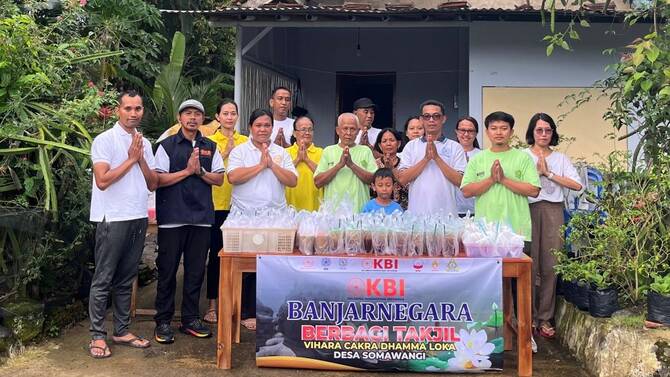

JAKARTA: As soon as Ramadan began last month, members of the Indonesian Buddhayana Family in Central Java started dividing cooking duties among themselves, in preparation for the iftar meals they plan to hand out every week throughout the fasting month.
While some are in charge of specific entrees to make meal boxes consisting of an egg dish, sauteed vegetables and soy-based protein, others make sweet iced treats, such as fruit cocktails or shaved ice.
“As Buddhists, we want to spread love all around and strengthen our ties with other religious groups, as we are all connected for being a part of the same community,” Kessy, an organizing member of the Indonesian Buddhayana Family, or KBI, in Central Java, told Arab News on Wednesday.
After distributing meal boxes and iced fruit cocktails for hundreds of Muslims in the province’s Somawangi village last Sunday, the group is setting out for the town of Jepara later this week.
“In Buddhism, one of our foundational prayers wishes the happiness of all living beings, so this is our attempt to put that prayer in practice,” Kessy said.
Muslims comprise nearly 90 percent of Indonesia’s 280 million population, but the multifaith nation officially recognizes six religions, including Buddhism, which has an estimated 2 million followers.
During Ramadan, many Buddhist temples and organizations across the country often extend support to their Muslim neighbors, including by preparing home-cooked meals or snacks to break their fast at sunset.
Such activities around iftar are an annual event for many congregations, including members of the Dewi Welas Asih Temple in Cirebon, West Java.
They hand out meal boxes around 4 p.m., right before sunset, hoping to reach the people who need their support the most.
The iftar preparation and distribution involve the temple’s younger members, including kindergarteners, teenagers, and young mothers, who are assigned special tasks on some of the days.
“My wish is for all of them to be aware of the importance of sharing with others. We don’t see people by their ethnicity, race or religion, but we see Ramadan as a great opportunity to do good, and this must be practiced from a very young age,” Yulia Hiyanto, who has been organizing the temple’s iftar activities, told Arab News.
“This year, I continue to hold close the meaning of brotherhood, the importance of tolerance. We emphasize the value of looking beyond religion, to look into the humanity of each and every person by doing good unto others, to remember that every religion teaches good values.”


