WEEKLY ENERGY RECAP: Oil prices defy lockdowns, Suez closure

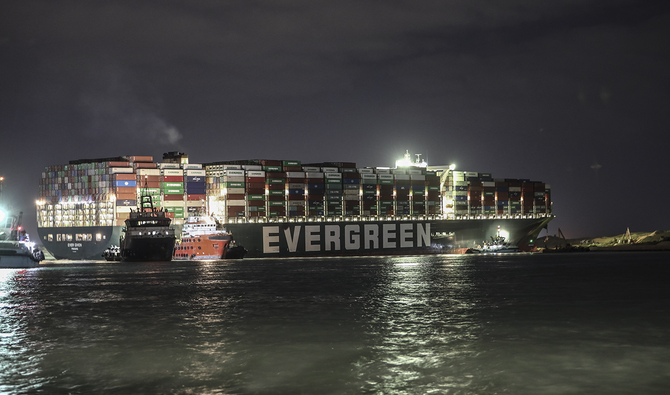
Ever Given, a Panama-flagged cargo ship, that is wedged across the Suez Canal and blocking traffic in the vital waterway is seen Saturday, March 27, 2021. (AP)
Short Url
Updated 28 March 2021
Follow

WEEKLY ENERGY RECAP: Oil prices defy lockdowns, Suez closure

  • The Suez Canal traffic jam did not weigh on oil prices too heavily as the oil shipments were headed to Europe, where demand was already weak

Oil prices ended a volatile week but remain steady on a weekly basis, despite some slow vaccination rollouts, extended lockdowns and softening demand in Asia as a result of spring maintenance season in the second quarter.

After moving down early in the week, prices then recovered, with Brent ending the week slightly higher at $64.57 per barrel, while West Texas Intermediate crude price rose to $60.97 per barrel.

The Suez Canal traffic jam did not weigh on oil prices too heavily as the oil shipments were headed to Europe, where demand was already weak, meaning the incident did not cause any serious supply fears.

However, while oil price movement might be detached and disconnected from the impact of the Suez Canal closure, it is still unclear if it will have any strong repercussions, as prices remained relatively settled in very narrow range below $65 per barrel, despite the new lockdowns and the news that the US will soon become a fully vaccinated nation.

Moreover, the weakness in the nearest part of the futures prices curve has nothing to do with the Suez Canal closure or the weak demand, but it is mainly due to Chinese crude inventories that have climbed back near their peak in October 2020. Such futures curve weakness may lead OPEC+ to continue its tight market strategy when they meet in early April.

US oil field services company Baker Hughes said that the rig count has been rising over the past seven months and is up nearly 70 percent from a record low of 244 in August 2020, when drilling activities were adversely impacted by the oil demand shock amid the pandemic.

The latest figures from the Commodity Futures Trading Commission on March 23, 2021 showed crude futures “long positions” on the New York Mercantile Exchange at 681,647 contracts, down by 4,698 contracts from the previous week (1,000 barrels for each contract).

• Faisal Faeq is an energy and oil marketing adviser. He was formerly with OPEC and Saudi Aramco. Twitter:@faisalfaeq


Mawani, Qatar Ports ink cooperation deal to boost regional maritime trade 

Updated 18 February 2026
Follow

Mawani, Qatar Ports ink cooperation deal to boost regional maritime trade 

RIYADH: The Saudi Ports Authority, or Mawani, and Qatar Ports Management Co. signed a memorandum of understanding aimed at boosting maritime and logistics cooperation, contributing to the development of the ports sector, raising operational efficiency, and supporting regional and international trade flows. 

The MoU was signed by Mawani President Suliman Al-Mazroua and Qatar Ports Management Co. CEO Abdullah Mohammed Al-Khanji, in the presence of Qatari Ambassador to Saudi Arabia Bandar bin Mohammed Al-Attiyah. 

The step reflects both sides’ commitment to building effective partnerships, exchanging expertise, establishing an organized framework for cooperation management, and developing joint investment opportunities in line with Saudi Vision 2030 and Qatar National Vision 2030. 

The MoU outlines eight key areas of cooperation, including the exchange of best practices in port management and operations, and studying opportunities for direct maritime and land connectivity between the two countries’ ports to enhance trade efficiency. 

It also includes collaboration in logistics services, exploring the establishment of joint maritime corridors serving bilateral and regional trade, and assessing the feasibility of creating shared regional distribution centers. 

Both parties agreed to enhance cooperation in digital transformation and artificial intelligence, focusing on smart systems, data governance, and a unified maritime window to improve operational efficiency and remain at the forefront of technological progress in the maritime sector. 

The MoU emphasizes maritime safety and environmental protection, including the exchange of expertise on marine pollution control and emergency response, the development of joint maritime emergency plans, and the establishment of a bilateral emergency communication line.  

It also promotes collaboration to ensure compliance with international conventions, conduct joint exercises, and implement risk-monitoring systems. 

Cooperation further extends to human capital development through joint training programs and on-the-ground expertise exchanges, as well as academic and research partnerships in maritime transport and logistics. 

Regarding joint investment, both parties will explore local and international opportunities in ports and related services, coordinating with the private sector to support these initiatives. 

The MoU also includes cooperation in cruise tourism through enhanced maritime connectivity and joint promotion of Gulf cruise routes, as well as coordination of positions in international maritime organizations and support for joint initiatives, notably “Green Ports” and “Safe Sea Corridors.” 

This memorandum reflects the commitment of Mawani and Qatar Ports Management Co. to advancing the ports sector and boosting its role as a key driver of trade and economic growth, contributing to Gulf integration, and enhancing regional competitiveness in maritime services.