SINGAPORE: A container ship blocking the Suez Canal like a “beached whale” may take weeks to free, the salvage company said, as officials stopped all ships entering the channel on Thursday in a new setback for global trade.
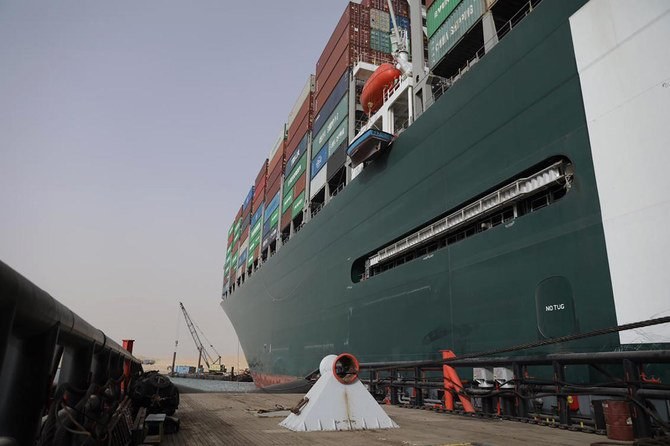
The 400 m (430 yard) Ever Given, almost as long as the Empire State Building is high, is blocking transit in both directions through one of the world’s busiest shipping channels for oil and grain and other trade linking Asia and Europe.
The Suez Canal Authority (SCA) said eight tugs were working to move the vessel, which got stuck diagonally across the single-lane southern stretch of the canal on Tuesday morning amid high winds and a dust storm.
“We can’t exclude it might take weeks, depending on the situation,” Peter Berdowski, CEO of Dutch company Boskalis which is trying to free the ship, told the Dutch television program “Nieuwsuur.”
A total of 156 large container ships, tankers carrying oil and gas, and bulk vessels hauling grain have backed up at either end of the canal, Egypt’s Leith Agencies said, creating one of the worst shipping jams seen for years.
Three ships were being escorted out of the canal, it added.
The blockage comes on top of the disruption to world trade already caused in the past year by COVID-19, with trade volumes hit by high rates of ship cancelations, shortages of containers and slower handling speeds at ports.
The SCA, which had allowed some vessels to enter the canal in the hope the blockage could be cleared, said it had temporarily suspended all traffic on Thursday. Shipping giant Maersk said in a customer advisory it had seven vessels affected.
Berdowski said the ship’s bow and stern had been lifted up against either side of the canal.
“It is like an enormous beached whale. It’s an enormous weight on the sand. We might have to work with a combination of reducing the weight by removing containers, oil and water from the ship, tug boats and dredging of sand.”
A new attempt to move it would take place later on Thursday, the ship’s technical manager, Bernhard Schulte Shipmanagement (BSM), said.
Roughly 30 percent of the world’s shipping container volume transits through the 193 km (120 miles) Suez Canal daily, and about 12 percent of total global trade of all goods.
Shipping experts say that if the blockage is not cleared in the coming days, some shipping may re-route around Africa, which would add roughly a week to the journey.
“Every port in Western Europe is going to feel this,” Leon Willems, a spokesman for Rotterdam Port, Europe’s largest, said. “We hope for both companies and consumers that it will be resolved soon. When these ships do arrive in Europe, there will inevitably be longer waiting times.”
Consultancy Wood Mackenzie said the biggest impact was on container shipping, but there were also a total of 16 laden crude and product oil tankers due to sail through the canal and now delayed.
The tankers were carrying 870,000 tons of crude and 670,000 tons of clean oil products such as gasoline, naphtha and diesel, it said.
Russia and Saudi Arabia are the top two exporters of oil through the canal, while India and China are the main importers, oil analytics firm Vortexa said. Consultancy Kpler said the canal accounted for only 4.4 percent of total oil flows but a prolonged disruption would complicate flows of Russian and Caspian oil to Asia and oil from the Middle East into Europe.
Joanna Konings, senior economist, International Trade Analysis at Dutch bank ING, noted the container shipping industry was used to days of delays.
But Germany’s BDI industry association was concerned. Deputy Managing Director Holger Loesch said earlier delays were already impacting production, with industries depending on raw materials or construction supply deliveries particularly affected.
About 16 percent of Germany’s chemicals imports arrive by ship via the Suez canal and the chief economist for the association of German chemicals and pharmaceuticals producers VCI, Henrik Meincke, said they would be affected with every day of blockage.
Ever Given’s technical manager BSM said dredgers were working to clear sand and mud from around it while tugboats in conjunction with Ever Given’s winches work to shift it.
Japanese shipowner Shoei Kisen apologized for the incident and said work on freeing the ship, which was heading to Europe from China, “has been extremely difficult” and it was not clear when the vessel would float again.
The owner and insurers face claims totalling millions of dollars even if the ship is refloated quickly, industry sources said on Wednesday. Shoei Kisen said the hull insurer of the group is MS&AD Insurance Group while the liability insurer is UK P&I Club.
The ship’s GPS signal shows only minor changes to its position over the past 24 hours.
Two professional rescue teams from the Netherlands and Japan will work with local authorities to design a more effective plan to refloat the vessel, the company leasing it, Taiwan’s Evergreen Marine Corp. said.


Ship blocking Suez Canal like ‘beached whale’ could be stuck for weeks
https://arab.news/gvvru
Ship blocking Suez Canal like ‘beached whale’ could be stuck for weeks

- Giant ship stuck for more than two days
- Two marine rescue firms to help refloat effort

Egypt, Turkiye aim to increase trade volume to $15bn by 2028
RIYADH: Egypt and Turkiye have agreed to work toward increasing bilateral trade volume from approximately $9 billion to $15 billion by 2028.
This includes cooperation in exploration and development activities in the hydrocarbons and mining sectors, as well as in transportation and the automotive industry.
This agreement was confirmed by Egyptian President Abdel Fattah El-Sisi and Turkish President Recep Tayyip Erdogan in Cairo during the second meeting of the High-Level Strategic Cooperation Council, co-chaired by the two heads of state.
President El-Sisi emphasized that the agreement seeks to strengthen constructive cooperation between the two countries in the coming period. He directed companies and institutions in Egypt and Turkiye to work towards achieving this goal and explore ways to enhance trade cooperation, currently valued at $9 billion. He noted that Egypt is Turkiye’s leading trading partner in Africa, and that Turkiye ranks among the top destinations for Egyptian exports.
In his remarks, El-Sisi highlighted the importance of working toward increasing trade volume to $15 billion, removing obstacles to achieving this objective, and bolstering investments as well as all aspects of economic cooperation.
For his part, Erdogan said: “We are taking decisive steps toward our goal of increasing the value of trade exchange between the two countries to $15 billion. We are pleased that Turkish companies’ investments in Egypt are approaching $4 billion and contributing to creating more job opportunities.”
Erdoğan further stressed Turkiye’s commitment to establishing “an economic model in which the two countries complement each other, making us stronger in the face of global fluctuations.”
Anticipated Egyptian-Turkish cooperation in energy, transportation
The Turkish president revealed that mutual investment opportunities between the two countries will be discussed during the Egypt-Turkiye Business Forum, adding: “We see opportunities in developing joint projects in the energy and transportation sectors, which are of paramount importance in terms of regional energy security.”
Erdogan highlighted the positive impact of strengthening relations between the two countries on tourism, noting that they have attracted more than 500,000 visitors each, and added: “We hope to double this number in the coming period.”
The Egyptian-Turkish statement also noted the continued “significant potential for enhancing cooperation in areas including the automotive industry, infrastructure development, and tourism.”
It further stated that both countries agreed to cooperate on exploration and development activities in the hydrocarbons and mining sectors in Egypt, including through public institutions, and to exchange expertise in geological activities and modern mining technologies.
Egypt and Turkiye also signed memoranda of understanding in key areas, including cooperation in defense, investment, trade, and agriculture, as well as health, youth and sports, and social protection. They also established a national committee to promote and monitor Turkish investments in Egypt, with the aim of facilitating investment procedures.
The two countries agreed to strengthen cooperation in the electricity and renewable energy sectors within the framework of the MoU signed in September 2024. They also agreed to appoint national contact points to coordinate joint working groups in the fields of conventional energy, renewable energy, green hydrogen, and nuclear energy.
The Egyptian and Turkish presidents met in Cairo on Feb. 4 as part of a regional tour by Erdogan that included Saudi Arabia. This visit marks Erdogan's third trip to Egypt in the past two years.
Turkiye has been the largest importer from Egypt for the past three years, with industrial exports constituting the largest portion of Egypt’s exports to Turkiye, while petroleum exports make up no more than 12 percent of Egypt’s total exports to Turkiye.


