

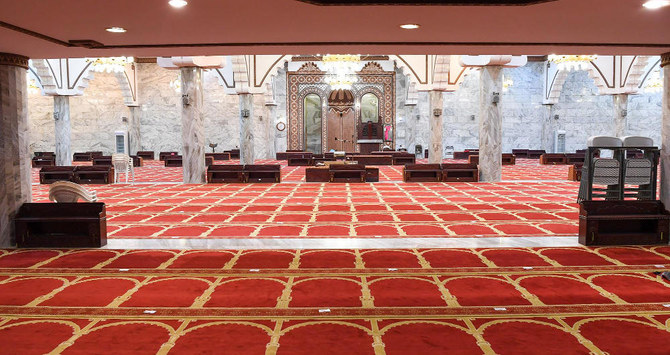
RIYADH: Saudi Arabia’s Ministry of Islamic Affairs, Dawah, and Guidance on Thursday said that sermons are allowed to be delivered in mosques but should not exceed 10 minutes.
The ministry said that lessons and lectures in mosques were still suspended and would continue remotely.
Sheikh Abdullatif Al-Asheikh, minister of Islamic affairs called on all mosque employees to adhere to all precautionary COVID-19 measures to ensure the safety and health of worshipers.
Meanwhile, the ministry temporarily shut seven mosques in six regions after some worshippers tested positive for coronavirus.
Virus cases have led to 364 mosques being forced to temporarily close over the past 46 days, with 347 reopening after sanitization measures were completed.
The ministry said that two of the mosques were in Riyadh, and one in each of the regions of Tabuk, the Northern Borders, Madinah, Qassim and Eastern Province.
Eleven mosques have been reopened in Riyadh, Makkah, Asir and Najran. The decision came after precautionary measures, including sanitization and maintenance, were carried out.
The ministry praised the cooperation of worshippers and mosque employees in complying with health and safety requirements.
Authorities will continue to sanitize and clean mosques and implement measures to ensure the safety of visitors, the ministry added.
Saudi Arabia permits 10-minute sermons in mosques, as more shut due to COVID-19 measures
https://arab.news/yzv84
Saudi Arabia permits 10-minute sermons in mosques, as more shut due to COVID-19 measures
- Virus cases have led to 364 mosques being forced to temporarily close over the past 46 days
18,000 personnel mobilized in Makkah, Madinah as itikaf begins
- Worshipers who completed registration and obtained permits have started performing the ritual of itikaf at the Prophet’s Mosque
- General Authority for the Care of the Affairs of the Grand Mosque and the Prophet’s Mosque has provided a range of services
JEDDAH: More than 18,000 personnel and nearly 6,000 vehicles and pieces of equipment have been deployed across Makkah and Madinah as authorities intensify preparations for the final 10 days of Ramadan, while worshipers began observing itikaf at the Prophet’s Mosque.
Worshipers who completed registration and obtained permits have started performing the ritual of itikaf at the Prophet’s Mosque, according to the Saudi Press Agency.
The General Authority for the Care of the Affairs of the Grand Mosque and the Prophet’s Mosque has provided a range of services, including guidance, organization, healthcare, translation, hospitality and essential supplies to ensure a comfortable and spiritually enriching experience.
Field teams have also been deployed to manage entry and exit points, and oversee service delivery so worshippers can dedicate themselves fully to prayer and reflection.
Meanwhile, the Madinah Municipality has intensified efforts to provide services to visitors at the Prophet’s Mosque and other major mosques across the city.
More than 5,700 personnel, 1,230 operational vehicles and pieces of equipment have been mobilized to support municipal services during the busy period.
The operational plan focuses on improving facility cleaning and environmental sanitation, strengthening infrastructure services, and intensifying inspections of commercial and food establishments to ensure compliance with health standards and product safety.
Electronic platforms have also been activated to enhance monitoring and speed up responses to municipal service reports.
Authorities are also conducting field campaigns to combat commercial fraud and regulate street vendors as visitor numbers rise in the city.
Through these plans, the Ministry of Municipalities and Housing has raised municipal readiness to provide services for Umrah performers and visitors, and enable them to perform their rituals in a safe and organized environment.
In Makkah, the municipality has deployed more than 13,000 personnel working round the clock to support cleaning and operational activities in the central area, and around the Grand Mosque.
Five parking areas with a capacity of more than 42,000 vehicles have also been prepared to ease access to the Grand Mosque and reduce congestion.


